Results by title
5 books match the query 'Religious literature'
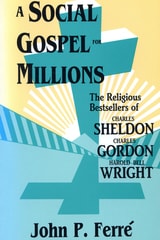
A Social Gospel for Millions
The Religious Bestsellers of Charles Sheldon, Charles Gordon, and Harold Bell WrightJohn Ferre
University of Wisconsin Press, 1988
In the twentieth century Marxism challenged laissez-faire economics, psychoanalysis reinterpreted the processes of thought, and evolution discredited the idea of creation. These changes profoundly affected American Protestantism. Ferré examines the belief system that underlies what middle-class Protestants chose to read.
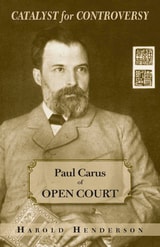
Catalyst for Controversy
Paul Carus of Open CourtHarold Henderson
Southern Illinois University Press, 2009
"I am not a common atheist; I am an atheist who loves God."—Paul Carus, "The God of Science," 1904
In the summer of 1880, while teaching at the military academy of the Royal Corps of Cadets of Saxony in Dresden, Paul Carus published a brief pamphlet denying the literal truth of scripture and describing the Bible as a great literary work comparable to the Odyssey.
This unremarkable document was Carus’s first step in a wide-ranging intellectual voyage in which he traversed philosophy, science, religion, mathematics, history, music, literature, and social and political issues. The Royal Corps, Carus later reported, found his published views "not in harmony with the Christian spirit, in accordance with which the training and education of the Corps of Cadets should be conducted." And so the corps offered the young teacher the choice of asking "most humbly for forgiveness for daring to have an opinion of my own and to express it, perhaps even promise to publish nothing more on religious matters, or to give up my post. I chose the latter. . . . There was thus no other choice for me but to emigrate and, trusting in my own powers, to establish for myself a new home." His resignation was effective on Easter Sunday, 1881.
Carus toured the Rhine, lived briefly in Belgium, and taught in a military college in England to learn English well enough to "thrive in the United States." By late 1884 or early 1885 he was on his way to the New World. Thriving in the United States proved more difficult than it had in England, but before 1885 ended he had published his first philosophical work in English, Monism and Meliorism. The book was not widely read, but it did reach Edward C. Hegeler, a La Salle, Illinois, zinc processor who became his father-in-law as well as his ideological and financial backer.
Established in La Salle, Carus began the work that would place him among the prominent American philosophers of his day and make the Open Court Publishing Company a leading publisher of philosophical, scientific, and religious books. He edited The Open Court and The Monist, offering the finest view of Oriental thought and religion then available in the West, and sought unsuccessfully to bring about a second World Parliament of Religions. He befriended physicist-philosopher Ernst Mach. For eleven years he employed D. T. Suzuki, who later became a great Zen Buddhist teacher. He published more articles by Charles S. Peirce, now viewed as one of the great world philosophers, in The Monist than appeared in any other publication.
Biographer Harold Henderson concludes his study of this remarkable man: "Whenever anyone is so fired with an idea that he or she can’t wait to write it down, there the spirit of Paul Carus remains, as he would have wished, active in the world."
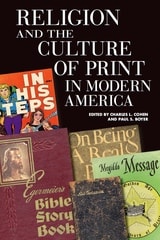
Religion and the Culture of Print in Modern America
Edited by Charles L. Cohen and Paul S. Boyer
University of Wisconsin Press, 2008
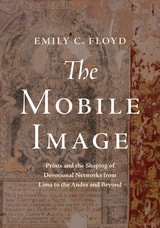
The Mobile Image
Prints and the Shaping of Devotional Networks from Lima to the Andes and BeyondEmily C. Floyd
University of Texas Press, 2025
A study of the production and movement of prints in colonial South America.
Printed images have had a central place in art-historical studies of colonial Spanish America, but scholars have typically focused on imported prints, designed and produced in Europe. The Mobile Image focuses instead on works printed in colonial Lima, generating there a distinctive print culture that served local and regional needs, while also appealing to European print consumers.
Inexpensive, easily transportable, and numerous, Lima’s prints traversed the varied geographies of the Viceroyalty of Peru both as loose sheets and within the protective covers of printed books. In the process, limeño devotional prints encouraged the development of shared regional imaginaries about the sacred Andean landscape, a space marked by miracle-working Virgins, potential saints, and powerful images of Christ. These same prints traveled abroad, where they promoted iconographies developed in Lima and influenced European conceptions of the Andes. Simultaneously, the visual language of limeño prints often challenges conventional approaches to interpreting colonial depictions of race. In analyzing limeño prints, and the identities of their makers, patrons, and consumers, The Mobile Image demonstrates that race is harder to recognize in colonial images than we might think. Unearthing hundreds of forgotten prints, Emily C. Floyd provides a fresh resource for interpreting colonial artworks, troubling established understandings of their aesthetics, and compelling us to reexamine colonial South American material cultures.
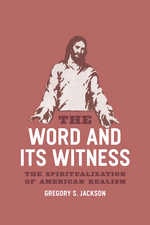
The Word and Its Witness
The Spiritualization of American RealismGregory S. Jackson
University of Chicago Press, 2009
Jackson shows how the homiletic tradition in Protestant sermons provided a foundation for the development of visual and literary realism. Evangelical preachers and writers used vivid language grounded in everyday life to translate abstract concepts like hell into concrete reality—a key influence on realist authors that brought about the more secular forms of the movement we know today. This emphasis on the sensuous also paved the way for Protestantism’s embrace of new media, evident in the photographs of Jacob Riis as well as the video game Left Behind: Eternal Forces.
With its remarkable scope and timely insights into the interplay between religion, secularism, and politics, The Word and Its Witness will transform the way we understand American realism and American religion.