Results by title

2 books match the query 'Rembis, Michael'
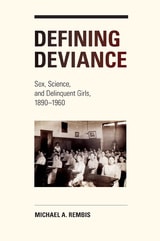
cover of Defining Deviance: Sex, Science, and Delinquent Girls, 1890-1960

Defining Deviance

Sex, Science, and Delinquent Girls, 1890-1960

Michael A. Rembis

University of Illinois Press, 2013
Defining Deviance analyzes how reformers in the late nineteenth and early twentieth centuries perceived delinquent girls and their often troubled lives. Drawing on exclusive access to thousands of case files and other documents at the State Training School in Geneva, Illinois, Michael A. Rembis uses Illinois as a case study to show how implementation of involuntary commitment laws in the United States reflected eugenic thinking about juvenile delinquency.
 
Much more than an institutional history, Defining Deviance examines the cases of vulnerable young women to reveal the centrality of sex, class, gender, and disability in the formation of scientific and social reform. Rembis recounts the contestations between largely working-class teenage girls and the mostly female reformers and professionals who attempted to diagnose and treat them based on changing ideas of eugenics, gender, and impairment. He shows how generational roles and prevailing notions of gender and sexuality influenced reformers to restrict, control, and institutionalize undesirable "defectives" within society, and he details the girls' attempts to influence methods of diagnosis, discipline, and reform.
 
In tracing the historical evolution of ideologies of impairment and gender to show the central importance of gender to the construction of disability, Rembis reveals the larger national implications of the cases at the State Training School. His study provides new insights into the treatment of young women whom the dominant society perceived as threats to the sexual and eugenic purity of modern America.
[more]
cover of Disability Histories

Disability Histories

Edited by Susan Burch and Michael Rembis

University of Illinois Press, 2014

The field of disability history continues to evolve rapidly. In this collection, Susan Burch and Michael Rembis present essays that integrate critical analysis of gender, race, historical context, and other factors to enrich and challenge the traditional modes of interpretation still dominating the field.

Contributors delve into four critical areas of study within disability history: family, community, and daily life; cultural histories; the relationship between disabled people and the medical field; and issues of citizenship, belonging, and normalcy. As the first collection of its kind in over a decade, Disability Histories not only brings readers up to date on scholarship within the field but fosters the process of moving it beyond the U.S. and Western Europe by offering work on Africa, South America, and Asia. The result is a broad range of readings that open new vistas for investigation and study while encouraging scholars at all levels to redraw the boundaries that delineate who and what is considered of historical value.

Informed and accessible, Disability Histories is essential for classrooms engaged in all facets of disability studies within and across disciplines.

[more]