Results by title
2 books match the query 'Remedies'
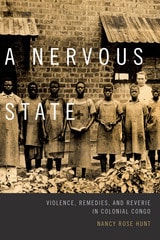
A Nervous State
Violence, Remedies, and Reverie in Colonial CongoNancy Rose Hunt
Duke University Press, 2016
In A Nervous State, Nancy Rose Hunt considers the afterlives of violence and harm in King Leopold’s Congo Free State. Discarding catastrophe as narrative form, she instead brings alive a history of colonial nervousness. This mood suffused medical investigations, security operations, and vernacular healing movements. With a heuristic of two colonial states—one "nervous," one biopolitical—the analysis alternates between medical research into birthrates, gonorrhea, and childlessness and the securitization of subaltern "therapeutic insurgencies." By the time of Belgian Congo’s famed postwar developmentalist schemes, a shining infertility clinic stood near a bleak penal colony, both sited where a notorious Leopoldian rubber company once enabled rape and mutilation. Hunt’s history bursts with layers of perceptibility and song, conveying everyday surfaces and daydreams of subalterns and colonials alike. Congolese endured and evaded forced labor and medical and security screening. Quick-witted, they stirred unease through healing, wonder, memory, and dance. This capacious medical history sheds light on Congolese sexual and musical economies, on practices of distraction, urbanity, and hedonism. Drawing on theoretical concepts from Georges Canguilhem, Georges Balandier, and Gaston Bachelard, Hunt provides a bold new framework for teasing out the complexities of colonial history.
[more]
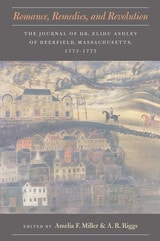
Romance, Remedies, and Revolution
The Journal of Dr. Elihu Ashley of Deerfield, Massachusetts, 1773-1775Edited by Amelia F. Miller and A. R. Riggs
University of Massachusetts Press, 2007
Elihu Ashley (1750–1817) was a twenty-three-year-old medical apprentice in Deerfield, Massachusetts, when he began keeping a personal journal in March 1773. Over the next two-and-a-half years, he recorded, in clear and simple prose, just about everything he did and everyone he saw. Although carefully preserved, the journal was later suppressed by the town historian, presumably because he found some of the entries morally objectionable. Rediscovered by Amelia F. Miller, and coedited by Miller and A. R. Riggs, this document now appears in print for the first time, accompanied by related letters of Ashley's extended family as well as brief biographies of more than 750 people mentioned by the young doctor in his writings.
With flashes of humor and close attention to detail, Ashley describes a broad range of activities and experiences in the small village of Deerfield and the surrounding towns of the Connecticut River valley. Articulate as well as observant, this former schoolteacher conveys a sense of immediacy that brings even the most mundane daily events to life. He discusses medical theory and practice, revolutionary politics, farming, his family, his circle of friends, and amusements ranging from singing and dancing to sleigh riding and bouts of drunkenness. He also writes about his love life, including a dalliance with the older sister of his fiancee, Polly Williams, while the latter is away visiting relatives in the Berkshires.
For Ashley, personal relationships and politics were the prominent issues of 1773 and 1774, as events in Massachusetts drew the province toward rebellion. He discusses the gathering of angry mobs in response to the so-called Intolerable Acts, the stoppage of the courts in Hampshire County, the anarchy that ensued, and the persecution of loyalists, with or without the sanction of law. When the revolution breaks out in April 1775, he describes the departure of companies of minutemen as they set out for Boston to challenge the British Army.
Six months later, in November 1775, the journal abruptly ends. By then, however, Elihu Ashley had already bequeathed to posterity an extraordinary firsthand account of life in rural New England in the years immediately preceding the War of Independence.
[more]