Results by title
6 books match the query 'Remember'
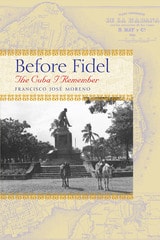
Before Fidel
The Cuba I RememberBy Francisco José Moreno
University of Texas Press, 2007
Before Fidel Castro seized power, Cuba was an ebullient and chaotic society in a permanent state of turmoil, combining a raucous tropical nature with the evils of arbitrary and corrupt government. Yet this fascinating period in Cuban history has been largely forgotten or misrepresented, even though it set the stage for Castro's dramatic takeover in 1959. To reclaim the Cuba that he knew—and add color and detail to the historical record—distinguished political scientist Francisco José Moreno here offers his recollections of the Cuba in which he came of age personally and politically.
Moreno takes us into the little-known world of privileged, upper-middle-class, white Cubans of the 1930s through the 1950s. His vivid depictions of life in the family and on the streets capture the distinctive rhythms of Cuban society and the dynamics between parents and children, men and women, and people of different races and classes. The heart of the book describes Moreno's political awakening, which culminated during his student years at the University of Havana. Moreno gives a detailed, insider's account of the anti-Batista movement, including the Ortodoxos and the Triple A. He recaptures the idealism and naiveté of the movement, as well as its ultimate ineffectiveness as it fell before the juggernaut of the Castro Revolution. His own disillusionment and wrenching decision to leave Cuba rather than accept a commission in Castro's army poignantly closes the book.

Body, Remember
A MemoirKenny Fries
University of Wisconsin Press, 2003
In this poetic, introspective memoir, Kenny Fries illustrates his intersecting identities as gay, Jewish, and disabled. While learning about the history of his body through medical records and his physical scars, Fries discovers just how deeply the memories and psychic scars run. As he reflects on his relationships with his family, his compassionate doctor, the brother who resented his disability, and the men who taught him to love, he confronts the challenges of his life. Body, Remember is a story about connection, a redemptive and passionate testimony to one man’s search for the sources of identity and difference.
Forgive and Remember
Managing Medical Failure, 2nd EditionCharles L. Bosk
University of Chicago Press, 2003
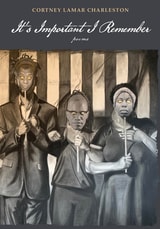
It's Important I Remember
PoemsCortney Lamar Charleston
Northwestern University Press, 2026
An incantation of strength and solace for persisting in twenty-first-century America
“History doesn’t repeat, it rhymes.” In his sweeping third collection, Charleston brings a poet’s ear for echo and rhythm to bear on American history and life after 2016. For Charleston, these rhymes cut two ways: the long tradition of American racism and fascism, and the steady pulse of Black persistence. The collection’s titular invocation frames each poem, at times an oratory to rally a crowd, in other moments a private prayer whispered as the speaker gathers himself to face another day. Charleston insists that should we cede memory of our national biography—whether to repression or indifference—we will witness the country’s dissolution into something unrecognizable to many, yet all too familiar to its most marginalized people. But with each reiteration and riff, he also invokes a tenuous hope—that if we summon an American history of Black resistance, we might still make a more perfect union.
Live and Remember
Valentin Rasputin
Northwestern University Press, 1992
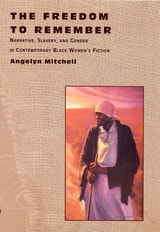
The Freedom to Remember
Narrative, Slavery, and Gender in Contemporary Black Women's FictionMitchell, Angelyn
Rutgers University Press, 2002
The Freedom to Remember examines contemporary literary revisions of slavery in the United States by black women writers. The narratives at the center of this book include: Octavia E. Butler’s Kindred, Sherley Anne Williams’s Dessa Rose, Toni Morrison’s Beloved, J. California Cooper’s Family, and Lorene Cary’s The Price of a Child.
Recent studies have investigated these works only from the standpoint of victimization. Angelyn Mitchell changes the conceptualization of these narratives, focusing on the theme of freedom, not slavery, defining these works as “liberatory narratives.” These works create a space to problematize the slavery/freedom dichotomy from which contemporary black women writers have the “safe” vantage point to reveal aspects of enslavement that their ancestors could not examine. The nineteenth-century female emancipatory narrative, by contrast, was written to aid the cause of abolition by revealing the unspeakable realitiesof slavery. Mitchell shows how the liberatory narrative functions to emancipate its readers from the legacies of slavery in American society: by facilitating a deeper discussion of the issues and by making them new through illumination and interrogation.