Results by title
7 books match the query 'Remodeling for other use'
A City for Children
Women, Architecture, and the Charitable Landscapes of Oakland, 1850-1950Marta Gutman
University of Chicago Press, 2014
American cities are constantly being built and rebuilt, resulting in ever-changing skylines and neighborhoods. While the dynamic urban landscapes of New York, Boston, and Chicago have been widely studied, there is much to be gleaned from west coast cities, especially in California, where the migration boom at the end of the nineteenth century permanently changed the urban fabric of these newly diverse, plural metropolises.
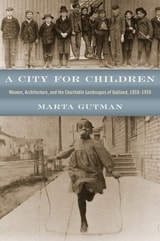
In A City for Children, Marta Gutman focuses on the use and adaptive reuse of everyday buildings in Oakland, California, to make the city a better place for children. She introduces us to the women who were determined to mitigate the burdens placed on working-class families by an indifferent industrial capitalist economy. Often without the financial means to build from scratch, women did not tend to conceive of urban land as a blank slate to be wiped clean for development. Instead, Gutman shows how, over and over, women turned private houses in Oakland into orphanages, kindergartens, settlement houses, and day care centers, and in the process built the charitable landscape—a network of places that was critical for the betterment of children, families, and public life. The industrial landscape of Oakland, riddled with the effects of social inequalities and racial prejudices, is not a neutral backdrop in Gutman’s story but an active player. Spanning one hundred years of history, A City for Children provides a compelling model for building urban institutions and demonstrates that children, women, charity, and incremental construction, renovations, alterations, additions, and repurposed structures are central to the understanding of modern cities.
In A City for Children, Marta Gutman focuses on the use and adaptive reuse of everyday buildings in Oakland, California, to make the city a better place for children. She introduces us to the women who were determined to mitigate the burdens placed on working-class families by an indifferent industrial capitalist economy. Often without the financial means to build from scratch, women did not tend to conceive of urban land as a blank slate to be wiped clean for development. Instead, Gutman shows how, over and over, women turned private houses in Oakland into orphanages, kindergartens, settlement houses, and day care centers, and in the process built the charitable landscape—a network of places that was critical for the betterment of children, families, and public life. The industrial landscape of Oakland, riddled with the effects of social inequalities and racial prejudices, is not a neutral backdrop in Gutman’s story but an active player. Spanning one hundred years of history, A City for Children provides a compelling model for building urban institutions and demonstrates that children, women, charity, and incremental construction, renovations, alterations, additions, and repurposed structures are central to the understanding of modern cities.
[more]
Deconstructing the High Line
Postindustrial Urbanism and the Rise of the Elevated ParkLindner, Christoph
Rutgers University Press, 2017
2017 Choice Outstanding Academic Title
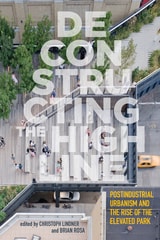
The High Line, an innovative promenade created on a disused elevated railway in Manhattan, is one of the world’s most iconic new urban landmarks. Since the opening of its first section in 2009, this unique greenway has exceeded all expectations in terms of attracting visitors, investment, and property development to Manhattan’s West Side. Frequently celebrated as a monument to community-led activism, adaptive re-use of urban infrastructure, and innovative ecological design, the High Line is being used as a model for numerous urban redevelopment plans proliferating worldwide.
Deconstructing the High Line is the first book to analyze the High Line from multiple perspectives, critically assessing its aesthetic, economic, ecological, symbolic, and social impacts. Including several essays by planners and architects directly involved in the High Line’s design, this volume also brings together a diverse range of scholars from the fields of urban studies, geography, anthropology, sociology, and cultural studies. Together, they offer insights into the project’s remarkable success, while also giving serious consideration to the critical charge that the High Line is “Disney World on the Hudson,” a project that has merely greened, sanitized, and gentrified an urban neighborhood while displacing longstanding residents and businesses.
Deconstructing the High Line is not just for New Yorkers, but for anyone interested in larger issues of public space, neoliberal redevelopment, creative design practice, and urban renewal.
[more]
Detroit Is No Dry Bones
The Eternal City of the Industrial AgeCamilo José Vergara
University of Michigan Press, 2016
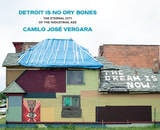
Over the past 25 years, award-winning ethnographer and photographer Camilo José Vergara has traveled annually to Detroit to document not only the city’s precipitous decline but also how its residents have survived. From the 1970s through the 1990s, changes in Detroit were almost all for the worse, as the fabric of the city was erased through neglect and abandonment. But over the last decade, Detroit has seen the beginnings of a positive transformation, and the photography in Detroit Is No Dry Bones provides unique documentation of the revival and its urbanistic possibilities. Beyond the fate of the city’s buildings themselves, Vergara’s camera has consistently sought to capture the distinct culture of this largely African American city. The photographs in this book, for example, are organized in part around the way people have re-used and re-purposed structures from the past. Vergara is unique in his documentation of local churches that have re-occupied old bank buildings and other impressive structures from the past and turned them into something unexpectedly powerful architecturally as well as spiritually.
[more]
Loft Living
Culture and Capital in Urban ChangeZukin, Sharon
Rutgers University Press, 2014
Since its initial publication, Loft Living has become the classic analysis of the emergence of artists as a force of gentrification and the related rise of “creative city” policies around the world. This 25th anniversary edition, with a new introduction, illustrates how loft living has spread around the world and that artists’ districts—trailing the success of SoHo in New York—have become a global tourist attraction. Sharon Zukin reveals the economic shifts and cultural transformations that brought widespread attention to artists as lifestyle models and agents of urban change, and explains their role in attracting investors and developers to the derelict loft districts where they made their home.
Prescient and dramatic, Loft Living shows how a declining downtown Manhattan became a popular “scene,” how loft apartments became hot commodities for the middle class, and how investors, corporations, and rich elites profited from deindustrializing the city’s factory districts and turning them into trendy venues for art galleries, artisanal restaurants, and bars. However, this edition points out that the artists who led the trend are now priced out of the loft market. Even in New York, where the loft living market was born, artists have no legal claim on loft districts, nor do they get any preferential treatment in the harsh real estate market.
From the story of SoHo in Lower Manhattan to SoWa in Boston and SoMa in San Francisco, Zukin explains how once-edgy districts are transformed into high-price neighborhoods, and how no city can restrain the juggernaut of rising property values.
[more]

Loft Living
Culture and Capital in Urban ChangeZukin, Sharon
Rutgers University Press, 1989
.
[more]
Ruins of the Past
The Use and Perception of Abandoned Structures in the Maya LowlandsTravis W. Stanton
University Press of Colorado, 2008
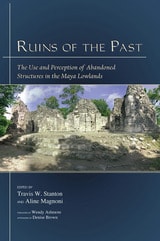
From the Preclassic to the present, Maya peoples have continuously built, altered, abandoned, and re-used structures, imbuing them with new meanings at each transformation. Ruins of the Past is the first volume to focus on how previously built structures in the Maya Lowlands were used and perceived by later peoples, exploring the topic through concepts of landscape, place, and memory. The collection, as Wendy Ashmore points out in her foreword, offers "a stimulating, productive, and fresh set of inferences about ancient Maya cognition of their own past." Contributors include Anthony P. Andrews, Ana Lucía Arroyave Prera, Antonio Benavides C., M. Kathryn Brown, Marcello A. Canuto, Mark B. Child, David A. Freidel, James F. Garber, Charles W. Golden, Stanley P. Guenter, Jon B. Hageman, Richard D. Hansen, Brett A. Houk, Wayne K. Howell, Paul Hughbanks, Scott R. Hutson, Aline Magnoni, T. Kam Manahan, Olivia C. Navarro Farr, Travis W. Stanton, Lauren A. Sullivan, and Fred Valdez Jr.
[more]
Schools for Sale
Disinvestment, Dispossession, and School Building Reuse in PhiladelphiaJulia McWilliams, Ariel H. Bierbaum, Amy J. Bach and Elaine Simon
University of Chicago Press, 2026
A surprising look at what happens to the actual school buildings in the wake of school closures.
School districts across the United States have closed thousands of schools since 2000 to cope with chronic underfunding and budget crises, declining enrollment, and poorly maintained buildings. Our knowledge about school closures has focused on battles over closure decision-making and the impacts of closing schools on communities of color in the immediate aftermath of these decisions. But what of the large, sometimes magisterial, formerly public spaces once at the center of community life? How do these now vacant buildings change daily life in the surrounding neighborhood?
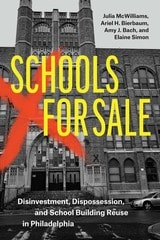
In Schools for Sale, Julia McWilliams, Ariel H. Bierbaum, Amy J. Bach, and Elaine Simon examine how school closures change the spatial and social arrangements of neighborhoods. Following a series of school closures in Philadelphia, the authors draw from research in urban studies, education, planning, and geography to explain how race, place, and capital merge to influence the trajectory of closed schools in Black and Brown communities and their surrounding neighborhoods. Some closed schools are repurposed as charter schools, upending the role those buildings have historically played in bringing communities together. Other buildings are sold for commercial development, caught up in cycles of gentrification even as developers foster programs to support community members. Others are left vacant or are demolished in the heart of their neighborhoods, decisions that reflect not only disinvestment in Black communities but the sobering reality of environmental racism.
Drawing needed attention to one of the significant consequences of school closures, Schools for Sale imparts a deeper understanding of the connections between place, race, and education amid broader urban transformations, prompting us to consider how school districts can work toward a new vision for public education and community development.
[more]