Results by title
11 books match the query 'Renaissance Italy'
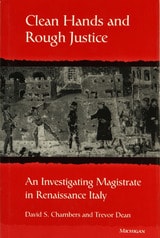
Clean Hands and Rough Justice
An Investigating Magistrate in Renaissance ItalyDavid S. Chambers and Trevor Dean
University of Michigan Press, 1997

Doctors, Ambassadors, Secretaries
Humanism and Professions in Renaissance ItalyDouglas Biow
University of Chicago Press, 2002
Examining a wide range of treatises, poems, and other works that humanists wrote both as and about doctors, ambassadors, and secretaries, Biow shows how interactions with these professions forced humanists to make their studies relevant to their own times, uniting theory and practice in a way that strengthened humanism. His detailed analyses of writings by familiar and lesser-known figures, from Petrarch, Machiavelli, and Tasso to Maggi, Fracastoro, and Barbaro, will especially interest students of Renaissance Italy, but also anyone concerned with the rise of professionalism during the early modern period.
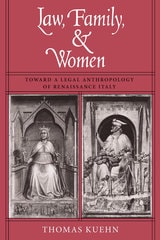
Law, Family, and Women
Toward a Legal Anthropology of Renaissance ItalyThomas Kuehn
University of Chicago Press, 1991
influence of law on Italian society during the Renaissance,
especially in the spheres of family and women. Kuehn's use
of legal sources along with letters, diaries, and
contemporary accounts allows him to present a compelling
image of the social processes that affected the shape and
function of the law.
The numerous law courts of Italian city-states
constantly devised and revised statutes. Kuehn traces the
permutations of these laws, then examines their use by
Florentines to arbitrate conflict and regulate social
behavior regarding such issues as kinship, marriage,
business, inheritance, illlegitimacy, and gender. Ranging
from one man's embittered denunciation of his father to
another's reaction to his kinsmen's rejection of him as
illegitimate, Law, Family, and Women provides
fascinating evidence of the tensions riddling family life in
Renaissance Florence. Kuehn shows how these same tensions,
often articulated in and through the law, affected women. He
examines the role of the mundualdus—a male legal guardian
for women—in Florence, the control of fathers over their
married daughters, and issues of inheritance by and through
women. An ambitious attempt to reformulate the agenda of
Renaissance social history, Kuehn's work will be of value to
both legal anthropologists and social historians.
Thomas Kuehn is professor of history at Clemson
University.
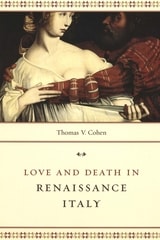
Love and Death in Renaissance Italy
Thomas V. Cohen
University of Chicago Press, 2004
Each of the chapters in this history chronicles a domestic drama around which the lives of ordinary Romans are suddenly and violently altered. You might read the gruesome murder that opens the book—when an Italian noble takes revenge on his wife and her bastard lover as he catches them in delicto flagrante—as straight from the pages of Boccaccio. But this tale, like the other stories Cohen recalls here, is true, and its recounting in this scintillating work is based on assiduous research in court proceedings kept in the state archives in Rome.
Love and Death in Renaissance Italy contains stories of a forbidden love for an orphan nun, of brothers who cruelly exact a will from their dying teenage sister, and of a malicious papal prosecutor who not only rapes a band of sisters, but turns their shambling father into a pimp! Cohen retells each cruel episode with a blend of sly wit and warm sympathy and then wraps his tales in ruminations on their lessons, both for the history of their own time and for historians writing today. What results is a book at once poignant and painfully human as well as deliciously entertaining.
Pastoral’s End
Art, Ecology, and Catastrophe in Renaissance ItalyJames Pilgrim
University of Chicago Press, 2026
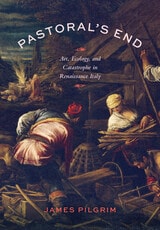
In the sixteenth century, Italian artist Jacopo Bassano painted pictures of herdsmen and animals moving through dark and muddy landscapes. But he also participated in the agricultural development of the region in which he lived, producing topographical maps of local mountains and forests, inventing new methods of drainage and irrigation, and studying the latest techniques of crop rotation and fertilization. The relationship between Bassano’s rustic art and his participation in environmental transformation has, however, never been explored.
One of the first studies of Italian Renaissance art to grapple with the connections between visual culture and the environment, Pastoral’s End explores this crucial, formative relationship. James Pilgrim looks at Bassano’s career holistically, demonstrating how his involvement in a world marked by agricultural expansion, industrialization, resource extraction, environmental degradation, social transformation, and radical philosophical development informed his paintings of country life. Introducing new archival and visual evidence of Bassano’s knowledge of hydrology, agronomy, husbandry, and architecture, Pastoral’s End argues that he transformed the more placid rustic imagery of previous Renaissance artists into visions of dangerous ecological instability.
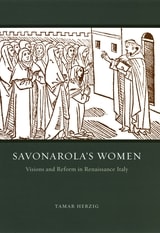
Savonarola's Women
Visions and Reform in Renaissance ItalyTamar Herzig
University of Chicago Press, 2007
In their quest to stay true to their leader’s teachings, Savonarola’s female followers faced hostile superiors within their orders, local political pressures, and the deep-rooted misogynistic assumptions of the Church establishment. This unprecedented volume demonstrates how reform circles throughout the Italian peninsula each tailored Savonarola’s life and works to their particular communities’ regionally specific needs. Savonarola’s Women is an important reconstruction of women’s influence on one of the most important and controversial religious movements in premodern Europe.
Spirituality, Gender, and the Self in Renaissance Italy
Angela Merici and the Company of St. Ursula (1474–1540)Querciolo Mazzonis
Catholic University of America Press, 2007
The Ambassador and the Courtesan
Political Bodies in Renaissance ItalyPaola De Santo
University of Delaware Press, 2026
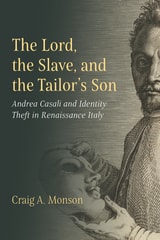
The Lord, the Slave, and the Tailor’s Son
Andrea Casali and Identity Theft in Renaissance ItalyCraig A. Monson
University of Michigan Press, 2027
Andrea Casali might well have been forgotten. A handsome, young Bolognese nobleman, heir to fabulous wealth, palaces, and artistic treasures, known as a poet and artist, in 1604 he was reported killed at age nineteen during the epic Siege of Ostend. Thirty years later, however, a grizzled, former galley slave appeared in Rome, claiming to be the dead Casali and demanding his inheritance. Was he a noble survivor of captivity under the Ottoman Turks or a cunning impostor, masquerading under an illustrious name?
His claim ignited scandal, vehement public argument, even physical assaults and rioting in the streets. A three-year trial ended with judges convicting him of impersonation but declining to rule on who he really was. Across seventeenth-century Italy and even beyond, writers offered claims and counterclaims as to his identity. The Lord, the Slave, and the Tailor’s Son offers the first comprehensive reconstruction of the Casali affair, drawing upon extensive documentary evidence, much of it newly discovered: trial records, suppressed witness testimony, autograph letters of both Casali and the alleged impostor, wills, and inventories, as well as poetry and polemical tracts. The book reveals an extraordinary, true story of stolen identity, fake news, elite collusion, and manipulation of popular belief in Renaissance Italy, a story that feels strikingly modern today.
Women, Family, and Ritual in Renaissance Italy
Christiane Klapisch-Zuber
University of Chicago Press, 1987
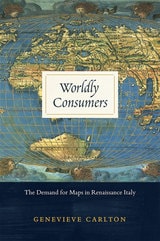
Worldly Consumers
The Demand for Maps in Renaissance ItalyGenevieve Carlton
University of Chicago Press, 2015
Drawing on a variety of sixteenth-century sources, including household inventories, epigrams, dedications, catalogs, travel books, and advice manuals, Worldly Consumers studies how individuals displayed different maps in their homes as deliberate acts of self-fashioning. One citizen decorated with maps of Bruges, Holland, Flanders, and Amsterdam to remind visitors of his military prowess, for example, while another hung maps of cities where his ancestors fought or governed, in homage to his auspicious family history. Renaissance Italians turned domestic spaces into a microcosm of larger geographical places to craft cosmopolitan, erudite identities for themselves, creating a new class of consumers who drew cultural capital from maps of the time.