Results by title

12 books match the query 'Repair'
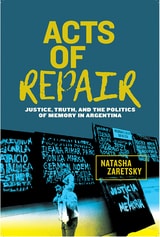
cover of Acts of Repair: Justice, Truth, and the Politics of Memory in Argentina

Acts of Repair

Justice, Truth, and the Politics of Memory in Argentina

Natasha Zaretsky

Rutgers University Press, 2021
Acts of Repair explores how ordinary people grapple with decades of political violence and genocide in Argentina—a history that includes the Holocaust, the political repression of the 1976–1983 dictatorship, and the 1994 AMIA bombing. Although the struggle against impunity seems inevitably incomplete, Argentines have created possibilities for repair through cultural memory, yielding spaces for transformation and agency critical to personal and political recovery.
 
[more]
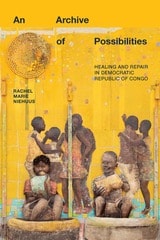
cover of An Archive of Possibilities: Healing and Repair in Democratic Republic of Congo

An Archive of Possibilities

Healing and Repair in Democratic Republic of Congo

Rachel Marie Niehuus

Duke University Press, 2024

In An Archive of Possibilities, anthropologist and surgeon Rachel Marie Niehuus explores possibilities of healing and repair in the eastern Democratic Republic of Congo against a backdrop of 250 years of Black displacement, enslavement, death, and chronic war. Niehuus argues that in a context in which violence characterizes everyday life, Congolese have developed innovative and imaginative ways to live amid and mend from repetitive harm. Drawing on ethnographic fieldwork and the Black critical theory of Achille Mbembe, Christina Sharpe, Alexis Pauline Gumbs and others, Niehuus explores the renegotiation of relationships with land as a form of public healing, the affective experience of living in insecurity, the hospital as a site for the socialization of pain, the possibility of necropolitical healing, and the uses of prophesy to create collective futures. By considering the radical nature of cohabitating with violence, Niehuus demonstrates that Congolese practices of healing imagine and articulate alternative ways of living in a global regime of antiblackness.
[more]
cover of Boundaries of Repair: Memory, Emotion, and Mobility across Timor-Leste and Indonesia

Boundaries of Repair

Memory, Emotion, and Mobility across Timor-Leste and Indonesia

Victoria Sakti

National University of Singapore Press, 2026

A study of Timorese communities that offers a human perspective on post-conflict reconciliation.

Violent conflict may end in a kind of peace. But reconciliation processes do not always work, let alone bring healing. How are families and communities to rebuild their lives when old divisions, pain, and memories still linger? Centering on social repair, this beautifully crafted study explores how families and communities in Timor-Leste and exile communities in Indonesia live with the enduring consequences of political violence, forced separation, and displacement after twenty-four years of Indonesian occupation.

Following relationships across borders and between generations, Boundaries of Repair shows how ruptures in kinship and community life reverberate across time and space, and even between the living and the dead. Rather than treating repair as a state-driven undertaking, the book reveals social repair as an uneven, fragile, and ongoing process, sustained through everyday care practices, memory work, emotional labor, and creative acts of negotiation in contexts marked by impunity and unresolved loss.

By foregrounding what it means to live with damage that cannot be fully repaired, the book challenges dominant assumptions about justice, healing, and closure. It offers a powerful account of how people renegotiate relationships, boundaries, and belonging amid traces of violence, contributing new insights to debates on post-conflict recovery, memory, displacement, and the limits of reconciliation.
[more]
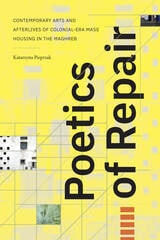
cover of Poetics of Repair: Contemporary Arts and Afterlives of Colonial-Era Mass Housing in the Maghreb

Poetics of Repair

Contemporary Arts and Afterlives of Colonial-Era Mass Housing in the Maghreb

Katarzyna Pieprzak

Duke University Press, 2025
Today, most colonial-era modernist mass housing is seen as fundamentally broken: crumbling concrete spaces of social alienation and containment that fractured societies both then and now. In Poetics of Repair, Katarzyna Pieprzak examines how contemporary visual, literary, and performance art of the Maghreb has the potential to change the terms, histories, and imagined futures of mass housing in North Africa and France. Pieprzak dives deeply into contemporary art engagements with three mass housing sites that epitomize the French colonial geography of modernist architecture in the Maghreb. She identifies in this art what she names a transformative “poetics of repair”: a practice that conjoins, puts in relation, or simply brings closer together broken materials, separated people, and severed timelines. Reading art and its engagements with mass housing, Pieprzak argues, has the potential to unmoor established knowledge and rehearse the tensions and productive ambiguities inherent to practices of constitution and revision. She demonstrates that such a reading practice is a step toward a reparative epistemology for mass housing that turns sites of wreckage and alienation into sites of possible solidarities and new formulations of history and experience.
[more]
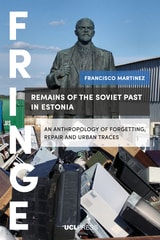
cover of Remains of the Soviet Past in Estonia: An Anthropology of Forgetting, Repair and Urban Traces

Remains of the Soviet Past in Estonia

An Anthropology of Forgetting, Repair and Urban Traces

Francisco Martinez

University College London, 2018

What happens to legacies that do not find any continuation? In Estonia, a new generation that does not remember the socialist era and is open to global influences has grown up. As a result, the impact of the Soviet memory in people's conventional values is losing its effective power, allowing for new opportunities for recuperation.

Francisco Martinez brings together a number of sites of interest to explore the vanquishing of the Soviet legacy in Estonia: a street market in Tallinn where concepts such as "market" and "employment" take on distinctly different meanings from their Western use; Linnahall, a multi-purpose venue, whose Soviet heritage now poses difficult questions of how to present the building’s history; Tallinn’s cityscape, where the social, spatial, and temporal coevolution of the city can be viewed and debated; Narva, a city that marks the border between the Russian Federation, NATO, and the European Union and represents a place of continual negotiation; and the new Estonian National Museum in Raadi, an area on the outskirts of Tartu that has avoided promoting a single narrative of the past.

By exploring these places of cultural and historical significance, which all contribute to our understanding of how the new generation in Estonia is not following the expectations and values of its predecessor, the book also demonstrates how we can understand generational change in a material sense.
[more]
cover of Remembering the Fragmented: War, Memory, and Repair in Colombia

Remembering the Fragmented

War, Memory, and Repair in Colombia

Pilar Riaño-Alcalá

University of Wisconsin Press, 2027

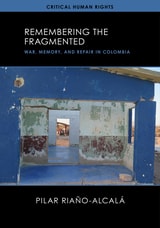
The South American nation of Colombia has experienced decades of violence involving state, guerrilla, and paramilitary actors, resulting in profound and enduring consequences. Scholars have examined both the violent events and the subsequent truth and reconciliation initiatives addressing this complex history. Pilar Riaño-Alcalá introduces a novel perspective by integrating Black, Indigenous, and memory studies in her analysis of two significant sites of mass violence: Bahia Portete, a Wayuu Indigenous territory in Upper Guajira, and Bojayá, a Black and Embera Indigenous territory in Chocó. By recognizing nonhuman and nonliving community members as actants and foregrounding Indigenous and Black ontologies in collective remembrance, Riaño-Alcalá reveals the processes through which these communities engage in social repair. She demonstrates how they interpret, restore, sustain, and reimagine their identities amid ongoing challenges posed by war and racial capitalism. This work advances scholarship in human rights studies, memory studies, Indigenous studies, Latin American studies, and the anthropology of social repair, offering significant new insights into a well-examined historical context.
[more]
cover of Speculative Relations: Indigenous Worlding and Repair

Speculative Relations

Indigenous Worlding and Repair

Joseph M. Pierce

Duke University Press, 2025
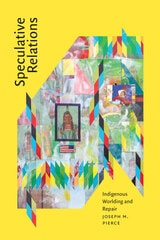
Indigenous relations are often described in anthropological terms, or as expressions of timeless, unchanging kinship ties. In Speculative Relations, Joseph M. Pierce challenges this view, considering the potential of these relations as a means of repairing the damages of history. Pierce approaches Indigenous art and culture not as objects of study, but through relations committed to reciprocity and care for human and more-than-human beings. Drawing on Cherokee thinking, Indigenous queer theory, literary and cultural studies, and art criticism, he illuminates pathways for understanding and resisting the ongoing damages of colonialism while pointing to future worlds and imaginaries that breathe life into Indigenous thought and practice. Analyzing a range of materials—from photography, literature, and sculpture to film and ethnography—Pierce reveals how speculation, as a form of situated knowledge production, can repair and reimagine the worlds that colonialism sought to destroy. In doing so, Pierce highlights how gestures, poetics, and embodiment can uphold tradition and harness the imaginative power of speculation to create pathways for living in good relations.
[more]
cover of Spoiled: Asian American Hostility and the Damage of Repair

Spoiled

Asian American Hostility and the Damage of Repair

Summer Kim Lee

Duke University Press, 2025

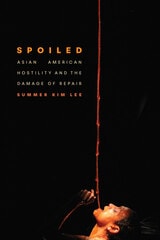
In Spoiled, Summer Kim Lee examines how contemporary Asian American artists challenge expectations that their work should repair the wounds of racial trauma. Kim Lee turns to the “spoiled”—the racialized, gendered body and all that it consumes, wrecks, and inflicts in its desire and excess—in visual culture, performance, music, and literature. Reading works by Cato Ouyang, Patty Chang, Wu Tsang, TJ Shin, Jes Fan, and others, Kim Lee highlights moments of hostility and deformation that spoil idealizations of Asian Americanness and incite modes of feeling and relating that relinquish fantasies of wholeness, power, and control. She observes the latent aggressive behaviors and negative affects in Asian American aesthetic practice: the embarrassment of asociality, the imposition of speaking as someone else, and the indulgence of ravenous appetites. In so doing, Kim Lee questions the political desires for repair expressed in “feeling Asian” and stays with the damage that spoilage creates as integral to the kinds of repair that Asian Americans seek.
[more]
cover of Survival: Dislocation and Repair in Burma

Survival

Dislocation and Repair in Burma

François Robinne

National University of Singapore Press, 2027

Captures the tenuous reality of daily life for those in and outside Burma.

In the wake of the military coup of February 2021, a new and unsettling reality has emerged in Burma. Unlike previous uprisings, this time the junta's reach extends beyond marginalized groups and ethnic territories to target the entire spectrum of civil society—urban and rural, young and old, across all groups, faiths, and social classes. The "Spring Revolution" sees Generation Z not only resisting authoritarian rule but also striving to forge a new societal vision.

In the face of totalitarian desocialization, a complex dance of dislocation and repair unfolds, within, outside, and along Burma's international borders. Survival takes a multi-sited approach to explore these dynamics: we hear from asylum seekers in France, the undocumented in Thailand, resistance leaders in constant motion, and, through the medium of the handphone, from within Burma. The result that emerges is a compelling picture of the individual struggle in an unforgiving situation, of interest to anyone who seeks a grounded understanding of the conflict—and what might emerge from it. Highly engaged yet academically rigorous, this compelling book also opens new spaces for understanding the complications of migration in today’s world.
[more]
cover of The City after Property: Abandonment and Repair in Postindustrial Detroit

The City after Property

Abandonment and Repair in Postindustrial Detroit

Sara Safransky

Duke University Press, 2023
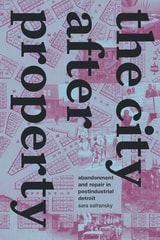
In The City after Property, Sara Safransky examines how postindustrial decline generates new forms of urban land politics. In the 2010s, Detroit government officials classified a staggering 150,000 lots—more than a third of the city—as “vacant” or “abandoned.” Analyzing subsequent efforts to shrink the Motor City’s footprint and budget, Safransky presents a new way of conceptualizing urban abandonment. She challenges popular myths that cast Detroit as empty along with narratives that reduce its historical decline to capital and white flight. In connecting contemporary debates over neoliberal urbanism to Cold War histories and the lasting political legacies of global movements for decolonization and Black liberation, she foregrounds how the making of—and challenges to—modern property regimes have shaped urban policy and politics. Drawing on critical geographical theory and community-based ethnography, Safransky shows how private property functions as a racialized construct, an ideology, and a moral force that shapes selves and worlds. By thinking the city “after property,” Safransky illuminates alternative ways of imagining and organizing urban life.
[more]
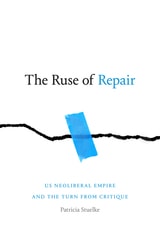
cover of The Ruse of Repair: US Neoliberal Empire and the Turn from Critique

The Ruse of Repair

US Neoliberal Empire and the Turn from Critique

Patricia Stuelke

Duke University Press, 2021
Since the 1990s, literary and queer studies scholars have eschewed Marxist and Foucauldian critique and hailed the reparative mode of criticism as a more humane and humble way of approaching literature and culture. The reparative turn has traveled far beyond the academy, influencing how people imagine justice, solidarity, and social change. In The Ruse of Repair, Patricia Stuelke locates the reparative turn's hidden history in the failed struggle against US empire and neoliberal capitalism in the 1970s and 1980s. She shows how feminist, antiracist, and anti-imperialist liberation movements' visions of connection across difference, practices of self care, and other reparative modes of artistic and cultural production have unintentionally reinforced forms of neoliberal governance. At the same time, the US government and military, universities, and other institutions have appropriated and depoliticized these same techniques to sidestep addressing structural racism and imperialism in more substantive ways. In tracing the reparative turn's complicated and fraught genealogy, Stuelke questions reparative criticism's efficacy in ways that will prompt critics to reevaluate their own reading practices.
[more]
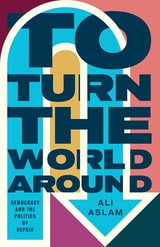
cover of To Turn the World Around: Democracy and the Politics of Repair

To Turn the World Around

Democracy and the Politics of Repair

Ali Aslam

University of Minnesota Press, 2027

A stirring exploration of abolitionist thought and Black feminism to articulate a transformative theory of repair

Amid the relentless news of ICE raids, Supreme Court rulings that dismantle our civil rights, and egregious violations of democratic norms, people in the United States are struggling to visualize an actionable path forward. In To Turn the World Around, Ali Aslam proposes a transformative approach that pairs inner healing work with collective external engagement challenging oppressive forces. To actualize W. E. B. DuBois’s concept of abolition democracy, drawing from Black sociality grounded in the refusal of white institutions, Aslam advocates for not working within a broken system nor fleeing it, or merely enduring injustice, and instead offers combined personal healing and embodied action.

Aslam’s vision of transformative selfhood centers healing justice, self and mutual aid, and a somatic approach informed by Black women’s history of navigating bodily dispossession and violations of autonomy and personhood. Simultaneously a tool of personal survival, political refusal, and collective care, inner work incubates new forms of resistance and prepares participants to engage with the outer work of abolition. The movements that rise from the foundation of this inner work are collaborative and experimental, a collective “figuring out” that creates holistic approaches to abolition that transcend conventional politics.

Reimagining inner work as resistance that is ongoing, expansive, and relational, To Turn the World Around offers a stirring framework for the creation of transformational movements. Aslam’s unique theory of repair carefully bridges constituencies, acknowledging the politics of refusal while embracing the hopefulness of sociality.

Retail e-book files for this title are screen-reader friendly.

[more]