Results by title
22 books match the query 'Reporters and reporting'
After the Czars and Commissars
Journalism in Authoritarian Post-Soviet Central AsiaEric Freedman
Michigan State University Press, 2011
Before Journalism Schools
How Gilded Age Reporters Learned the RulesRandall S. Sumpter
University of Missouri Press, 2018
Behind the Scenes
Covering the JFK AssassinationDarwin Payne
University of North Texas Press, 2023

Embargoed Science
Vincent Kiernan
University of Illinois Press, 2006
The popular notion of a lone scientist privately toiling long hours in a laboratory, striking upon a great discovery, and announcing it to the world is a romanticized fiction. Vincent Kiernan's Embargoed Science reveals the true process behind science news: an elite few scholarly journals control press coverage through a mechanism known as an embargo. The journals distribute advance copies of their articles to hundreds and sometimes thousands of journalists around the world, on the condition that journalists agree not to report their stories until a common time, several days later. When the embargo lifts, airwaves and newspaper pages are flooded with stories based on the journal's latest issue.
In addition to divulging the realities behind this collusive practice, Kiernan offers an unprecedented exploration of the embargo's impact on public and academic knowledge of science and medical issues. He surveys twenty five daily U.S. newspapers and relates his in-depth interviews with reporters to examine the inner workings of the embargo and how it structures our understanding of news about science. Kiernan ultimately argues that this system fosters "pack journalism" and creates an unhealthy shield against journalistic competition. The result is the uncritical reporting of science and medical news according to the dictates of a few key sources.
Forward Positions
The War Correspondence of Homer BigartHomer Bigart
University of Arkansas Press, 1992
Among journalists—and particularly war correspondents—Homer Bigart was both legend and example. In a career of four decades, first with the New York Herald Tribuneand then, through 1972, with The New York Times, Bigart distinguished himself as a superb writer and tireless digger for the realities that could be learned only in the field and not at headquarters. In 1943 Bigart sailed for England to cover the air war and was soon on mule-back in Sicily, and hanging on at Anzio. He then went to the Pacific, where his dispatches won him his first Pulitzer Prize for foreign correspondence. When hostilities erupted in Korea he was again on the front lines in the front lines in the Orient, and again recipient of a Pulitzer. By the time of the American involvement in Vietnam, he was an old-timer, a seasoned correspondent admired and celebrated for his wit but regarded with awe for his masterly stories, in which straightforward prose, informed by tenacious reporting, cut to the heart of the issues.
Previously available only n crumbling library copies of the Tribune and the Times, or in microfilm repositories, his dispatches, with their rare insights into warefar and he minds of those who wage war, are now collected in Forward Positions: The War Correspondence of Home Bigart, edited by Betsy Wade and introduced by Harrison E. Salisbury, himself the winner of a Pulitzer Prize for journalism.
Forward Positions does honor to a breed of journalist that had passed into history by the time of Bigart’s death. It includes one of the first accounts of the atomic annihilation of Hiroshima, a report on the war-crimes trial of Adolf Eichmann, a number of dispatches on “hot” battles of the Cold War, and a probing dispatch on Lieutenant William Calley’s testimony on the Mỹ Lai Massacre. With this representative selection of more than fifty of Bigart’s accounts of war on the ground, in the air, and in the courtroom, Wade provides a wealth of background material about his career, as well as glimpses of his impact on journalism. The book promises hours of captivating and informative reading for journalists, historians, veterans, and anyone who likes a good story tautly told.
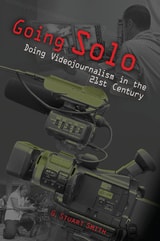
Going Solo
Doing Videojournalism in the 21st CenturyG. Stuart Smith
University of Missouri Press, 2011
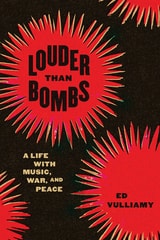
Louder Than Bombs
A Life with Music, War, and PeaceEd Vulliamy
University of Chicago Press, 2020
Describing the artists, songs, and concerts that most influenced him, Vulliamy brings together the two largest threads of his life—music and war. Louder Than Bombs covers some of the most important musical milestones of the past fifty years, from Jimi Hendrix playing “Machine Gun” at the Isle of Wight Festival in 1970 to the Bataclan in Paris under siege in 2015. Vulliamy was present for many of these historic moments, and with him as our guide, we see them afresh, along the way meeting musicians like B. B. King, Graham Nash, Patti Smith, Daniel Barenboim, Gustavo Dudamel, and Bob Dylan. Vulliamy peppers the book with short vignettes—which he dubs 7" singles—recounting some of his happiest memories from a lifetime with music. Whether he’s working as an extra in the Vienna State Opera’s production of Aida, buying blues records in Chicago, or drinking coffee with Joan Baez, music is never far from his mind. As Vulliamy discovers, when horror is unspeakable, when words seem to fail us, we can turn to music for expression and comfort, or for rage and pain. Poignant and sensitively told, Louder Than Bombs is an unforgettable record of a life bursting with music.
Manufacturing the News
By Mark Fishman
University of Texas Press, 1980
There is little argument that mass media news projects a particular point of view. The question is how that bias is formed. Most media critics look to the attitudes of reporters and editors, the covert news policy of a publisher, or the outside pressures of politicians and advertisers. Manufacturing the News takes a different tack. Mark Fishman’s research shows how the routine methods of gathering news, rather than any hidden manipulators, determine the ideological character of the product.
News organizations cover the world mainly through “beats,” which tend to route reporters exclusively through governmental agencies and corporate bureaucracies in their search for news. Crime, for instance, is covered through the police and court bureaucracies; local politics through the meetings of the city council, county commissioners, and other official agencies. Reporters under daily deadlines come to depend upon these organizations for the predictable, steady flow of raw news material they provide.
It is part of the function of such bureaucracies to transform complex happenings into procedurally defined “cases.” Thus the information they produce for newsworkers represents their own bureaucratic reality. Occurrences which are not part of some bureaucratic phase are simply ignored. Journalists participate in this system by publicizing bureaucratic reality as hard fact, while accounts from other sources are treated as unconfirmed reports which cannot be published without time-consuming investigation.
Were journalists to employ different methods of news gathering, Fishman concludes, a different reality would emerge in the news—one that might challenge the legitimacy of prevailing political structures. But, under the traditional system, news reports will continue to support the interests of the status quo independently of the attitudes and intentions of reporters, editors, and news sources.
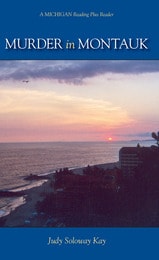
Murder in Montauk
Judy Soloway Kay
University of Michigan Press, 2005
The MICHIGAN Reading Plus Readers are original fiction written for students who wish to improve their reading skills. The MICHIGAN Reading Plus Readers support the need for extensive reading on topics of interest to today's students. The Readers offer students books in the genres of mystery, science-fiction, and romance. Activities that practice vocabulary and reading skills are provided on the companion website.
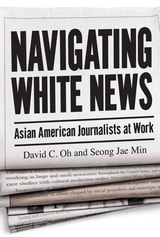
Navigating White News
Asian American Journalists at WorkDavid C Oh
Rutgers University Press, 2023
Combining critical race studies with cultural production studies, Navigating White News: Asian American Journalists at Work is the only academic book to examine the ways that racial identification and activation matters in their understanding of news. This adds to the existing literature on race and the sociology of news by examining intra-racial differences in the ways they navigate and understand White newsrooms. Employing in-depth interviews with twenty Asian American journalists who are actively working in large and small newsrooms across the United States, Navigating White News: Asian American Journalists at Work argues that Asian American reporters for whom racial identities are important questioned what counted as news, questioned the implicitly White perspective of objectivity, and actively worked toward providing more complex, substantive coverage of Asian American communities. For Asian American reporters for whom racial identity was not meaningful, they were more invested in existing professional norms. Regardless, all journalists understood that news is a predominantly and culturally White institution.
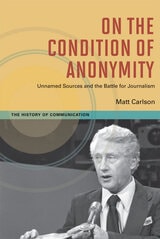
On The Condition of Anonymity
Unnamed Sources and the Battle for JournalismMatt Carlson
University of Illinois Press, 2012
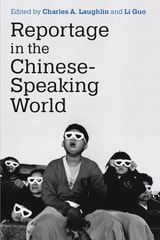
Reportage in the Chinese-Speaking World
Edited by Charles A. Laughlin and Li Guo
University of Michigan Press, 2026
Reportage in the Chinese-Speaking World examines reportage as an important aesthetic form of cultural production in the Sinophone world. Originating as a proletarian nonfiction form in interwar Europe, reportage spread around the world, coming into its own in the Sinophone world from the 1930s to today. Going beyond fact-based journalism, reportage is pursued through a variety of artistic forms and media, from nonfiction writing to photography to documentary film. Reportage’s plurimedial representations facilitate and amplify intersectional struggles against multiple forms of social and political oppression. Engaging its audiences in affective ethico-political exchanges with (human or nonhuman) subjects, reportage promotes audiences’ empathetic responses to the democratic appeals of marginalized groups whose status, identity, or situation manifest emergent ethical challenges in the society of their time.
This work offers new understandings of reportage’s dialectical relationship with its readership by evoking sympathetic identifications with personal contemplations of place, hearth, and senses of belonging. Covering a breadth of media across mainland China, Taiwan, and the Sinophone diaspora in the United States and Japan, this book examines how intermediality cultivates distinctive expressions in reportage, cross-cultural empathy, and ethico-political relationships between the reporter, photographer, filmmaker, and their surroundings.
Reporting on Risk
How the Mass Media Portray Accidents, Diseases, Other HazardsEleanor Singer
Russell Sage Foundation, 1993
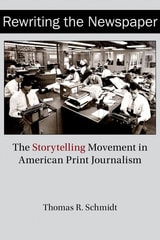
Rewriting the Newspaper
The Storytelling Movement in American Print JournalismThomas R. Schmidt
University of Missouri Press, 2020
Thomas Schmidt analyzes the expansion of narrative journalism and the corresponding institutional changes in the American newspaper industry in the last quarter of the twentieth century. In doing so, he offers the first institutionally situated history of narrative journalism’s evolution from the New Journalism of the 1960s to long-form literary journalism in the 1990s. Based on the analysis of primary sources, industry publications, and oral history interviews, this study traces how narrative techniques developed and spread through newsrooms, advanced by institutional initiatives and a growing network of practitioners, proponents, and writing coaches who mainstreamed the use of storytelling. Challenging the popular belief that it was only a few talented New York reporters (Tome Wolfe, Jimmy Breslin, Gay Talese, Joan Didion, and others) who revolutionized journalism by deciding to employ storytelling techniques in their writing, Schmidt shows that the evolution of narrative in late twentieth century American Journalism was more nuanced, more purposeful, and more institutionally based than the New Journalism myth suggests.
Tamarack River Ghost
A NovelJerry Apps
University of Wisconsin Press, 2012
Josh’s big story is that a corporation that plans to establish an enormous hog farm has bought a lot of land along the Tamarack River in bucolic Ames County. Some of the local residents and officials are excited about the jobs and tax revenues that the big farm will bring, while others worry about truck traffic, porcine aromas, and manure runoff polluting the river. And how would the arrival of a large agribusiness affect life and traditions in this tightly knit rural community of family farmers? Josh strives to provide impartial agricultural reporting, even as his newspaper is replaced by a new Internet-only version owned by a former New York investment banker. And it seems that there may be another force in play: the vengeful ghost of a drowned logger who locals say haunts the valley of the Tamarack River.
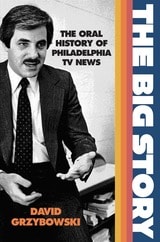
The Big Story
The Oral History of Philadelphia TV NewsDavid Grzybowski
Temple University Press, 2025
“We were the only station that stayed on the air continuously. We even pre-empted the CBS evening news.”—Larry Kane, anchor at WCAU, about covering the MOVE bombing
“The highs of working during the pandemic were keeping people informed of this deadly virus and what they had to do to take care of themselves and each other.”—Ukee Washington, KYW anchor, on the pandemic
The Big Story is David Grzybowski’s engrossing oral history of Philadelphia TV news from the perspective of reporters, photographers, producers, and news directors. Covering all the big stories from the late 1970s through the present, this fast-paced running commentary reflects on the uncertainty of the Three Mile Island disaster, the thrill of the Live Aid concert, the “Storm of the Century” (that wasn’t), and the championship victories of the Phillies and the Eagles, among other notable events, local, national, and global.
The Big Story features more than 200 interviews, including anecdotes from seasoned Philadelphia anchors Jim Gardner, Larry Kane, Lisa Thomas-Laury, Mike Jerrick, Vai Sikahema, Tamala Edwards, Pat Ciarrocchi, and Cecily Tynan, among others, about their experience on and off the job. Decision makers reflect on how to cover hot news stories such as Pennsylvania State Treasure R. Budd Dwyer’s on-air suicide. (“It was a big bloody horrifying mess,” according to Chris Wagner, WPVI anchor.)
Grzybowski highlights the Mummers, the launch of Good Day Philadelphia, off-the-air scandals, and how the Action News style secured a loyal following with Philadelphians while the Eyewitness News format competed hard to gain ratings. But the Big Story is how The Big Story provides compelling stories about Philadelphia’s news breakers and newsmakers.

The Great Reporters
David Randall
Pluto Press, 2005
This unique book is the first to try and answer this question. Author David Randall searched nearly two centuries of newspapers and magazines, consulted editors and journalism experts worldwide, and the result is The Great Reporters---13 in-depth profiles of the best journalists who ever lived. They include nine Americans and four Britons, ten men and three women, whose lives were full of adventure, wit, and the considerable ingenuity required to bring the story home. Among chapters are those on the reporter who:
Booked himself onto a ship likely to be sunk by the Germans so he could report its torpedoing Was called out to a multiple shooting, who interviewed 50 witnesses, went back to the office, and wrote a Pulitzer Prize-winning story of 4,000 words in two and a half hours Was deemed useless by her teacher but who went on to become the greatest crime reporter in history Wrote a story that changed the map of Europe Out-bluffed a top Soviet official to get into Russia so he could cover the appalling famine there Feigned madness to get herself locked up in an asylum so she could expose its terrible conditions Was the best ever to apply words to newsprint Became a national hero in America because he stood up for the little guy and his war reporting told it like it really was At the age of 63, and after three major operations, went under-cover in Iran so she could report on the regime's repression Was nearly fired for fouling up his first major assignment, but went on to shock his nation with his courageous war reporting Wrote faster than anyone who could write better and better than anyone who could write faster Single-handedly took on the tobacco industry Said no to William Randolph Hearst
Each profile tells of the reporter's life and his or her major stories, how they were obtained, and their impact. Packed with anecdotes, and inspiring accounts of difficulties overcome, the book quotes extensively from each reporter's work. It also includes an essay on the history of reporting, charting the technologies, economics, and attitudes that made it the way it is---from the invention of the telegraph to the Internet. The Great Reporters is not just the story of 13 remarkable people, it is the story of how society's information hunter-gatherers succeed in bringing us all what we need to know.
The Politics of Herding Cats
When Congressional Leaders FailJohn Lovett
University of Michigan Press, 2021
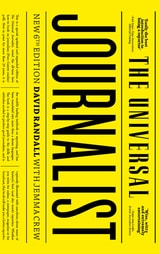
The Universal Journalist
David Randall
Pluto Press, 2021
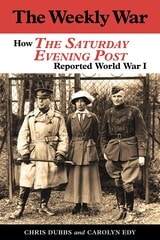
The Weekly War
How the Saturday Evening Post Reported World War IChris Dubbs
University of North Texas Press, 2023

Tides Of War
World News Reporting 1931-1945Robert W. Desmond
University of Iowa Press, 1984
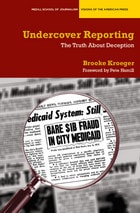
Undercover Reporting
The Truth About DeceptionBrooke Kroeger, Foreword by Pete Hamill
Northwestern University Press, 2012
In her provocative book, Brooke Kroeger argues for a reconsideration of the place of oft-maligned journalistic practices. While it may seem paradoxical, much of the valuable journalism in the past century and a half has emerged from undercover investigations that employed subterfuge or deception to expose wrong. Kroeger asserts that undercover work is not a separate world, but rather it embodies a central discipline of good reporting—the ability to extract significant information or to create indelible, real-time descriptions of hard-to-penetrate institutions or social situations that deserve the public’s attention. Together with a companion website that gathers some of the best investigative work of the past century, Undercover Reporting serves as a rallying call for an endangered aspect of the journalistic endeavor.