Results by title

9 books match the query 'Reporting'
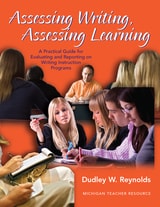
cover of Assessing Writing, Assessing Learning: A Practical Guide for Evaluating and Reporting on Writing Instruction Programs

Assessing Writing, Assessing Learning

A Practical Guide for Evaluating and Reporting on Writing Instruction Programs

Dudley W. Reynolds

University of Michigan Press, 2010

The goals of this resource are broader than many standard books on writing assessment, which focus on evaluating an individual’s ability to create an effective piece of writing for a particular purpose. Assessing Writing, Assessing Learning seeks to support teachers, administrators, program directors, and funding entities who want to make the best use of the resources at their disposal to understand what students are learning and why and then take actions based on what they have learned. It also seeks to provide a common basis for communication among all the interested parties—the writing professionals, the people who identified the need for the program, and the students.

The book has sections on planning, tools (different ways of collecting data and links to instruments), and reporting (examples provided). Each section includes a discussion of issues and advice for working through the issue along with numerous examples, plus a list of resources to consult to learn more. The final chapter provides worksheets that may be reproduced and used to help those in charge of setting up and delivering a writing program to think through the issues presented. A glossary of terms is also included.
[more]
cover of Reporting of Social Science in the National Media

Reporting of Social Science in the National Media

Carol Weiss

Russell Sage Foundation, 1988
Policy makers, as well as the general public, are often unaware of social science research until a story about it appears in the national media. Even in official Washington, a staffer's report on social research may go unnoticed while a report in the Washington Post receives immediate attention. This study takes a systematic and revealing look at social science reporting. How do journalists hear about social science, and why do they select certain stories to cover and not others? How do journalistic standards for selection compare with social scientists' own judgments of merit? How do reporters attempt to ensure accuracy, and how freely do they introduce their own interpretations of social science findings? How satisfied are social scientists with the selection and accuracy of social science news? In Part I, Carol H. Weiss addresses these questions on the basis of personal interviews with social scientists and the journalists who wrote about their work. Part II, by Eleanor Singer, is based on an analysis of media content itself, and compares social science reporting over time (between 1970 and 1982) and across media (newspapers, newsmagazines, television). These two complementary perspectives combine to produce a thorough, realistic assessment of the way social science moves out of the academy and into the world of news.
[more]
cover of Reporting on Risk: How the Mass Media Portray Accidents, Diseases, Other Hazards

Reporting on Risk

How the Mass Media Portray Accidents, Diseases, Other Hazards

Eleanor Singer

Russell Sage Foundation, 1993

After acts of airline terrorism, air travel tends to drop dramatically—yet Americans routinely pursue the far riskier business of driving cards, where accidents resulting in death or injury are much more likely to occur. Reporting on Risk argues that this selective concern with danger is powerfully shaped by the media, whose coverage of potentially hazardous events is governed more by a need to excite the public than to inform it. Singer and Endreny survey a wide range of print and electronic media to provide an unprecedented look at how hundreds of different hazards are presented to the public—from toxic waste and food poisoning to cigarette smoking, from transportation accidents to famine, and from experimental surgery to communicable diseases. Their investigations raise thought-provoking questions about what the media tell us about modern risks, which hazards are covered and which ignored, and how the media determine when hazards should be considered risky. Are natural hazards reported differently than man-made hazards? Is greater emphasis placed on the potential benefits or the potential drawbacks of complex new technologies? Are journalists more concerned with reporting on unproven cures or informing the public about preventative measures? Do newspapers differ from magazines and television in their risk reporting practices? Reporting on Risk investigates how the media place blame for disasters, and looks at how the reporting of risks has changed in the past twenty-five years as such hazards as nuclear power, birth control methods, and industrial by-products have grown in national prominence. The authors demonstrate that the media often fail to report on risks until energized by the occurrence of some disastrous or dramatic event—the Union Carbide pesticide leak in Bhopal, the Challenger explosion, the outbreak of famine in Somalia, or the failed transplant of a baboon heart to "Baby Fae." Sustained attention to these hazards depends less on whether the underlying issues have been resolved than on whether they continue to unfold in newsworthy events. Reporting on Risk examines the accuracy and the amount of information we receive about our environment. It offers a critical perspective on how our perceptions of risk, as shaped by the media, may contribute to misguided individual and public choices for action and prevention in an increasingly complex world. The authors' probing assessment of how the media report a vast array of risks offers insights useful to journalists, policy analysts, risk specialists, legislators, and concerned citizens.
[more]
cover of Reporting the Chinese Revolution: The Letters of Rayna Prohme

Reporting the Chinese Revolution

The Letters of Rayna Prohme

Gregor Benton and Arthur J. Knodel

Pluto Press, 2007

Rayna and her husband Bill edited the Kuomintang's English-language newspaper in Wuhan. Rayna's account of her intimate involvement in the Chinese Revolution brings to life the eventful Wuhan years of 1926-27, which shaped the revolution's course. Her letters illuminate from a personal angle the battle for China's future and include remarkable portraits of some of the people who shaped the Communist and Nationalist movements of the time.

The book consists of letters Prohme wrote to her closest friend and her husband in the period immediately before, during and after the Wuhan interlude. Her reporting brought her into contact with many major political figures including Madam Sun Yat-sen (a prominent figure in the opposition to Chiang Kai-shek) and Mikhail Borodin (a chief Soviet advisor in China).

This book provides an unusual and often moving insight into a fascinating period in modern Chinese history.
[more]
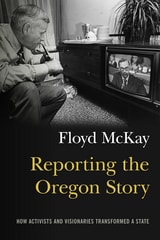
cover of Reporting the Oregon Story: How Activists and Visionaries Transformed a State

Reporting the Oregon Story

How Activists and Visionaries Transformed a State

Floyd J. McKay

Oregon State University Press, 2016

Oregon entered a new era in 1964 with the election of Tom McCall as Secretary of State and Bob Straub as State Treasurer.  Their political rivalry formed the backdrop for two of Oregon’s most transformative decades, as they successively fought for, lost, and won the governorship. Veteran Oregon journalist Floyd McKay had a front-row seat.
 
As a political reporter for The Oregon Statesman in Salem, and then as news analyst for KGW-TV in Portland, McKay was known for asking tough questions and pulling no punches. His reporting and commentaries ranged from analysis of the “Tom and Bob” rivalry, to the Vietnam War’s impact on Senators Wayne Morse and Mark Hatfield and the emergence of a new generation of Portland activists in the 1970s.
 
McKay and his colleagues were on the beaches as Oregon crafted its landmark Beach Bill, ensuring the protection of beaches for public use. They watched as activists turned back efforts to build a highway on the sand at Pacific City. Pitched battles over Oregon’s Bottle Bill, and the panic-inducing excitement of “Vortex”—the nation’s only state-sponsored rock festival—characterized the period. Covering the period from 1964-1986, McKay remembers the action, the players and the consequences, in this compelling and personal account.
 
As major actors fade from the scene and new leaders emerge, McKay casts a backwards glance at enduring Oregon legends. Half a century later, amid today’s cynicism and disillusionment with media, politics, and politicians, Reporting the Oregon Story serves as a timely reminder that charged politics and bitter rivalries can also come hand-in-hand with lasting social progress.
 
Reporting the Oregon Story will be relished by those who lived the history, and it will serve as a worthy introduction to Oregonians young and old who want a first-hand account of Oregon’s mid- twentieth-century political history and legislative legacy.
[more]
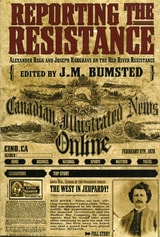
cover of Reporting the Resistance: Alexander Begg and Joseph Hargrave on the Red River Resistance

Reporting the Resistance

Alexander Begg and Joseph Hargrave on the Red River Resistance

Alexander Begg

University of Manitoba Press, 2003

Reporting the Resistance brings together two first-person accounts to give a view "from the ground" of the developments that shocked Canada and created the province of Manitoba. In 1869 and 1870, Begg and Hargrave were regular correspondents for (respectively) the Toronto Globe and the Montreal Herald. While neither man was a committed supporter of the Metis or Louis Riel, each gives a more complex, and more sympathetic, view of the resistance that is commonly expected from the Anglophone community of Red River. They describe, often from very different perspectives, the events of the resistance, as well as give insider accounts of the social and political background. Largely unreprinted until now, this correspondence remains a relatively untapped resource for contemporary views of the resistance. These are the Red River's own accounts, and are often quite different from the perspective of eastern observers.
[more]
cover of Reporting the Wars

Reporting the Wars

Joseph J. Mathews

University of Minnesota Press, 1957

Reporting the Wars was first published in 1957. Minnesota Archive Editions uses digital technology to make long-unavailable books once again accessible, and are published unaltered from the original University of Minnesota Press editions.

News of the wars has always intrigued the public, from the time of the Napoleonic wars up to the present. In this period of the last century and a half, however, the character both of the public and of the news has changed. Mr. Mathews traces the history of war news coverage from John Bell, who, in 1794, was probably the first war correspondent, to Ernie Pyle of World War II fame. The account is colorful, since war correspondents are notably adventurous individuals, and it is significant for a basic understanding of history, since the reporting of war news has represented a constant struggle against the forces of censorship and propaganda. The book is illustrated with newspaper cartoons.

[more]
cover of The Information Process: Reporting To Twentieth Century

The Information Process

Reporting To Twentieth Century

Robert W. Desmond

University of Iowa Press, 1978
[more]
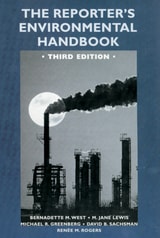
cover of The Reporter's Environmental Handbook: Third Edition

The Reporter's Environmental Handbook

Third Edition

Bernadette M West, M. Jane Lewis, Michael R Greenberg, David B. Sachsman, and Renee M. Rogers

Rutgers University Press, 2003

When an environmental news story breaks, the first place to turn for background on the issue is The Reporter's Environmental Handbook, now available in an updated and expanded third edition. Here, journalists can find the fast facts they need to accurately cover complex and controversial environmental stories ranging from indoor and outdoor air quality to sprawl and bioterrorism.
[more]