Results by title
2 books match the query 'Representative Democracy'
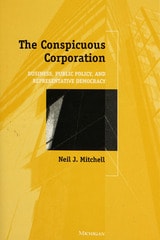
Conspicuous Corporation
Business, Public Policy, and Representative DemocracyNeil J. Mitchell
University of Michigan Press, 1997
Why, despite the political advantages of business in the policy process, do business interests still sometimes lose policy fights in the political system? Money, mobility, connections, and incentives load the political system in favor of business interests. Against the odds, when the conspicuous corporation meets the virtuous politician, business often loses in the policy struggle. In answering this question, Neil J. Mitchell reassesses the dimensions of business power in the political system and provides a fresh consideration of how economic power translates into political power. Charles Lindbloom's analysis of business power provides a point of departure for an examination of the evidence on business influence over public preferences, on the importance of business confidence to politicians, and on the financial and lobbying activities of business interests. Mitchell then considers the position of labor unions--the traditional opposition to business--in contemporary policy making. Finally, he discusses the conditions under which business power breaks down. This is accompanied by an analysis of a variety of cases in which business has attempted to influence the policy making process to test his findings. Extensively researched, this book sheds new light on the activities of business in politics, on the strength of interests opposing business, and on business policy failures in the United States and the United Kingdom. The empirical analysis builds on survey data, extensive interviews, and archival research. The relationship between business and government is a core topic for economists, sociologists and political scientists, taking us from heroic struggles over policy to sordid episodes of political corruption. The book will be of interest to scholars in the social sciences and in business schools as well as to the general reader interested in power and influence in representative democracies. Neil Mitchell is Professor of Political Science, University of New Mexico.
[more]
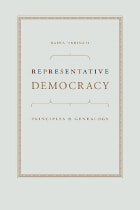
Representative Democracy
Principles and GenealogyNadia Urbinati
University of Chicago Press, 2006
It is usually held that representative government is not strictly democratic, since it does not allow the people themselves to directly make decisions. But here, taking as her guide Thomas Paine’s subversive view that “Athens, by representation, would have surpassed her own democracy,” Nadia Urbinati challenges this accepted wisdom, arguing that political representation deserves to be regarded as a fully legitimate mode of democratic decision making—and not just a pragmatic second choice when direct democracy is not possible.
As Urbinati shows, the idea that representation is incompatible with democracy stems from our modern concept of sovereignty, which identifies politics with a decision maker’s direct physical presence and the immediate act of the will. She goes on to contend that a democratic theory of representation can and should go beyond these identifications. Political representation, she demonstrates, is ultimately grounded in a continuum of influence and power created by political judgment, as well as the way presence through ideas and speech links society with representative institutions. Deftly integrating the ideas of such thinkers as Rousseau, Kant, Emmanuel Joseph Sieyès, Paine, and the Marquis de Condorcet with her own, Urbinati constructs a thought-provoking alternative vision of democracy.
[more]