Results by title

6 books match the query 'Representatives'
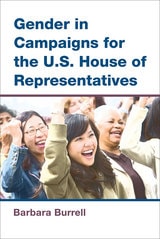
cover of Gender in Campaigns for the U.S. House of Representatives

Gender in Campaigns for the U.S. House of Representatives

Barbara Burrell

University of Michigan Press, 2014
Barbara Burrell presents a comprehensive comparative examination of men's and women’s candidacies for the U.S. House of Representatives in elections from 1994 through 2012. Analyzing extensive data sets on all major party candidates for 10 elections—covering candidate status, party affiliation, fund-raising, candidate background variables, votes obtained, and success rates for both primary and general elections—Burrell finds little evidence of categorical discrimination against women candidates. Women compete equally with men and often outpace them in raising money, gaining interest group and political party support, and winning elections.

Yet the number of women elected to the U.S. House has expanded only incrementally. The electoral structure limits opportunities for newcomers to win congressional seats and there remains a lower presence of women in winnable contests despite growing recruitment efforts. Burrell suggests that congressional dysfunction discourages potential candidates from pursuing legislative careers and that ambitious women are finding alternative paths to influence and affect public policy.
[more]
cover of Leadership Organizations in the House of Representatives: Party Participation and Partisan Politics

Leadership Organizations in the House of Representatives

Party Participation and Partisan Politics

Scott R. Meinke

University of Michigan Press, 2016
In recent Congresses, roughly half of the members of the U.S. House of Representatives served in whip organizations and on party committees. According to Scott R. Meinke, rising electoral competition and polarization over the past 40 years have altered the nature of party participation. In the 1970s and 1980s, the participation of a wide range of members was crucial to building consensus. Since then, organizations responsible for coordination in the party have become dominated by those who follow the party line. At the same time, key leaders in the House use participatory organizations less as forums for internal deliberations over policy and strategy than as channels for exchanging information with supporters outside Congress, and broadcasting sharply partisan campaign messages to the public.
 
[more]
cover of Legislating in the Dark: Information and Power in the House of Representatives

Legislating in the Dark

Information and Power in the House of Representatives

James M. Curry

University of Chicago Press, 2015

The 2009 financial stimulus bill ran to more than 1,100 pages, yet it wasn’t even given to Congress in its final form until thirteen hours before debate was set to begin, and it was passed twenty-eight hours later. How are representatives expected to digest so much information in such a short time.

The answer? They aren’t. With Legislating in the Dark, James M. Curry reveals that the availability of information about legislation is a key tool through which Congressional leadership exercises power. Through a deft mix of legislative analysis, interviews, and participant observation, Curry shows how congresspersons—lacking the time and resources to study bills deeply themselves—are forced to rely on information and cues from their leadership. By controlling their rank-and-file’s access to information, Congressional leaders are able to emphasize or bury particular items, exploiting their information advantage to push the legislative agenda in directions that they and their party prefer.

Offering an unexpected new way of thinking about party power and influence, Legislating in the Dark will spark substantial debate in political science.
[more]
cover of Legislative Entrepreneurship in the U.S. House of Representatives

Legislative Entrepreneurship in the U.S. House of Representatives

Gregory Wawro

University of Michigan Press, 2001
When members are elected to the House of Representatives they have a certain freedom to decide how they will act as members and how they will build their reputations. Just as in the market place entrepreneurs build businesses, so in the House of Representatives members have the freedom to choose to build legislative programs that will enhance their reputations in the institution. And yet entrepreneurship is also costly to members. Gregory Wawro explains why members of the House engage in legislative entrepreneurship by examining what motivates them to acquire policy knowledge, draft legislation, build coalitions, and push their legislation in the House. He considers what incentives members have to perform what many have perceived to be the difficult and unrewarding tasks of legislating.
This book shows how becoming a legislative entrepreneur relates to members' goals of reelection, enacting good public policy, and obtaining influence in the House. The analysis differs from previous studies of this behavior, which for the most part have employed case study methods and have relied on anecdotal evidence to support their arguments. Wawro analyzes legislative entrepreneurship in a general and systematic fashion, developing hypotheses from rational-choice-based theories and testing these hypotheses using quantitative methods.
Wawro argues that members engage in legislative entrepreneurship in order to get ahead within the House. He finds that the more legislative entrepreneurship that members engage in, the more likely it is that they will advance to prestigious positions.
This book is of interest to students of Congress, legislative behavior and institutions, elections, and campaign finance.
Gregory Wawro is Assistant Professor of Political Science, Columbia University.
[more]
cover of Party Discipline in the U.S. House of Representatives

Party Discipline in the U.S. House of Representatives

Kathryn Pearson

University of Michigan Press, 2015
Political party leaders in the U.S. House of Representatives command greater loyalty than ever from fellow party members in roll call votes, campaign contributions, and partisan speeches. In return, leaders reward compliant members with opportunities to promote constituent interests and to advance their own political careers. Denial of such privileges as retribution against those who don’t fully support the party agenda may significantly damage a member’s prospects.

Kathryn Pearson examines the disciplinary measures that party leaders in the U.S. House of Representatives employ to exact such loyalty, as well as the consequences for a democratic legislature. Drawing upon data from 1987–2010, Pearson identifies the conditions under which party leaders opt to prioritize policy control and those which induce them to prioritize majority control. She then assesses the ways in which these choices affect, on one hand, the party’s ability to achieve its goals, and on the other hand, rank-and-file members’ ability to represent their constituents. Astute party leaders recognize the need for balance, as voters could oust representatives who repeatedly support the party’s agenda over their constituents’ concerns, thereby jeopardizing the number of seats their party holds.

In her conclusion, Pearson discusses the consequences of party discipline such as legislative gridlock, stalled bills, and proposals banned from the agenda. Although party discipline is likely to remain strong as citizens become more cognizant of enforced party loyalty, their increasing dissatisfaction with Congress may spur change.
[more]
cover of Trust: Representatives and Constituents

Trust

Representatives and Constituents

William T. Bianco

University of Michigan Press, 1994

Why do constituents sometimes defer to their representative's judgment, rewarding her for acting as she thinks best, even when she ignores their demands? By making decisions about trust, constituents determine whether their representative is rewarded for implementing their demands or for using her judgment. These decisions shape legislator behavior and, through behavior, policy outcomes. Therefore, any attempt to explain or evaluate representative institutions such as the modern Congress requires an answer to a simple question: When do constituents trust their representative, and what is the basis of that trust?

This book is the first systematic analysis of constituent trust. It assumes that elected officials and ordinary citizens are rational actors. However, the book moves beyond the standard rational choice framework in three ways. It avoids narrow, unrealistic assumptions about motivations and information. It shows that many kinds of behavior not usually thought of as rational choices, such as a voter's desire to be represented by "someone like them," are the product of a systematic, predictable calculus---a calculus aimed at securing favorable policy outcomes. Finally, the book uses interviews with ninety-three members of the U.S. House of Representatives to test its predictions about trust.

[more]