Results by title
18 books match the query 'Reptiles'
Amniote Paleobiology
Perspectives on the Evolution of Mammals, Birds, and ReptilesEdited by Matthew T. Carrano, Timothy J. Gaudin, Richard W. Blob, and John R. Wi
University of Chicago Press, 2006
A collaborative effort of twenty-four researchers, Amniote Paleobiology presents thirteen new and important scientific perspectives on the evolution and biology of this familiar group. It includes new discoveries of dinosaurs and primitive relatives of mammals; studies of mammalian chewing and locomotion; and examinations of the evolutionary process in plesiosaurs, mammals, and dinosaurs. Emphasizing the rich variety of analytical techniques available to vertebrate paleontologists—from traditional description to multivariate morphometrics and complex three-dimensional kinematics—Amniote Paleobiology seeks to understand how species are related to each other and what these relationships reveal about changes in anatomy and function over time. A timely synthesis of modern contributions to the field of evolutionary studies, Amniote Paleobiology furthers our understanding of this diverse group.
Amphibians and Reptiles of New England
Habitats and Natural HistoryRichard M. DeGraaf
University of Massachusetts Press, 1983
Although numerous species of amphibians and reptiles live in New England and the northeastern Untied States, few people are aware of their existence of know much about their life histories, habitats, or distributions. This illustrated work provides such information, compiling the latest data on nearly sixty species. Included is a detailed account of each species' range, relative abundance, habitat, breeding period (from egg deposition through larval period), home range and movements, and food habitats. Additional comments and selected references are provided throughout.
The book is designed specifically for use in New England. The regional approach makes it possible to examine the details of distribution and habitat preference, important factors because many of these species have local, disjunct populations. The authors stress that these species constitute a valuable resource requiring and deserving conservative measures and urge that reptiles and amphibians be considered in wildlife-management policy.
Amphibians and Reptiles of the Great Lakes Region, Revised Ed.
James H. Harding and David A. Mifsud
University of Michigan Press, 2017
Amphibians, Reptiles, and Their Habitats at Sabino Canyon
David W. Lazaroff, Philip C. Rosen, and Charles H. Lowe, Jr.
University of Arizona Press, 2006
In this first publication to describe Sabino Canyon’s biota in scientific detail, three expert authors pool their knowledge to provide a detailed discussion of ecological change—especially as a consequence of drought, flooding, the introduction of exotic species, and direct human impact. Suburbia has arrived on the canyon’s doorstep, and human visitation has soared, inalterably affecting the area. Of particular concern, breeding habitats for amphibians were profoundly altered by flash flooding in Sabino’s streams following the 2003 Aspen Fire, which ravaged large parts of the Santa Catalina Mountains. The book contains richly detailed accounts of the 57 species found at Sabino—25 snakes, 17 lizards, 8 toads and frogs, 6 turtles, and 1 salamander—emphasizing their local ecology and the behavior likely to be witnessed by visitors. Physical descriptions and numerous photographs—many in color—facilitate identification. Up-to-date distribution maps provide an essential baseline against which future researchers can measure change.
Amphibians, Reptiles, and Their Habitats at Sabino Canyon is essential for anyone who seeks to understand this desert oasis, how it has changed, and how it may change in the future. Written with minimal technical jargon to make it as useful to students and visitors as it will be to scientists and resource managers, it makes a vital contribution to our understanding of creatures underfoot whose habitat we seek to share.
Biogeography of Reptiles and Amphibians in the Gomez Farias Region, Tamaulipas, Mexico
Paul S. Martin
University of Michigan Press, 1958
Ecology and Evolution in the Tropics
A Herpetological PerspectiveEdited by Maureen A. Donnelly, Brian I. Crother, Craig Guyer, Marvalee H. Wake,
University of Chicago Press, 2005
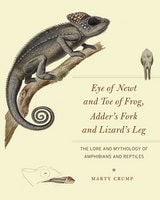
Eye of Newt and Toe of Frog, Adder's Fork and Lizard's Leg
The Lore and Mythology of Amphibians and ReptilesMarty Crump
University of Chicago Press, 2015
Frogs are worshipped for bringing nourishing rains, but blamed for devastating floods. Turtles are admired for their wisdom and longevity, but ridiculed for their sluggish and cowardly behavior. Snakes are respected for their ability to heal and restore life, but despised as symbols of evil. Lizards are revered as beneficent guardian spirits, but feared as the Devil himself.
In this ode to toads and snakes, newts and tuatara, crocodiles and tortoises, herpetologist and science writer Marty Crump explores folklore across the world and throughout time. From creation myths to trickster tales; from associations with fertility and rebirth to fire and rain; and from the use of herps in folk medicines and magic, as food, pets, and gods, to their roles in literature, visual art, music, and dance, Crump reveals both our love and hatred of amphibians and reptiles—and their perceived power. In a world where we keep home terrariums at the same time that we battle invasive cane toads, and where public attitudes often dictate that the cute and cuddly receive conservation priority over the slimy and venomous, she shows how our complex and conflicting perceptions threaten the conservation of these ecologically vital animals.
Sumptuously illustrated, Eye of Newt and Toe of Frog, Adder’s Fork and Lizard’s Leg is a beautiful and enthralling brew of natural history and folklore, sobering science and humor, that leaves us with one irrefutable lesson: love herps. Warts, scales, and all.
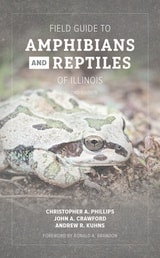
Field Guide to Amphibians and Reptiles of Illinois
Christopher A. Phillips, John A. Crawford, and Andrew R. Kuhns. Foreword by Ronald A. Brandon
University of Illinois Press, 2022
A one-of-a-kind resource, the Field Guide to Amphibians and Reptiles of Illinois is a definitive guide aimed at biologists, teachers, students, wildlife specialists, natural resource managers, conservationists, law enforcement officials, landowners, hobbyists, and everyone else eager to explore herpetology and nature in the Prairie State.
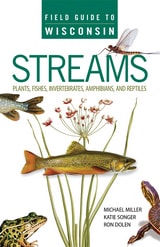
Field Guide to Wisconsin Streams
Plants, Fishes, Invertebrates, Amphibians, and ReptilesMichael A. Miller, Katie Songer, and Ron Dolen
University of Wisconsin Press, 2014
More than 1,000 images illustrate the species in this field guide. These images are augmented by detailed ecological and taxonomic notes, descriptions of look-alike species, and distribution maps. The guide identifies:
• more than 130 common plants
• all 120 fishes known to inhabit Wisconsin streams
• 8 crayfishes
• 50 mussels
• 10 amphibians
• 17 reptiles
• 70 families of insects
• other commonly found invertebrates.
Best Regional General Interest Books, selected by the American Association of School Librarians
Best Regional General Interest Books, selected by the Public Library Reviewers
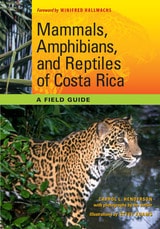
Mammals, Amphibians, and Reptiles of Costa Rica
A Field GuideBy Carrol L. Henderson
University of Texas Press, 2010
To help visitors, as well as local residents, identify and enjoy the wildlife of Costa Rica, Carrol L. Henderson published Field Guide to the Wildlife of Costa Rica in 2002, and it instantly became the indispensable guide. Now Henderson has created a field guide dedicated to the monkeys, sloths, treefrogs, lizards, crocodiles, and other animals that travelers are most likely to see while exploring the wild lands of Costa Rica. He includes fascinating information on their natural history, ecology, identification, and behavior gleaned from his forty years of travels, studies, and wildlife viewing in Costa Rica, as well as details on where to see these remarkable and beautiful creatures. The mammals, amphibians, and reptiles are illustrated by stunning and colorful photographs—most of which were taken in the wild by Henderson. A detailed and invaluable appendix that identifies many of Costa Rica's best wildlife-watching destinations, lodges, and contact information for trip-planning purposes completes the volume.
Reptiles and Amphibians of Minnesota
W.J. Breckenridge
University of Minnesota Press, 1944
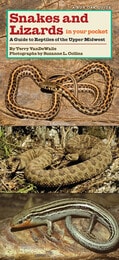
Snakes and Lizards in Your Pocket
A Guide to Reptiles of the Upper MidwestTerry VanDeWalle
University of Iowa Press, 2010
From the rare and docile massasauga, which relies on camouflage to remain unnoticed, to the more familiar bullsnake, which defends itself by hissing loudly and vibrating its tail from an S-shaped striking position, to the eastern racer, often seen crawling at more than three miles an hour during daytime, snakes are beautiful animals with habits both fascinating and beneficial to humans. Their relatives the lizards, most of which are more easily seen and identified, exhibit similarly fascinating behavior. This colorful addition to our series of laminated guides informs both amateur and professional herpetologists about twenty-seven species of snakes and six species of lizards in the Upper Midwest states of Minnesota, Wisconsin, Illinois, Indiana, Michigan, Ohio, South Dakota, North Dakota, Kansas, Nebraska, Iowa, and Missouri.
Terry VanDeWalle provides a complete description of each species, both adult and young, as well as distinguishing characteristics for thirty-two subspecies of snakes and two subspecies of lizards: length, color, head and neck patterns, scales, and so on. Also included is information about habitat preferences: forests, wet meadows, and sand prairies, for example. Most helpful for identifying snakes and lizards in the field are his comparisons of similar species and his comprehensive key.
Superb photographs by Suzanne Collins of adult and, when needed for identification, young snakes and lizards make this guide the perfect companion for hikers in all kinds of environments whenever a snake ripples across your path or a lizard darts into the underbrush.
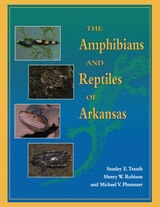
The Amphibians and Reptiles of Arkansas
Stanley E. Trauth
University of Arkansas Press, 2004
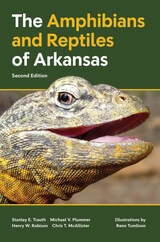
The Amphibians and Reptiles of Arkansas
Stanley E. Trauth
University of Arkansas Press, 2026
The rich diversity of Arkansas’s amphibian and reptilian species comes alive in this thoroughly updated second edition of The Amphibians and Reptiles of Arkansas. An indispensable resource for both professionals and enthusiasts, and praised for its accessible language and scientific rigor, this field guide not only reflects the latest in taxonomic research but also celebrates the surge in herpetological studies in Arkansas over the past two decades, showcasing a thriving academic interest while addressing gaps in the first edition.
Building on the foundation of the acclaimed first edition, this updated work introduces enhanced color maps, updated range data, and an array of new illustrations, capturing a more vivid and comprehensive picture of Arkansas’s herpetofauna. Meticulously illustrated identification keys, species accounts, and pictorial guides make this a valuable tool for identifying species in the field, in classrooms, or in one’s own backyard.
The Amphibians and Reptiles of Costa Rica
A Herpetofauna between Two Continents, between Two SeasJay M. Savage
University of Chicago Press, 2006
Costa Rica has played, and continues to play, a pivotal role in the study of tropical biology as well as the development of ecotourism and ecoprospecting, in part because more than half of the amphibians and reptiles in Costa Rica are also found elsewhere in Central America. The Amphibians and Reptiles of Costa Rica will be an essential book for a wide audience of nature lovers, naturalists, ecotourists, field biologists, conservationists, government planners, and those interested in Central America more generally.
"Written for the enthusiast as well as for the field researcher, this work is an excellent reference source for each of the 396 species of amphibians and reptiles that can be found in Costa Rica. Includes complete full-color photographs of all known species in the region, as well as maps showing their distribution patterns. . . . A must-have book for any library with interests in this subject area."—J. Elliott, Southeastern Naturalist
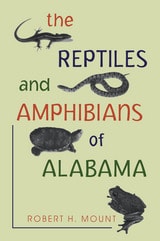
The Reptiles and Amphibians of Alabama
Robert H. Mount
University of Alabama Press, 1980
Generously illustrated, it contains photographs and range maps for each species, showing the specific locality from which each specimen on record was collected. The text includes keys, detailed descriptions, accounts of habitats and life histories, remarks about variations and ecological disturbances, as well as general information on such topics as collecting and care in captivity. The volume is an essential guide for herpetologists of all ages.
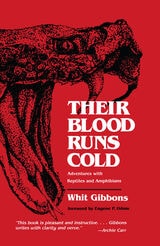
Their Blood Runs Cold
Adventures with Reptiles and AmphibiansWhit Gibbons
University of Alabama Press, 1983
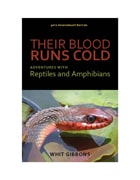
Their Blood Runs Cold
Adventures with Reptiles and AmphibiansWhit Gibbons
University of Alabama Press, 2013
Enter the fascinating world of reptiles and amphibians through the eyes of a pioneering field scientist.
Their Blood Runs Cold is entertaining, informative reading that not only enhances our understanding of a unique group of animals, but also provides genuine insight into the mind and character of a research scientist.
Whit Gibbons possesses the rare talent of conveying the challenge and excitement of scientific inquiry. A research ecologist who specializes in the study of reptiles and amphibians, he gives accounts of work in the field that are as readable as good short stories.
From the dangers of being chased by an angry rattlesnake to the exhilaration of discovering a previously undescribed species, Gibbons brings to life the everyday experiences of the herpetologist as he chases down lizards, turtles, snakes, alligators, salamanders, and frogs in their natural habitats. With essays like “Turtles May Be Slow but They’re 200 Million Years Ahead of Us” and “How to Catch an Alligator in One Uneasy Lesson,” Their Blood Runs Cold both entertains and informs.
The thirtieth anniversary edition of Their Blood Runs Cold features a new prologue and epilogue, additions that address changes in the taxonomy and study of reptiles and amphibians that have occurred since the publication of the original edition and offer suggestions for further reading that highlight the explosion of interest in the topic.