131 books match the query 'Republic of South Africa' and 15 start with a

cover of A Bed Called Home: Life In The Migrant Labour Hostels of Cape Town

A Bed Called Home

Life In The Migrant Labour Hostels of Cape Town

Mamphela Ramphele

Ohio University Press, 1993

In the last three years the migrant labor hostels of South Africa, particularly those in the Transvaal, have gained international notoriety as theaters of violence. For many years they were hidden from public view and neglected by the white authorities. Now, it seems, hostel dwellers may have chosen physical violence to draw attention to the structural violence of their appalling conditions of life. Yet we should not lose sight of the fact that the majority of hostel dwellers are peace-loving people who have over the years developed creative strategies to cope with their impoverished and degrading environment.

In this challenging study, Dr. Mamphela Ramphele documents the life of the hostel dwellers of Cape Town, for whom a bed is literally a home for both themselves and their families. Elaborating the concept of space in its many dimensions—not just physical, but political, ideological, social, and economic as well—she emphasizes the constraints exerted on hostel dwellers by the limited spaces they inhabit. At the same time, she argues that within these constraints people have managed to find room for manoeuvre, and in her book explores the emancipatory possibilities of their environment.

The text is illustrated with a number of black-and-white photographs taken by Roger Meintjes in the townships and hostels.
[more]
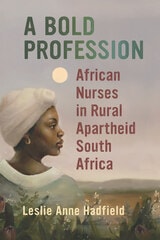
cover of A Bold Profession: African Nurses in Rural Apartheid South Africa

A Bold Profession

African Nurses in Rural Apartheid South Africa

Leslie Anne Hadfield

University of Wisconsin Press, 2023

In rural South African clinics, Black nurses played critical roles. Charged with administering valuable and life-saving health care measures despite a lack of equipment and personnel, these nurses had to navigate the intersections of traditional African healing practices, changing gender relations, and increasing educational and economic opportunities for South Africa’s Black middle class between the 1960s and 1980s.
 
Leslie Anne Hadfield compellingly demonstrates how these women were able to successfully carve out their own professional space and reshape notions of health and healing in the Eastern Cape. Bringing forth the stories of these nurses in their own voices, A Bold Profession is an homage to their dedication to the well-being of their communities. Hadfield sheds light on the struggles of balancing commitment to career and family lives during an oppressive apartheid. The volume fills an important gap for scholars studying the history of women, nursing, and health care in South Africa, illuminating the humanity of health care workers.
[more]
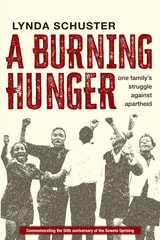
cover of A Burning Hunger: One Family’s Struggle Against Apartheid

A Burning Hunger

One Family’s Struggle Against Apartheid

Lynda Schuster

Ohio University Press, 2006

Reissued for the 50th anniversary of the Soweto Uprising, A Burning Hunger reveals how one family’s courage ignited resistance and forever changed South Africa.

If the Mandelas were the generals in the fight for black liberation, the Mashininis were the foot soldiers. Theirs is a story of exile, imprisonment, torture, and loss, but also of dignity, courage, and strength in the face of appalling adversity. Originally published in Great Britain to critical acclaim, A Burning Hunger: One Family’s Struggle Against Apartheid tells a deeply moving human story and is one of the seminal books about the struggle against apartheid.

This family, Joseph and Nomkhitha Mashinini and their thirteen children, became immersed in almost every facet of the liberation struggle—from guerrilla warfare to urban insurrection. Although Joseph and Nomkhitha were peaceful citizens who had never been involved in politics, five of their sons became leaders in the antiapartheid movement. When the students of Soweto rose up in 1976 to protest a new rule making Afrikaans the language of instruction, they were led by charismatic young Tsietsi Mashinini. Scores of students were shot down and hundreds were injured. Tsietsi’s actions on that day set in motion a chain of events that would forever change South Africa, define his family, and transform their lives.

A Burning Hunger shows the human catastrophe that plagued generations of black Africans in the powerful story of one religious and law-abiding Soweto family. Basing her narrative on extensive research and interviews, Lynda Schuster richly portrays this remarkable family and in so doing reveals black South Africa during a time of momentous change.
[more]
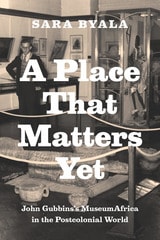
cover of A Place That Matters Yet: John Gubbins's MuseumAfrica in the Postcolonial World

A Place That Matters Yet

John Gubbins's MuseumAfrica in the Postcolonial World

Sara Byala

University of Chicago Press, 2013
A Place That Matters Yet unearths the little-known story of Johannesburg’s MuseumAfrica, a South African history museum that embodies one of the most dynamic and fraught stories of colonialism and postcolonialism, its life spanning the eras before, during, and after apartheid. Sara Byala, in examining this story, sheds new light not only on racism and its institutionalization in South Africa but also on the problems facing any museum that is charged with navigating colonial history from a postcolonial perspective.
 
Drawing on thirty years of personal letters and public writings by museum founder John Gubbins, Byala paints a picture of a uniquely progressive colonist, focusing on his philosophical notion of “three-dimensional thinking,” which aimed to transcend binaries and thus—quite explicitly—racism. Unfortunately, Gubbins died within weeks of the museum’s opening, and his hopes would go unrealized as the museum fell in line with emergent apartheid politics. Following the museum through this transformation and on to its 1994 reconfiguration as a post-apartheid institution, Byala showcases it as a rich—and problematic—archive of both material culture and the ideas that surround that culture, arguing for its continued importance in the establishment of a unified South Africa.
[more]
cover of A Prophet of the People: Isaiah Shembe and the Making of a South African Church

A Prophet of the People

Isaiah Shembe and the Making of a South African Church

Lauren V. Jarvis

Michigan State University Press, 2024

In 1910 Isaiah Shembe was struggling. He had left his family and quit his job as a sanitation worker to become a Baptist evangelist, but he ended his first mission without much to show. Little did he know that he would soon establish the Nazaretha Church as he began to attract attention from people left behind by industrial capitalism in South Africa. By his death in 1935, Shembe was an internationally known prophet and healer, described by his peers as “better off than all the Black people.” In A Prophet of the People: Isaiah Shembe and the Making of a South African Church, historian Lauren V. Jarvis provides a fascinating and intimate portrait of one of South Africa’s most famous religious figures, and in turn the making of modern South Africa. Following Shembe from his birth in the 1860s across many environments and contexts, Jarvis illuminates the tight links between the spread of Christianity, strategies of evasion, and the capacious forms of community that continue to shape South Africa today.
[more]
cover of A Will for the Machine: Computerization, Automation, and the Arts in South Africa

A Will for the Machine

Computerization, Automation, and the Arts in South Africa

Mark Sanders

University of Chicago Press, 2026

This study takes up the relations among computerization, labor, and the arts in South Africa.

There are many books about the history and discourses of computerization in the United States but relatively little about these phenomena anywhere in the Global South. In A Will for the Machine, Mark Sanders outlines South Africa’s entry into the computer age in the 1960s and ’70s and explains how it coincided with the high point of apartheid. South Africa’s government viewed automation and computerization as one way of barring Black Africans from skilled work and reserving it for whites. Sanders unpacks this peculiar history, relates it to early twentieth-century struggles around mechanization in mining and telephony in South Africa, and analyzes responses to it by the writers Miriam Tlali and J. M. Coetzee, the artist William Kentridge, and Handspring Puppet Company. Showing how the arts realize ideas about the ethics and politics of automation, Sanders contributes to debates about locally divergent understandings of computer technology and human-computer interaction.
[more]
cover of Africa South

Africa South

Harm J. de Blij

Northwestern University Press, 1962

Africa South presents a history and description of southern Africa from the arrival of Europeans until the creation of the Republic of South Africa in 1961. Harm J. de Blij provides a portrait of the landscape and the internal policies and struggles within the region. The work serves as a historical travel guide and an introduction to the history of southern Africa. All the maps in Africa South were prepared by the author.
[more]
cover of Africa's World Cup: Critical Reflections on Play, Patriotism, Spectatorship, and Space

Africa's World Cup

Critical Reflections on Play, Patriotism, Spectatorship, and Space

Edited by Peter Alegi and Chris Bolsmann

University of Michigan Press, 2013

Africa’s World Cup: Critical Reflections on Play, Patriotism, Spectatorship, and Spacefocuses on a remarkable month in the modern history of Africa and in the global history of football. Peter Alegi and Chris Bolsmann are well-known experts on South African football, and they have assembled an impressive team of local and international journalists, academics, and football experts to reflect on the 2010 World Cup and its broader significance, its meanings, complexities, and contradictions.

The World Cup’s sounds, sights, and aesthetics are explored, along with questions of patriotism, nationalism, and spectatorship in Africa and around the world. Experts on urban design and communities write on how the presence of the World Cup worked to refashion urban spaces and negotiate the local struggles in the hosting cities. The volume is richly illustrated by authors’ photographs, and the essays in this volume feature chronicles of match day experiences; travelogues; ethnographies of fan cultures; analyses of print, broadcast, and electronic media coverage of the tournament; reflections on the World Cup’s private and public spaces; football exhibits in South African museums; and critiques of the World Cup’s processes of inclusion and exclusion, as well as its political and economic legacies.

The volume concludes with a forum on the World Cup, including Thabo Dladla, Director of Soccer at the University of KwaZulu-Natal, Mohlomi Kekeletso Maubane, a well-known Soweto-based writer and a soccer researcher, and Rodney Reiners, former professional footballer and current chief soccer writer for the Cape Argus newspaper in Cape Town. This collection will appeal to students, scholars, journalists, and fans.

Cover illustration: South African fan blowing his vuvuzela at South Africa vs. France, Free State Stadium, Bloemfontein, June 22, 2010. Photo by Chris Bolsmann.
[more]
cover of After the TRC: Reflections on Truth and Reconciliation

After the TRC

Reflections on Truth and Reconciliation

Wilmot James

Ohio University Press, 2001

Has South Africa dealt effectively with the past, and is the country ready to face the future? What are the challenges facing both government and civil society in the years ahead? These and other questions are explored in this collection of essays by international and local commentators on the Truth and Reconciliation Commission.

A range of perspectives on whether the TRC met its objectives of truth and reconciliation is presented. The areas of particular contention-the payment of reparation, the granting of amnesty, and memorialization-are also examined.

Finally, the major challenges facing South Africa are identified, and ways of meeting these challenges and developing the assets of the nation are explored.

Contributors: Haribert Adam, Kanya Adam, Alex Boraine, Colin Bundy, Mary Burton, John de Gruchy, Richard Goldstone, Willem Heath, Wilmot James, Jeffrey Lever, Mahmood Mamdani, Gary Minkley, Njabulo Ndebele, Dumisa Ntsebeza, Kaizer Nyatsumba, Grace Naledi Pandor, Mamphela Ramphele, Ciraj Rassool, Albie Sachs, Patricia Valdez, Linda van de Vijver, Jan van Eck, Frederik Van Zyl Slabbert, Charles Villa-Vicencio, Francis Wilson, and Leslie Witz

[more]
cover of After the Thrill Is Gone: A Decade of Post-Apartheid South Africa, Volume 103

After the Thrill Is Gone

A Decade of Post-Apartheid South Africa, Volume 103

Grant Farred and Rita Barnard, eds.

Duke University Press, 0

After the Thrill Is Gone is a serious appraisal of what South African democracy has yielded and has failed to yield in the era following the heady expectations of liberation from apartheid’s multiple repressions. Since that time, South Africa has revealed itself as a turbulent, dynamic nation. After the release of black political prisoners in 1990 and the first national democratic election in 1994, its citizens have witnessed a massive increase in crime, unemployment, and poverty and an educational system in chaos.

In a range of politically inflected essays by philosophers, community activists, political scientists, sociologists, literary scholars, and cultural and postcolonial theorists—many of whom are diasporic or resident South Africans—this special issue of SAQ provides a critical look at the realities of black majority governance, at the African National Congress, and at the costs of ANC rule to the populace. One essay draws a condemning sketch of poverty and violence in the townships and the growing communities of squatters that continue despite the emergence of democracy. A philosophical piece contemplates the practice of human rights in a South African society grappling with the memory of apartheid abuses. The fiction and poetry in the collection explore sexual identity, including issues created by the AIDS epidemic, and offer critiques of government policies. Using comic strips, another contributor demonstrates the ability of South African popular culture to satirize the nation’s political status quo. Taken together, the essays in After the Thrill Is Gone open a sobering perspective on South Africa’s recent history, its present, and its future.

Contributors. Rita Barnard, Patrick Bond, Ashwin Desai, Emmanuel Chukwudi Eze, Grant Fared, Michiel Heyns, Shaun Irlam, Neil Lazarus, Michael MacDonald, Zine Magubane, Richard Pithouse, Lesego Rampolokeng, Adam Sitze

[more]
cover of Allies In Adversity: The Frontline States In Southern

Allies In Adversity

The Frontline States In Southern

Gilbert M. Khadiagala

Ohio University Press, 1994

[more]
cover of Apartheid Remains

Apartheid Remains

Sharad Chari

Duke University Press, 2024
In Apartheid Remains, Sharad Chari explores how people handle the remains of segregation and apartheid in South Africa as witnessed through portals in an industrial-residential landscape in the Indian Ocean city of Durban. Through long-term historical and ethnographic research, Chari portrays South Africa’s twentieth century as a palimpsest that conserves the remains of multiple pasts, including attempts by the racial state to remake territory and personhood while instead deepening spatial contradictions and struggles. When South Durban’s denizens collectively mobilized in various ways---through Black Consciousness politics and other attempts at refusing the ruinous articulation of biopolitics, sovereignty, and capital---submerged traditions of the Indian Ocean and the Black Atlantic offered them powerful resources. Of these, Chari reads Black documentary photography as particularly insightful audiovisual blues critique. At the tense interface of Marxism, feminism, and Black study, he offers a method and form of geography attentive to the spatial and embodied remains of history. Apartheid Remains looks out from South Durban to imaginations of abolition of all forms of racial capitalism and environmental suffering that define our planetary predicament.
[more]
cover of Apartheid’s Leviathan: Electricity and the Power of Technological Ambivalence

Apartheid’s Leviathan

Electricity and the Power of Technological Ambivalence

Faeeza Ballim

Ohio University Press, 2023
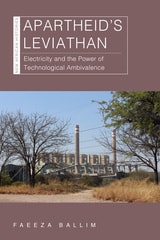
A fascinating study that shows how the intersection of technology and politics has shaped South African history since the 1960s. This book details the development of an interconnected technological system of a coal mine and of the Matimba and Medupi power stations in the Waterberg, a rural region of South Africa near the country’s border with Botswana. South Africa’s state steel manufacturing corporation, Iscor, which has since been privatized, developed a coal mine in the region in the 1970s. This set the stage for the national electricity provider, Eskom, to build coal-fueled power stations in the Waterberg. Faeeza Ballim follows the development of these technological systems from the late 1960s, a period of heightened repression as the apartheid government attempted to realize its vision of racial segregation, to the deeply fraught construction of the Medupi power station in postapartheid South Africa. The Medupi power station was planned toward the end of the first decade of the twenty-first century as a measure to alleviate the country’s electricity shortage, but the continued delay of its completion and the escalation of its costs meant that it failed to realize those ambitions while public frustration and electricity outages grew. By tracing this story, this book highlights the importance of technology to our understanding of South African history. This characterization challenges the idea that the technological state corporations were proxies for the apartheid government and highlights that their activities in the Waterberg did not necessarily accord with the government’s strategic purposes. While a part of the broader national modernization project under apartheid, they also set the stage for worker solidarity and trade union organization in the Waterberg and elsewhere in the country. This book also argues that the state corporations, their technology, and their engineers enjoyed ambivalent relationships with the governments of their time, relationships that can be characterized as both autonomous and immersive. In the era of democracy, while Eskom has been caught up in government corruption—a major scourge to the fortunes of South Africa—it has also retained a degree of organizational autonomy and offered a degree of resistance to those who sought to further corruption. The examination of the workings of these technological systems, and the state corporations responsible for them, complicates conventional understandings of the transition from the authoritarian rule of apartheid to democratic South Africa, which coincided with the transition from state-led development to neoliberalism. This book is an indispensable case study on the workings of industrial and political power in Africa and beyond.
[more]
cover of Archives and Justice

Archives and Justice

Verne Harris

Society of American Archivists, 2007

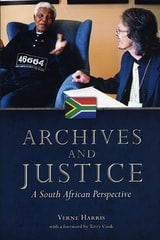
ARCHIVES AND JUSTICE: A SOUTH AFRICAN PERSPECTIVE is collection of Verne Harris's best writing during the first decade of South Africa's post-apartheid democracy. Harris is the project director of the Nelson Mandela Centre of Memory in Johannesburg. While South Africa is his immediate context, Harris always engages wider geographical and conceptual worlds. The volume is organized into five sections. "Discourses" illuminates Harris's engagement with writings and discussions related to archives. "Narratives," the second section, "explores the stories that archivists tell in certain domains of professional work-appraisal, electronic recordmaking, and arrangement and description." The third and fourth sections, "Politics and Ethics" and "Pasts and Secrets," recount and reflect on events and issues with which Harris has wrestled as a South African archivist. The op-eds contained in the final section, "Actualities," provide evidence of Harris's "deliberate endeavors to bring awareness of archive to popular debates in South Africa." Drawing on the energies of Derridean deconstruction, Harris suggests an ethics, and a politics, expressed in the maxim "memory for justice." And he portrays the work of archives as a work of critical importance to the building of democracy.
[more]
cover of Available Light: Omar Badsha and the Struggle for Change in South Africa

Available Light

Omar Badsha and the Struggle for Change in South Africa

Daniel Magaziner

Ohio University Press, 2024

Available Light tells the story of an activist, an artist, a uniquely South African individual, and his community and family across the second half of the twentieth century. Omar Badsha was born in Durban, on the country’s southeastern coast in 1945. His was the third generation of his Gujarati family to call South Africa home. Before he turned five, the country’s white electorate had voted to institute apartheid to strip the rights and privileges of citizenship from most of the population, including Badsha’s Indian community and especially the country’s Black majority. By the time he turned fifteen, nonviolent protest against apartheid had been quashed; by the time he turned twenty, so too had the armed struggle to dislodge white supremacy within the country. The ongoing, resilient, and oft-rebuffed struggle against apartheid was a definitive factor in Badsha’s life. Furthermore, Badsha was raised in a community where art—painting, carving, music, poetry, theater—was inseparable from other values, whether Islamic and conservative or radical and urgently committed. When Badsha struggled in school, he, like his father, turned to art to express what he otherwise had difficulty conveying. Art brought him into contact with people of disparate backgrounds from far beyond Durban. In time, his friendships with other artists helped him refine his voice, first in drawing and eventually in photography, and capture the political ethic by which he strove to live his life and which he shared with similarly committed artist-activists. Daniel Magaziner chronicles how art and politics became intertwined in South Africa and explains what it takes to maintain a critical aesthetic approach to political crises in the past and present. The book tracks the personal and social costs that commitment can incur, while also appreciating how Badsha and others like him have maintained their vision of an equitable, transformed society even today, when the ideals that once animated the South African struggle are on the back foot worldwide.
[more]