Results by title
6 books match the query 'Republicans'
Apostles of Equality
The Birneys, the Republicans, and the Civil WarD. Laurence Rogers
Michigan State University Press, 2011
The first biographical account of the life of James Gillespie Birney in more than fifty years, this fabulously insightful history illuminates and elevates an all-but-forgotten figure whose political career contributed mightily to the American political fabric. Birney was a southern-born politician at the heart of the antislavery movement, with two southern-born sons who were major generals involved in key Union Army activities, including the leadership of the black troops. The interaction of the Birneys with historical figures (Abraham Lincoln, Harriet Beecher Stowe, and Henry Clay) highlights the significance of the family’s activities in politics and war. D. Laurence Rogers offers a unique historiography of the abolition movement, the Civil War, and Reconstruction through the experiences of one family navigating momentous developments from the founding of the Republic until the late 19th century.

History after Liberty
Tacitus on Tyrants, Sycophants, and RepublicansThomas E. Strunk
University of Michigan Press, 2017
History after Liberty explores Tacitus’ political thought through his understanding of liberty. Influenced by modern republican writers such as Quentin Skinner and Philip Pettit, this study defines Tacitean libertas as the freedom from the rule of a dominus and as freedom to participate in the traditional politics of Rome through military service, public service in the senate and magistracies, and public speech. All of these elements are balanced in Tacitus’ writings with examples of those resisting the corruption of politics in an effort to restore a sense of free civic engagement. The work concludes with an exploration of Tacitus’ own writings as an act of restoring liberty. In contrast to most studies on Tacitus, History after Liberty argues that Tacitus is a republican who writes both to demonstrate that Rome had become a tyranny and to show a way out of that tyranny.
History after Liberty addresses the political thought of Tacitus’ writings. As such it will be of most interest to those who study the history and historiography of the early Roman empire, namely classicists and ancient historians. The work will also be of use to those interested in the antecedents to modern political thought, particularly the history of republicanism and freedom; readers from this category will include political scientists, philosophers, and modern historians.
Race, Republicans, and the Return of the Party of Lincoln
Tasha S. Philpot
University of Michigan Press, 2007
Whether their slogan is “compassionate conservatism” or “hawkish liberalism,” political parties have always sought to expand their electoral coalitions by making minor adjustments to their public image. How do voters respond to these, often short-term, campaign appeals? Race, Republicans, and the Return of the Party of Lincoln is Tasha Philpot’s insightful study of how parties use racial images to shape and reshape the way citizens perceive them.
“Philpot has produced a timely, provocative, and nuanced analysis of political party image change, using the Republican Party’s attempts to recast itself as a party sensitive to issues of race with its 2000, and later 2004, national conventions as case examples. Using a mixture of experiments, focus groups, national surveys, and analyses of major national and black newspaper articles, Philpot finds that if race-related issues are important to individuals, such as blacks, the ability of the party to change its image without changing its political positions is far more difficult than it is among individuals who do not consider race-related issues important, e.g., whites. This book makes a major contribution
to our understanding of party image in general, and political parties’ use of race in particular. Bravo!”
—Paula D. McClain, Duke University
“This book does an excellent job of illuminating the linkages between racial images and partisan support. By highlighting Republican efforts to ‘play against type’ Philpot emphasizes the limits of successfully altering partisan images. That she accomplishes this in the controversial, yet salient, domain of race is no small feat. In short, by focusing on a topical issue, and by adopting a novel theoretical approach, Philpot is poised to make a significant contribution to the literatures on race and party images.”
—Vincent Hutchings, University of Michigan
Tasha S. Philpot is Assistant Professor of Government and African and African American Studies at the University of Texas at Austin.
The End of Kings
A History of Republics and RepublicansWilliam R. Everdell
University of Chicago Press, 2000
"[An] energetic, aphoristic, wide-ranging book."—Marcus Cunliffe, Washington Post Book World
"Ambitious in conception and presented in a clear and sprightly prose. . . . [This] excellent study . . . is the best statement of the republican faith since Alphonse Aulard's essays almost a century ago." —Choice
"A book which ought to be in the hand of every American who agrees with Benjamin Franklin that the Founding Fathers gave us a Republic and hoped that we would be able to keep it."-Sam J. Ervin, Jr.
The Irony of the Solid South
Democrats, Republicans, and Race, 1865–1944Glenn Feldman
University of Alabama Press, 2013
Race, Politics, and the Making of the Modern South.
The Irony of the Solid South examines how the south became the “Solid South” for the Democratic Party and how that solidarity began to crack with the advent of American involvement in World War II. Relying on a sophisticated analysis of secondary research—as well as a wealth of deep research in primary sources such as letters, diaries, interviews, court cases, newspapers, and other archival materials—Glenn Feldman argues in The Irony of the Solid South that the history of the solid Democratic south is actually marked by several ironies that involve a concern with the fundamental nature of southern society and culture and the central place that race and allied types of cultural conservatism have played in ensuring regional distinctiveness and continuity across time and various partisan labels. Along the way, this account has much to say about the quality and nature of the New Deal in Dixie, southern liberalism, and its fatal shortcomings.
Feldman focuses primarily on Alabama and race but also considers at length circumstances in the other southern states as well as insights into the uses of emotional issues other than race that have been used time and again to distract whites from their economic and material interests. Feldman explains how conservative political forces (Bourbon Democrats, Dixiecrats, Wallace, independents, and eventually the modern GOP) ingeniously fused white supremacy with economic conservatism based on the common glue of animus to the federal government. A second great melding is exposed, one that joined economic fundamentalism to the religious kind along the shared axis of antidemocratic impulses.
Feldman’s study has much to say about southern and American conservatism, the enduring power of cultural and emotional issues, and the modern south’s path to becoming solidly Republican.
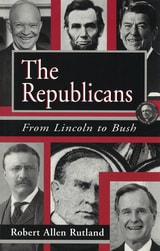
The Republicans
From Lincoln to BushRobert Allen Rutland
University of Missouri Press, 1996
The Republican party has always been fascinating to those who subscribe to its principles, as well as to those who take an alternative stand on the issues. In The Republicans: From Lincoln to Bush, Robert Allen Rutland has brought a clear and concise understanding of this political party to the general reader. The book is a lucid and fast-paced overview of the Republican party from its beginnings in the 1850s through the 1994 congressional elections, which saw the Democratic domination of the House and Senate come to an abrupt end.
In a crisp, highly readable style, Rutland begins by explaining how the "obnoxious" Kansas-Nebraska Act of 1854 overturned the Missouri Compromise, inflamed the North, and caused the collapse of the Whig and American parties. The result was the birth of the Republican party, whose purpose was to oppose the Democrats and stop the spread of slavery. Abraham Lincoln was elected the first Republican president in 1860.
The Republicans suggests that a major shift in voting strength took place twice during the twentieth century, first in the New Deal years, and again after 1968 when the GOP made an appeal to southern voters and finally took control of the area that had previously been dominated by the Democrats. With the 1980 election of Ronald Reagan as the fortieth president of the United States, the Republicans gained support from many first-time voters, middle-class whites, and labor unions-- groups not previously expected to vote Republican. In the companion volume, The Democrats: From Jefferson to Clinton, Rutland provides an honest and straightforward assessment of the strengths and weaknesses of Democratic presidents. Here he presents an evenhanded look at the good and not-so-good Republicans. By skillfully using stories and anecdotes from various administrations to enliven this narrative of political history, Rutland gives Republicans and Democrats alike a deeper appreciation for the two-party system.