Results by title
8 books match the query 'Research libraries'

Assessing Liaison Librarians
Documenting Impact ForDaniel Mack
American Library Association, 2014
[more]

Assessing Liaison Librarians
Documenting Impact for Positive ChangeDaniel C. Mack
Assoc of College & Research Libraries, 2014
[more]
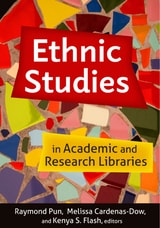
Ethnic Studies in Academic and Research Libraries
Raymond Pun
Assoc of College & Research Libraries, 2021
Supporting ethnic studies is an opportunity to uplift diverse stories and perspectives and to build and affirm such communities and their voices, experiences, and histories. Ethnic studies librarianship requires engagement, a desire to listen and engage with one’s constituents, and a focused approach to re-humanizing and emphasizing the voices of those who are being studied. Race and ethnicity, despite their abstractness, have real, concrete meaning and consequences in American society. Being able to see who speaks and who is silenced matters, and ethnic studies librarianship supports the intellectual journey of students in becoming aware of the various ways we see the world and the numerous stories we tell and come across in our lifetime.
Ethnic Studies in Academic and Research Libraries serves as a snapshot of critical work that library workers are doing to support ethnic studies, including areas focusing on ethnic and racial experiences across the disciplines. Other curriculums or programs may emphasize race, migration, and diasporic studies, and these intersecting areas are highlighted to ensure work supporting ethnic studies is not solely defined by a discipline, but by commitment to programs that uplift underserved and underrepresented ethnic communities and communities of color. Twenty chapters are broken into three thorough sections:
Ethnic Studies in Academic and Research Libraries serves as a snapshot of critical work that library workers are doing to support ethnic studies, including areas focusing on ethnic and racial experiences across the disciplines. Other curriculums or programs may emphasize race, migration, and diasporic studies, and these intersecting areas are highlighted to ensure work supporting ethnic studies is not solely defined by a discipline, but by commitment to programs that uplift underserved and underrepresented ethnic communities and communities of color. Twenty chapters are broken into three thorough sections:
- Instruction, Liaison Engagement, and Outreach
- Collections Projects and Programs
- Collaborations, Special Projects, and Community Partnerships
[more]
Libraries, Leadership, and Scholarly Communication
Essays by Rick AndersonRick Anderson
American Library Association, 2016
[more]
Managing Creativity
The Innovative Research LibraryRonald Jantz
American Library Association, 2016
[more]

Past Imperfect
Essays on History, Libraries, and the HumanitiesLawrence W. Towner
University of Chicago Press, 1993
Lawrence W. Towner was head of one of the country's largest independent research libraries. He was also an eloquent spokesman for the needs of scholars and institutions in the humanities. While at the Newberry Library, he built and focused its prestigious collections, pioneered in the preservation of books, and created major research centers. His efforts established the library as a community of scholars while encouraging its use by students and the general public.
Towner's essays and talks cover a broad range of topics of continuing relevance to scholarship and the humanities. His writings gathered in Past Imperfect are concerned with such issues as the role of independent research libraries and the politics of funding. A section of historical essays on the common people of New England reveal his concern with neglected fields of history, a theme that guided his career as a librarian. Spanning the range of his experience and expertise, this volume expresses Towner's coherent vision of the place of humanities, libraries, and scholarship in American life.
Lawrence W. Towner (1921-92) taught history at M.I.T., the College of William and Mary, and Northwestern University. In 1962 he was appointed librarian of the Newberry Library and directed the library for the next twenty-four years.
[more]
The Managing Creativity
The Innovative Research LibraryRonald Jantz
Assoc of College & Research Libraries, 2016
[more]
The Quality Infrastructure
Measuring, Analyzing, and Improving Library ServicesSarah Anne Murphy
American Library Association, 2013
[more]