Results by title
5 books match the query 'Resentment'
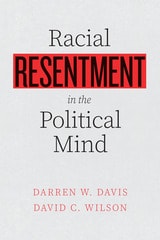
Racial Resentment in the Political Mind
Darren W. Davis and David C. Wilson
University of Chicago Press, 2022
In Racial Resentment in the Political Mind, Darren W. Davis and David C. Wilson challenge the commonly held notion that all racial negativity, disagreements, and objections to policies that seek to help racial minorities stem from racial prejudice. They argue that racial resentment arises from just-world beliefs and appraisals of deservingness that help explain the persistence of racial inequality in America in ways more consequential than racism or racial prejudice alone.
The culprits, as many White people see it, are undeserving people of color, who are perceived to benefit unfairly from, and take advantage of, resources that come at Whites’ expense—a worldview in which any attempt at modest change is seen as a challenge to the status quo and privilege. Yet, as Davis and Wilson reveal, many Whites have become racially resentful due to their perceptions that African Americans skirt the “rules of the game” and violate traditional values by taking advantage of unearned resources. Resulting attempts at racial progress lead Whites to respond in ways that retain their social advantage—opposing ameliorative policies, minority candidates, and other advancement on racial progress. Because racial resentment is rooted in beliefs about justice, fairness, and deservingness, ordinary citizens, who may not harbor racist motivations, may wind up in the same political position as racists, but for different reasons.
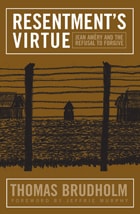
Resentment's Virtue
Jean Amery and the Refusal to ForgiveThomas Brudholm, Foreword by Jeffrie Murphy
Temple University Press, 2010
Most current talk of forgiveness and reconciliation in the aftermath of collective violence proceeds from an assumption that forgiveness is always superior to resentment and refusal to forgive. Victims who demonstrate a willingness to forgive are often celebrated as virtuous moral models, while those who refuse to forgive are frequently seen as suffering from a pathology. Resentment is viewed as a negative state, held by victims who are not "ready" or "capable" of forgiving and healing.
Resentment's Virtue offers a new, more nuanced view. Building on the writings of Holocaust survivor Jean Améry and the work of the South African Truth and Reconciliation Commission, Thomas Brudholm argues that the preservation of resentment can be the reflex of a moral protest that might be as permissible, humane or honorable as the willingness to forgive. Taking into account the experiences of victims, the findings of truth commissions, and studies of mass atrocities, Brudholm seeks to enrich the philosophical understanding of resentment.
Ressentiment
Reflections on Mimetic Desire and SocietyStefano Tomelleri
Michigan State University Press, 2015
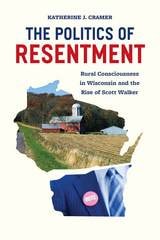
The Politics of Resentment
Rural Consciousness in Wisconsin and the Rise of Scott WalkerKatherine J. Cramer
University of Chicago Press, 2016
With The Politics of Resentment, Katherine J. Cramer uncovers an oft-overlooked piece of the puzzle: rural political consciousness and the resentment of the “liberal elite.” Rural voters are distrustful that politicians will respect the distinct values of their communities and allocate a fair share of resources. What can look like disagreements about basic political principles are therefore actually rooted in something even more fundamental: who we are as people and how closely a candidate’s social identity matches our own. Using Scott Walker and Wisconsin’s prominent and protracted debate about the appropriate role of government, Cramer illuminates the contours of rural consciousness, showing how place-based identities profoundly influence how people understand politics, regardless of whether urban politicians and their supporters really do shortchange or look down on those living in the country.
The Politics of Resentment shows that rural resentment—no less than partisanship, race, or class—plays a major role in dividing America against itself.
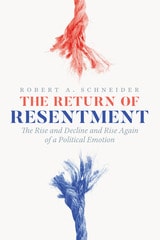
The Return of Resentment
The Rise and Decline and Rise Again of a Political EmotionRobert A. Schneider
University of Chicago Press, 2023
The term “resentment,” often casually paired with words like “hatred,” “rage,” and “fear,” has dominated US news analysis since November 2016. Despite its increased use, this word seems to defy easy categorization. Does “resentment” describe many interlocking sentiments, or is it just another way of saying “anger”? Does it suggest an irrational grievance, as opposed to a legitimate callout of injustice? Does it imply political leanings, or is it nonpartisan by nature?
In The Return of Resentment, Robert A. Schneider explores these questions and more, moving from eighteenth-century Britain to the aftermath of the French Revolution to social movements throughout the twentieth century. Drawing on a wide range of writers, thinkers, and historical experiences, Schneider illustrates how resentment has morphed across time, coming to express a collective sentiment felt by people and movements across the political spectrum. In this history, we discover resentment’s modernity and its ambiguity—how it can be used to dismiss legitimate critique and explain away violence, but also convey a moral stance that demands recognition. Schneider anatomizes the many ways resentment has been used to label present-day movements, from followers of Trump and supporters of Brexit to radical Islamicists and proponents of identity politics. Addressing our contemporary political situation in a novel way, The Return of Resentment challenges us to think critically about the roles different emotions play in politics.