Results by title
4 books match the query 'Resonance'

Law in Film
RESONANCE AND REPRESENTATIONDavid A. Black
University of Illinois Press, 1999
The courtroom, like the movie theater, is an arena for the telling and interpreting of stories. Investigators piece them together, witnesses tell them, advocates retell them, and judges and juries assess their plausibility. These narratives reconstitute absent events through words, and their filming constitutes a double narrative: one important cultural practice rendered in the terms of another.
Drawing on both film studies and legal scholarship, David A. Black explores the implications of representing court procedure, as well as other phases of legal process, in film. His study ranges from an inquiry into the common metaphorical ground between film and law, explored through "the detective" and "the witness," to a critical survey of legal writings about the cinema, to close analyses of key films about law. In examining multiple aspects of law in film, Black sustains a focus on the central importance of narrative while also unearthing the influences—pleasure in film, power in law—that lie beyond the narrative realm. Black's penetrating study treats questions of narrative authority and structure, social authority, and cultural history, revealing the underlying historical, cultural, and cognitive connections between legal and cinematic practices.
Drawing on both film studies and legal scholarship, David A. Black explores the implications of representing court procedure, as well as other phases of legal process, in film. His study ranges from an inquiry into the common metaphorical ground between film and law, explored through "the detective" and "the witness," to a critical survey of legal writings about the cinema, to close analyses of key films about law. In examining multiple aspects of law in film, Black sustains a focus on the central importance of narrative while also unearthing the influences—pleasure in film, power in law—that lie beyond the narrative realm. Black's penetrating study treats questions of narrative authority and structure, social authority, and cultural history, revealing the underlying historical, cultural, and cognitive connections between legal and cinematic practices.
[more]
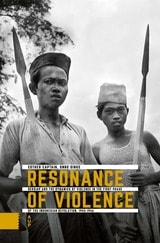
Resonance of Violence
Bersiap and the Dynamics of Violence in the First Phase of the Indonesian Revolution, 1945-1946Esther Captain
Amsterdam University Press, 2026
The battle cry ‘Bersiap!’ resounded in numerous cities and towns across Indonesia during the first months following the declaration of independence on August 17, 1945. Heard from all sides, this call to ‘stand by’ for the young nation’s fight for freedom marked the start of the Indonesian national revolution, heralding a period of extreme violence. These acts of violence were aimed primarily against civilians and served no military purpose. Resonance of Violence outlines the dynamics of this extreme violence in which Indonesian groups took up arms against Indo-Europeans, Moluccans, Dutch and Chinese, but also against Japanese civilians and both Japanese and British (or British Indian) soldiers.
The authors expressly situate this terrifying period within the wider context of mutual Indonesian violence and the use of violence by the Japanese, British and Dutch against Indonesian citizens. Java, Sumatra, and other islands are discussed in the book, as well as the complex issue of the number of victims. Finally, they discuss the development of the term "bersiap" over the past 75 years, which grew into a key concept in the Netherlands to describe the earliest phase of the Indonesian War of Independence.
The authors expressly situate this terrifying period within the wider context of mutual Indonesian violence and the use of violence by the Japanese, British and Dutch against Indonesian citizens. Java, Sumatra, and other islands are discussed in the book, as well as the complex issue of the number of victims. Finally, they discuss the development of the term "bersiap" over the past 75 years, which grew into a key concept in the Netherlands to describe the earliest phase of the Indonesian War of Independence.
[more]
Resonance
Beyond the WordsUnni Wikan
University of Chicago Press, 2012
Resonance gathers together forty years of anthropological study by a researcher and writer with one of the broadest fieldwork résumés in anthropology: Unni Wikan. In its twelve essays—four of which are brand new—Resonance covers encounters with transvestites in Oman, childbirth in Bhutan, poverty in Cairo, and honor killings in Scandinavia, with visits to several other locales and subjects in between. Including a comprehensive preface and introduction that brings the whole work into focus, Resonance surveys an astonishing career of anthropological inquiry that demonstrates the possibility for a common humanity, a way of knowing others on their own terms.
Deploying Clifford Geertz’s concept of “experience-near” observations —and driven by an ambition to work beyond Geertz’s own limitations—Wikan strives for an anthropology that sees, describes, and understands the human condition in the models and concepts of the people being observed. She highlights the fundamentals of an explicitly comparative, person-centered, and empathic approach to fieldwork, pushing anthropology to shift from the specialist discourses of academic experts to a grasp of what the Balinese call keneh— the heart, thought, and feeling of the real people of the world. By deploying this strategy across such a range of sites and communities, she provides a powerful argument that ever-deeper insight can be attained despite our differences.
[more]
The Resonance of Unseen Things
Poetics, Power, Captivity, and UFOs in the American UncannySusan Lepselter
University of Michigan Press, 2016
The Resonance of Unseen Things offers an ethnographic meditation on the “uncanny” persistence and cultural freight of conspiracy theory. The project is a reading of conspiracy theory as an index of a certain strain of late 20th-century American despondency and malaise, especially as understood by people experiencing downward social mobility. Written by a cultural anthropologist with a literary background, this deeply interdisciplinary book focuses on the enduring American preoccupation with captivity in a rapidly transforming world. Captivity is a trope that appears in both ordinary and fantastic iterations here, and Susan Lepselter shows how multiple troubled histories—of race, class, gender, and power—become compressed into stories of uncanny memory.
“We really don’t have anything like this in terms of a focused, sympathetic, open-minded ethnographic study of UFO experiencers. . . . The author’s semiotic approach to the paranormal is immensely productive, positive, and, above all, resonant with what actually happens in history.”
—Jeffrey J. Kripal, J. Newton Rayzor Professor of Religion, Rice University
“Lepselter relates a weave of intimate alien sensibilities in out-off-the-way places which are surprisingly, profoundly, close to home. Readers can expect to share her experience of contact with complex logics of feeling, and to do so in a contemporary America they may have thought they understood.”
—Debbora Battaglia, Mount Holyoke College
“An original and beautifully written study of contemporary American cultural poetics. . . . The book convincingly brings into relief the anxieties of those at the margins of American economic and civic life, their perceptions of state power, and the narrative continuities that bond them to histories of violence and expansion in the American West.”
—Deirdre de la Cruz, University of Michigan
[more]