Results by title
14 books match the query 'Restoration ecology'
Beyond Preservation
Restoring and Inventing LandscapesDwight Baldwin
University of Minnesota Press, 1994
Beyond Preservation was first published in 1993. Minnesota Archive Editions uses digital technology to make long-unavailable books once again accessible, and are published unaltered from the original University of Minnesota Press editions.
Addressing current ecological issues, from the philosophical to the practical, Frederick Turner and William R. Jordan III Here offer a new paradigm for understanding the relationship between the humans and nature. Challenging the idea that preserving nature is the only solution to environmental problems, they advocate going beyond preservation to restoration and actual construction of our landscape. Fifteen respondents reflect on the implications and consequences of Turner’s and Jordan’s bold proposals.“Ecological restoration is the most helpful and provocative contribution to our thinking about nature to come along in many years, and Beyond Preservation is without a doubt the best book on the subject to date.” Michael Polan, Harper’sContributors include Gary W. Barrett, Ann Cline, David L. Gorchov, William Jordan III, G. Stanley Kane, Jack Temple Kirby, Dora G. Lodwick, Orie L. Loucks, Kimberly E. Medley, Constance Pierce, Ellen Price, Frederick Turner, John E. Wierwille, and Gene E. Willeke.
Bombs Away
Militarization, Conservation, and Ecological RestorationDavid G. Havlick
University of Chicago Press, 2018
Looking at particular international sites of transition—from Indiana’s Big Oaks National Wildlife Refuge to Cold War remnants along the former Iron Curtain—Havlick argues that these new frontiers of conservation must accomplish seemingly antithetical aims: rebuilding and protecting ecosystems, or restoring life, while also commemorating the historical and cultural legacies of warfare and militarization. Developing these ideas further, he shows that despite the ecological devastation often wrought by military testing and training, these activities need not be inconsistent with environmental goals, and in some cases can even complement them—a concept he calls ecological militarization. A profound, clear explication of landscapes both fraught and fecund, marked by death but also reservoirs of life, Bombs Away shows us how “military activities, conservation goals, and ecological restoration efforts are made to work together to create new kinds of places and new conceptions of place.”
Ecological Restoration in the Midwest
Past, Present, and FutureChristian Lenhard and Peter C. Smiley, Jr.
University of Iowa Press, 2018
Most people do not realize it, but the Midwest has been at the forefront of ecological restoration longer than perhaps any other region in the United States, dating back to the 1930s. Because of its industrial history, agricultural productivity, and natural features such as the Great Lakes, the Midwest has always faced a unique set of ecological challenges.
Focusing on six cutting-edge case studies that highlight thirty restoration efforts and research sites throughout the region— Iowa, Indiana, Illinois, Wisconsin, Michigan, Minnesota, and Ohio— editors Christian Lenhart and Peter “Rocky” Smiley Jr. bring together a group of scholars and practitioners to show how midwestern restoration efforts have developed, as well as where they are headed. Whether cleaning up contamination from auto plants in Ohio, or restoring native prairie grasses along the Iowa highway, the contributors uncover a vast network of interested citizens and volunteer groups committed to preserving the region’s environment.
This study, intended for researchers, students, and practitioners, also provides an updated synthesis of restoration theory and practice, and pinpoints emerging issues of importance in the Midwest, such as climate change and the increase in invasive species it will bring to the region. Though focusing exclusively on the Midwest, the contributors demonstrate how these case studies apply to restoration efforts across the globe.
Contributors: Luther Aadland, David P. Benson, Andrew F. Casper, Hua Chen, Joe DiMisa, Steve Glass, Heath M. Hagy, John A. Harrington, Neil Haugerud, Constance Hausman, Michael J. Lemke, Christian Lenhart, Jen Lyndall, Dan Shaw, John A. Shuey, Peter C. Smiley Jr., Daryl Smith
Feral
Rewilding the Land, the Sea, and Human LifeGeorge Monbiot
University of Chicago Press, 2014
So what if we stopped hedging? What if we grounded our efforts to solve environmental problems in hope instead, and let nature make our case for us? That’s what George Monbiot does in Feral, a lyrical, unabashedly romantic vision of how, by inviting nature back into our lives, we can simultaneously cure our “ecological boredom” and begin repairing centuries of environmental damage. Monbiot takes readers on an enchanting journey around the world to explore ecosystems that have been “rewilded”: freed from human intervention and allowed—in some cases for the first time in millennia—to resume their natural ecological processes. We share his awe, and wonder, as he kayaks among dolphins and seabirds off the coast of Wales and wanders the forests of Eastern Europe, where lynx and wolf packs are reclaiming their ancient hunting grounds. Through his eyes, we see environmental success—and begin to envision a future world where humans and nature are no longer separate and antagonistic, but are together part of a single, healing world.
Monbiot’s commitment is fierce, his passion infectious, his writing compelling. Readers willing to leave the confines of civilization and join him on his bewitching journey will emerge changed—and ready to change our world for the better.
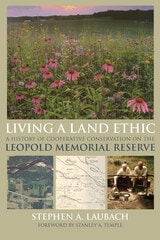
Living a Land Ethic
A History of Cooperative Conservation on the Leopold Memorial ReserveStephen A. Laubach
University of Wisconsin Press, 2014
Living a Land Ethic chronicles the formation of the 1,600-acre reserve surrounding the Shack. When the Leopold Memorial Reserve was founded in 1967, five neighboring families signed an innovative agreement to jointly care for their properties in ways that honored Aldo Leopold's legacy. In the ensuing years, the Reserve's Coleman and Leopold families formed the Sand County Foundation and the Aldo Leopold Foundation. These organizations have been the primary stewards of the Reserve, carrying on a tradition of ecological restoration and cooperative conservation. Author Stephen A. Laubach draws from the archives of both foundations, including articles of incorporation, correspondence, photos, managers' notes, and interviews to share with readers the Reserve's untold history and its important place in the American conservation movement.
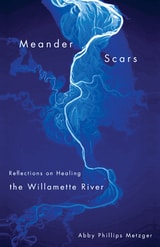
Meander Scars
Reflections on Healing the Willamette RiverAbby Phillips Metzger
Oregon State University Press, 2013
Yet, through canoe trips and intimate explorations of the river, Metzger discovers glints of resiliency: a beaver trolling through a slough, native fish in quiet backwaters, and strong currents that carry undertones of the wild Willamette. Together with tales from farmers and scientists alike, these experiences lead Metzger to ask whether something scarred can fully heal, and whether a disjointed river can be whole again.
A story of re-discovery as told by a learner, Meander Scars will appeal to readers of literary nonfiction, river advocates, naturalists, and outdoor enthusiasts interested in sustaining healthy river systems for themselves, their children, and beyond.
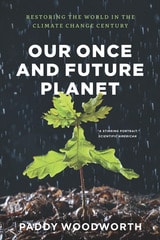
Our Once and Future Planet
Restoring the World in the Climate Change CenturyPaddy Woodworth
University of Chicago Press, 2013
But that paints an unbalanced—and overly disheartening—picture of what’s going on with environmental stewardship today. There are success stories, and Our Once and Future Planet delivers a fascinating account of one of the most impressive areas of current environmental experimentation and innovation: ecological restoration. Veteran investigative reporter Paddy Woodworth has spent years traveling the globe and talking with people—scientists, politicians, and ordinary citizens—who are working on the front lines of the battle against environmental degradation. At sites ranging from Mexico to New Zealand and Chicago to Cape Town, Woodworth shows us the striking successes (and a few humbling failures) of groups that are attempting to use cutting-edge science to restore blighted, polluted, and otherwise troubled landscapes to states of ecological health—and, in some of the most controversial cases, to particular moments in historical time, before widespread human intervention. His firsthand field reports and interviews with participants reveal the promise, power, and limitations of restoration.
Ecological restoration alone won’t solve the myriad problems facing our environment. But Our Once and Future Planet demonstrates the role it can play, and the hope, inspiration, and new knowledge that can come from saving even one small patch of earth.
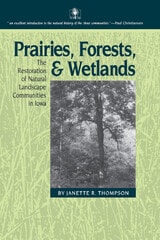
Prairies Forests And Wetlands
Natural Landscape CommunitiesJanette R. Thompson
University of Iowa Press, 1992
Before Euro-American settlement, graceful prairies and prairie-wetland complexes dominated Iowa's rolling landscape, with forest communities hugging rivers and streams and savannas or forests covering the southern and eastern portions of the state. During the last 150 years these original natural communities have nearly been eliminated by conversion of over 95 percent of the land to agricultural and urban uses.
This timely, practical book combines a nontechnical natural history of each native community with a how-to manual for lay restorationists dedicated to reconstructing prairies, forests, and wetlands. Thompson intelligently presents the collective experience of professionals active in restoring the splendid natural areas of Iowa and the greater Midwest—discussing site selection, site preparation, plant species, planting techniques, costs, and maintenance of restoration areas. She includes a useful list of sources for plant materials in and near Iowa as well as information on the birds and mammals, reptiles and amphibians of these landscapes. Prairies, Forests, and Wetlands will help individual landowners, farmers, landscape architects, D.O.T. engineers, teachers, botanists, county conservation boards, and wildlife area managers in their private and professional campaigns to reclaim Iowa's land.
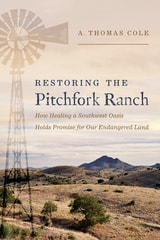
Restoring the Pitchfork Ranch
How Healing a Southwest Oasis Holds Promise for Our Endangered LandA. Thomas Cole
University of Arizona Press, 2024
Restoring the Pitchfork Ranch tells the story of a decades-long habitat restoration project in southwestern New Mexico. A. Thomas Cole explains what inspired him and his wife, Lucinda, to turn their retirement into years dedicated to hard work and renewal. The book shares the past and present history of a very special ranch south of Silver City, which is home to a rare type of regional wetland, a fragile desert grassland ecosystem, archaeological sites, and a critical wildlife corridor in a drought-stricken landscape.
Today the 11,300 acres that make up the Pitchfork Ranch provide an important setting for carbon sequestration, wildlife habitats, and space for the reintroduction of endangered or threatened species. Restoring the Pitchfork Ranch weaves together stories of mine strikers, cattle ranching, and the climate crisis into an important and inspiring call to action. For anyone who has wondered how they can help, the Pitchfork Ranch provides an inspiring way forward.
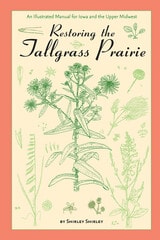
Restoring the Tallgrass Prairie
An Illustrated Manual for Iowa and the Upper MidwestShirley Shirley
University of Iowa Press, 1994
Iowa is the only state that lies entirely within the natural region of the tallgrass prairie. Early documents indicate that 95 percent of the state—close to 30 million acres—was covered by prairie vegetation at the time of Euro-American settlement. By 1930 the prairie sod had been almost totally converted to cropland; only about 30,000 acres of the original “great green sea” remained. Now, in this gracefully illustrated manual, Shirley Shirley has created a step-by-step guide to reconstructing the natural landscape of Iowa and the Upper Midwest.
Chapters on planning, obtaining and selecting plants and seeds, starting seeds indoors, preparing the site, planting, and maintenance set the stage for comprehensive species accounts. Shirley gives firsthand information on soil, moisture, sun, and pH requirements; location, size, and structure; blooming time and color; and propagation, germination, and harvesting for more than a hundred wildflowers and grasses.
Shirley's sketches—all drawn from native plants and from seedlings that she grew herself—will be valuable for even the most experienced gardener. While other books typically feature only the flowering plant, her careful drawings show the three stages of the seedlings, the flower, and the seedhead with seeds as well as the entire plant. This practical and attractive volume will help anyone dedicated to reconstructing the lost “emerald growth” of the historic tallgrass prairie.
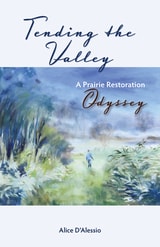
Tending the Valley
A Prairie Restoration OdysseyAlice D'Alessio
Wisconsin Historical Society Press, 2020
In Tending the Valley, Alice chronicles their efforts to return the land to its natural prairie state and to manage their oak and pine woods. Along the way they joined the land restoration movement, became involved in a number of stewardship groups, and discovered the depths of dedication and toil required to bring their dream to fruition. With hard-earned experience and the evocative language of a poet, D’Alessio shares her personal triumphs and setbacks as a prairie steward, along with a profound love for the land and respect for the natural history of the Driftless.
The Bird is Gone
A ManifestoStephen Graham Jones
University of Alabama Press, 2003
A lost pipe holds the power to rewrite a nation.
Cleverly blending alternate history, mystery, and indigenous resurgence, Stephen Graham Jones’s The Bird Is Gone unfolds in a transformed Great Plains where a visionary conservation act has made the land truly “Indian again.” Fourteen years later, a motley crew led by LP Deal converges in a bowling alley within Indian Territories, on a quest for a forgotten treaty pipe—sealed in a locker and flushed into oblivion—that could return all of America to Indigenous hands. Surreal, suspenseful, and richly original, this manifesto of resistance challenges readers to reconsider power, history, and the stakes of reclaiming a stolen world.
The Man Who Created Paradise
A FableGene Logsdon
Ohio University Press, 2001
Gene Logsdon’s The Man Who Created Paradise is a message of hope at a time when the very concept of earth stewardship is under attack. The fable, inspired by a true story, tells how Wally Spero looked at one of the bleakest places in America—a raw and barren strip-mined landscape—and saw in it his escape from the drudgery of his factory job. He bought an old bulldozer and used the machine to carve patiently, acre by acre, a beautiful little farm out of a seemingly worthless wasteland.
Wally’s story is a charming distillation of the themes that the late, beloved Gene Logsdon returned to again and again in his many books and hundreds of articles. Environmental restoration is the task of our time. The work of healing our land begins in our own backyards and farms, in our neighborhoods and our regions. Humans can turn the earth into a veritable paradise—if they really want to.
Noted photographer Gregory Spaid retraced the trail that Logsdon traveled when he was inspired to write The Man Who Created Paradise. His photographs evoke the same yearning for wholeness, for ties to land and community, that infuses the fable’s poetic prose.

The Promise of Multispecies Justice
Sophie Chao, Karin Bolender, and Eben Kirksey, editors
Duke University Press, 2022
Contributors. Karin Bolender, Sophie Chao, M. L. Clark, Radhika Govindrajan, Zsuzsanna Dominika Ihar, Noriko Ishiyama, Eben Kirksey, Elizabeth Lara, Jia Hui Lee, Kristina Lyons, Michael Marder, Alyssa Paredes, Craig Santos Perez, Kim TallBear