Results by title
6 books match the query 'Restructuring'
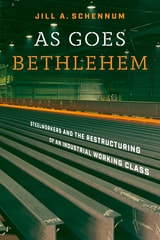
As Goes Bethlehem
Steelworkers and the Restructuring of an Industrial Working ClassJill A. Schennum
Vanderbilt University Press, 2023
Through the experiences and reflections of steelworkers, Jill A. Schennum demonstrates the significance of work, and particularly of industrial work, in giving meaning to people’s lives, identities, and sense of worth. She uses workers’ narratives and voices to show the importance of work space, time, and social relations, rejecting dominant interpretations of blue-collar workers as alienated from their work but well-paid and co-opted by a middle-class standard of living. Schennum covers thirty-five years of investment and disinvestment, managerial initiatives, transfer decisions, layoffs and downsizings, external transfers, the eventual bankruptcy of the Bethlehem Steel Corporation, and movement into retirement, unemployment, and new postindustrial jobs.
The very solidarities, rights of citizenship, and rule of law forged in the mill and built on by the union were constructed, in part, through exclusions based on race, ethnicity, gender, and region. These lines of fracture were mobilized to undermine working-class strength in the postindustrial period. Through the experiences of African American, Puerto Rican, coal country, and women workers in the steel mills, this book explores these issues of fracture and solidarity.
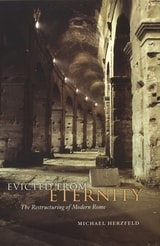
Evicted from Eternity
The Restructuring of Modern RomeMichael Herzfeld
University of Chicago Press, 2009
Modern Rome is a city rife with contradictions. Once the seat of ancient glory, it is now often the object of national contempt. It plays a significant part on the world stage, but the concerns of its residents are often deeply parochial. And while they live in the seat of a world religion, Romans can be vehemently anticlerical. These tensions between the past and the present, the global and the local, make Rome fertile ground to study urban social life, the construction of the past, the role of religion in daily life, and how a capital city relates to the rest of the nation.
Michael Herzfeld focuses on Rome’s historic Monti district and the wrenching dislocation caused by rapid economical, political, and social change. Evicted from Eternity tells the story of the gentrification of Monti—once the architecturally stunning home of a community of artisans and shopkeepers now displaced by an invasion of rapacious real estate speculators, corrupt officials, dithering politicians, deceptive clerics, and shady thugs. As Herzfeld picks apart the messy story of Monti’s transformation, he ranges widely over many aspects of life there and in the rest of the city, richly depicting the uniquely local landscape of globalization in Rome.
Malaysian "Bail Outs"?
Capital Controls, Restructuring and RecoveryTranslated by Wong Sook, K.S. Jomo, and Chin Kok Fay
National University of Singapore Press, 2005
Restructuring the Philadelphia Region
Metropolitan Divisions and InequalityCarolyn Adams, David W. Bartelt, David Elesh and Ira Goldstein with Joshua Freely Michelle Schmitt
Temple University Press, 2008
Restructuring the Philadelphia Region offers one of the most comprehensive and careful investigations written to date about metropolitan inequalities in America’s large urban regions. Moving beyond simplistic analyses of cities-versus-suburbs, the authors use a large and unique data set to discover the special patterns of opportunity in greater Philadelphia, a sprawling, complex metropolitan region consisting of more than 350 separate localities. With each community operating its own public services and competing to attract residents and businesses, the places people live offer them dramatically different opportunities.
The book vividly portrays the region’s uneven development—paying particular attention to differences in housing, employment and educational opportunities in different communities—and describes the actors who are working to promote greater regional cooperation. Surprisingly, local government officials are not prominent among those actors. Instead, a rich network of “third-sector” actors, represented by nonprofit organizations, quasi-governmental authorities and voluntary associations, is shaping a new form of regionalism.
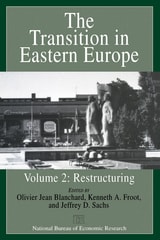
The Transition in Eastern Europe, Volume 2
RestructuringEdited by Olivier Jean Blanchard, Kenneth A. Froot, and Jeffrey D. Sachs
University of Chicago Press, 1994
Volume 1, Country Studies, gives an in-depth, country-by-country analysis of various reform experiences, including historical backgrounds and discussions of policies and results to date. The countries analyzed are Poland, Czechoslovakia, Hungary, eastern Germany, Slovenia, and Russia. Written by leading economists, some of whom helped shape local and national reforms, this volume identifies common progress, common difficulties, and tentative solutions to the problems of economic transition.
Volume 2, Restructuring, focuses on specific issues of transition, including how to design labor market institutions, privatization, new fiscal structures, and bankruptcy laws; how to reorganize foreign trade; and how to promote foreign direct investment. The articles, written by experts in the field, will be of direct help to those involved in the transition process.
These volumes provide a standard reference on economic transition in the region for policymakers in Eastern Europe and in western countries, for international agencies concerned with the transition process, and for anyone interested in learning about the dramatic changes that have recently occurred in Eastern Europe.

WELCOME TO HEIGHTS HIGH
THE CRIPPLING POLITICS OF RESTRUCTURINGDiana Tittle
The Ohio State University Press, 1995