Results by title
13 books match the query 'Resurrection'

Bandido
The Death and Resurrection of Oscar "Zeta" AcostaIlan Stavans
Northwestern University Press, 2003
Hailed as "a fine, learned homage" (Kirkus), "a kaleidoscopic portrait" (Booklist), and "a game of mirrors" (The Washington Post), Bandido is a veritable tour de force. Through interviews and Acosta's writings (published and unpublished), Ilan Stavans reconstructs—even reinvents—the man behind the myth. Part biographical appraisal, part reflection on the legacy of the Civil Rights era, Bandido is an opportunity to understand the challenges and pitfalls Latinos face in finding a place of their own in America.
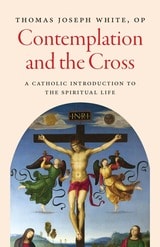
Contemplation and the Cross
A Catholic Introduction to the Spiritual LifeThomas Joseph White, OP
Catholic University of America Press, 2025
On Resurrection
Irven M. St. Albert the Great
Catholic University of America Press, 2020
Paul and the Resurrected Body
Social Identity and Ethical PracticeMatt O'Reilly
SBL Press, 2020
A new reading of Pauline theology, ethics, and eschatology grounded in social-identity theory and sociorhetorical criticism
Readers often think of Paul’s attitude toward the resurrection of the body in individual terms: a single body raised as the climax of an individual’s salvation. In Paul and the Resurrected Body: Social Identity and Ethical Practice, Matt O’Reilly makes the case that, for Paul, the social dimension of future bodily resurrection is just as important, if not more so. Through a close reading of key texts in the letters to the Corinthians, Romans, and Philippians, O’Reilly argues that resurrection is integral to Paul’s understanding of Christian social identity. In Paul’s theological reasoning, a believer’s hope for the future depends on being identified as part of the people of God who will be resurrected.
Features
- A clarification of the eschatological basis for Paul’s ethical expectations
- Exploration of the social significance of Paul’s theological reasoning
- An integration of ancient rhetorical theory with contemporary social-identity theory
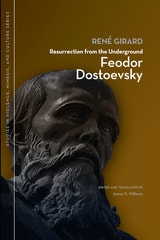
Resurrection from the Underground
Feodor DostoevskyRené Girard
Michigan State University Press, 2012
In a fascinating analysis of critical themes in Feodor Dostoevsky’s work, René Girard explores the implications of the Russian author’s “underground,” a site of isolation, alienation, and resentment. Brilliantly translated, this book is a testament to Girard’s remarkable engagement with Dostoevsky’s work, through which he discusses numerous aspects of the human condition, including desire, which Girard argues is “triangular” or “mimetic”—copied from models or mediators whose objects of desire become our own. Girard’s interdisciplinary approach allows him to shed new light on religion, spirituality, and redemption in Dostoevsky’s writing, culminating in a revelatory discussion of the author’s spiritual understanding and personal integration. Resurrection is an essential and thought-provoking companion to Dostoevsky’s Notes from the Underground.
Resurrection in Paul
Cognition, Metaphor, and TransformationFrederick S. Tappenden
SBL Press, 2016
Explore the embodied foundations of Paul's resurrection ideals
It is commonly recognized that Paul's resurrection ideals are bodily ideals, though this dictum is usually configured along literal and metaphorical lines. The realism of future resurrected bodies is disconnected from the metaphoricity of bodily transformation in the present. Drawing on cognitive linguistics, this fresh and innovative study addresses this problem. By eschewing the opposition of metaphor and realism, Tappenden explores the concepts and metaphors Paul uses to fashion notions of resurrection, and the uses to which those notions are put. Rather than asserting resurrection as a disembodied, cognicentric proposition, this book illuminates the body's central role in shaping and grounding the apostle's thought and writings.
Features:
- Close examination of Paul's letters within multiple, interlocking cultural contexts
- Provides a novel and fresh approach to assessing (in)coherence across the undisputed letters
- Addresses the materialist nature of early Christian and Judean resurrection ideals without compromising the metaphoricity of those ideals
Resurrection of the Animals
Anita Skeen
Michigan State University Press, 2002
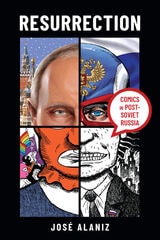
Resurrection
Comics in Post-Soviet RussiaJosé Alaniz
The Ohio State University Press, 2022
Resurrection: Comics in Post-Soviet Russia traces the “kopecks to rubles” journey of Russian comics at the turn of the century. As the follow-up to José Alaniz’s groundbreaking Komiks: Comic Art in Russia (2010), Resurrection authoritatively and exhaustively details the Russian comic landscape of the last three decades: beginning after the 1991 fall of the Soviet Union and encompassing the fourth Putin administration, the COVID-19 crisis, and beyond. Bolstering his analysis with interviews with some of the major figures in Russia’s comics industry, Alaniz particularly focuses on the representation of masculinity, disability, historical trauma, and superheroes, as well as on the recent rise of fandom, alternative micropresses, and nonfiction graphic narrative. Resurrection is a sweeping discussion of the metamorphosis of contemporary Russian comic art from its rebirth to its entry into mainstream culture.
Risen Indeed? Resurrection and Doubt in the Gospel of Mark
Austin Busch
SBL Press, 2022
Risen Indeed? Resurrection and Doubt in the Gospel of Mark traces the literary dynamics and explores the theological dimensions of the Gospel of Mark’s thematization of skepticism regarding resurrection. In every place where it seems to depict resurrection—Jesus's and others'—Mark evades the issue of whether resurrection actually occurs. Austin Busch argues that, despite Mark's abbreviated and ambiguous conclusion, this gospel does not downplay resurrection but rather foregrounds it, imagining Jesus’s death and restoration to life as a divine plot to overcome Satan through cunning deception. Risen Indeed? constitutes a careful literary reading of Mark's Gospel, as well as an assessment of Mark's impact on the traditions of Christian literature and theology that emerged in its wake.
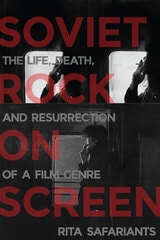
Soviet Rock on Screen
The Life, Death, and Resurrection of a Film GenreRita Safariants
University of Wisconsin Press, 2026
In Soviet Rock on Screen, Rita Safariants chronicles the birth, life, death, and resurrection of a genre that rapidly became one of the most readily recognized cultural signifiers of the perestroika era and which continues to reflect and codify Russian culture. During their initial heyday in the 1980s, rock films were influenced by and encouraged the cultural shifts of perestroika and the incipient political storm. Today, Safariants argues, the reemergence and reconfiguration of the genre indicates the extent to which Soviet-era cultural emblems inform Russian national identity and obliquely support the current political repression under Putin.
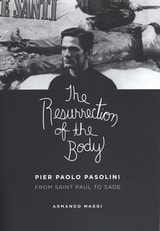
The Resurrection of the Body
Pier Paolo Pasolini from Saint Paul to SadeArmando Maggi
University of Chicago Press, 2009
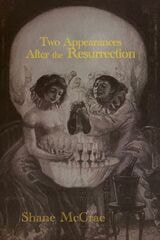
Two Appearances After the Resurrection
Shane McCrae
Omnidawn, 2025
This is a book about perceiving and being perceived. The various subjects of these poems are viewed by an artist, a devil, a soul floating out of a body it had inhabited, a god fed up with her husband’s infidelities, and a father whose young child has COVID-19. The poems of Two Appearances After the Resurrection are haunted by the question of what one ought to do with their perceivability.
After a decade of publishing poems almost exclusively utilizing no punctuation aside from the slash, Shane McCrae began including semi-regular punctuation in his 2023 book, The Many Hundreds of the Scent. He continues that project in Two Appearances After the Resurrection. Here, he further explores the consequences—especially the rhythmical consequences—of the change. Throughout these poems, McCrae perceives and implicitly considers his own shifting approaches to writing.
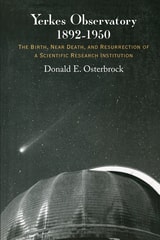
Yerkes Observatory, 1892-1950
The Birth, Near Death, and Resurrection of a Scientific Research InstitutionDonald E. Osterbrock
University of Chicago Press, 1996