Results by title
10 books match the query 'Retailing'

Big Box USA
The Environmental Impact of America’s Biggest Retail StoresBart Elmore
University of Wyoming Press, 2023
The rise of big box retail since the 1960s has transformed environments on both local and global scales. Almost everyone has explored the aisles of big box stores. The allure of “everyday low prices” and brightly colored products of every kind connect shoppers with a global marketplace. Contributors join a growing conversation between business and environmental history, addressing the ways American retail institutions have affected physical and cultural ecologies around the world. Essays on Walmart, Target, Cabela’s, REI, and Bass Pro Shops assess the “bigness” of these superstores from “smokestacks to coat racks” and contend that their ecological impacts are not limited to the footprints of parking lots and manufacturing but also play a didactic role in educating consumers about their relationships with the environment.
A model for historians seeking to bring business and environmental histories together in their analyses of merchant capital’s role in the landscapes of everyday life and how it has remade human relationships with nature, Big Box USA is a must-read for students and scholars of the environment, business, sustainability, retail professionals, and a general audience.
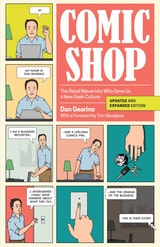
Comic Shop
The Retail Mavericks Who Gave Us a New Geek CultureDan Gearino
Ohio University Press, 2019
The modern comic book shop was born in the early 1970s. Its rise was due in large part to Phil Seuling, the entrepreneur whose direct market model allowed shops to get comics straight from the publishers. Stores could then better customize their offerings and independent publishers could access national distribution. Shops opened up a space for quirky ideas to gain an audience and helped transform small-press series, from Teenage Mutant Ninja Turtles to Bone, into media giants.
Comic Shop is the first book to trace the history of these cultural icons. Dan Gearino brings us from their origins to the present-day, when the rise of digital platforms and a changing retail landscape have the industry at a crossroads. When the book was first published in 2017, Gearino had spent a year with stores around the country, following how they navigated the business. For this updated and expanded paperback edition, he covers the wild retail landscape of 2017 and 2018, a time that was brutal for stores and rich for comics as an art form.
Along the way he interviews pioneers of comics retailing and other important players, including many women; top creators; and those who continue to push the business in new directions. A revised guide to dozens of the most interesting shops around the United States and Canada is a bonus for fans.

Franchising Dreams
The Lure of Entrepreneurship in AmericaPeter M. Birkeland
University of Chicago Press, 2002
Peter M. Birkeland worked for three years in the front-line operations of franchise units for three companies, met with CEOs and executives, and attended countless trade shows, seminars, and expositions. All this firsthand experience gave him unprecedented access to the hopes and aspirations of franchisees. His book closely traces different franchisees and follows them as their dreams of wealth and independence buckle beneath the weight of frustrating logistics and contractual technicalities. Through extensive interviews and research, Birkeland not only discovers what makes franchisees succeed or fail, he uncovers the difficulties in running a business according to someone else's system and values. Bearing witness to a market flooded with fierce competitors and dependent on the inscrutable whims of consumers, he uncovers the numerous challenges that franchisees face in making their businesses succeed.

History of Pedlars in Europe
Laurence Fontaine
Duke University Press, 1996
Focusing primarily on the fifteenth through eighteenth centuries, Fontaine traces the origins and development of peddling and the establishment of trading networks. She analyzes the changing social construction of the practice and the effect of encounters between traders of different regions. Following the pedlars’ trade routes across Europe from Spain to Sweden and Scotland to the upper Rhine, she examines their importance as channels of communication as well as of goods and raises such issues as the impact of pedlars on the values and cultural practices of the communities they visited and the ways in which being merchants changed the lives of these migrants.
History of Pedlars in Europe separates the mythology that surrounds peddling from the historically reliable and integrates existing studies with new archival research to illuminate one of the most remote areas of the social and economic history of early modern Europe. A means of trade based on mobility, uncertainty, and interdependence, peddling is rediscovered as a dynamic force involved in nothing less than the creation of a modern consumer society.

L. S. Ayres and Company
The Store at the Crossroads of AmericaKenneth L. Turchi
Indiana Historical Society Press, 2012

Point of Sale
Analyzing Media RetailDaniel Herbert
Rutgers University Press, 2020

Sales and Celebrations
Retailing and Regional Identity in Western New York State, 1920–1940Sarah Elvins
Ohio University Press, 2004
Between the two world wars, the retail world experienced tremendous changes. New forms of competition, expanded networks of communication and transportation, and the proliferation of manufactured goods posed challenges to department store and small shopkeeper alike.
In western New York, and in Buffalo and Rochester in particular, retailers were a crucial part of urban life, acting as cultural brokers and civic leaders. They were also cultivators of area pride. Even as they adopted the latest merchandising techniques or stocked the newest items, merchants emphasized their local roots and their ability to put a local spin on national trends and innovations. Regional identity became a powerful selling tool not only during the prosperity of the 1920s but also through the economic crisis of the Great Depression.
Sales and Celebrations explains how local traditions and institutions affected the evolution of American consumer culture. It expands our understanding of American consumerism, demonstrating that local particularities and loyalties could often coexist with, and occasionally challenge, the spread of mass consumption. In her award-winning study, Professor Sarah Elvins provides new insight into the relationship between America’s largest metropolises and its smaller centers. Retailers in Buffalo and Rochester did not simply imitate the practices of their counterparts in Manhattan and Chicago; they highlighted their unique ability to serve the wants and needs of their particular markets.
By drawing attention to this persistent power of the local, Sales and Celebrations illuminates a neglected aspect of the story of American culture in the interwar period.
Small Privatization
The Transformation of Retail Trade and Consumer Services in the Czech Republic, Hungary and PolandRoman Frydman
Central European University Press, 1994
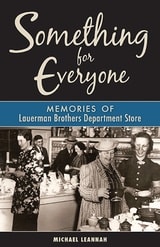
Something for Everyone
Memories of Lauerman Brothers Department StoreMichael Leanah
Wisconsin Historical Society Press, 2013
This book traces the history of the Lauerman enterprise and its importance to the community of Marinette and dozens of counties in northern Wisconsin and the UP. The author takes readers on a tour of the store’s most memorable and delightful features, from the plethora of merchandise offered to the record-listening booths to the famous frosted malt cones. Along the way we hear the recollections of dozens of former customers and employees whose memories form a unique tapestry of family, business, and community story. As it brings to life the people who worked and shopped at Lauermans, Something for Everyone will have readers fondly recalling their own favorite shopping destinations during the golden age of department stores.
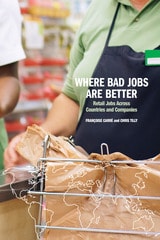
Where Bad Jobs Are Better
Retail Jobs Across Countries and CompaniesFrancoise Carre
Russell Sage Foundation, 2017
In surveying retail work across the United States, Carré and Tilly find that the majority of retail workers receive low pay and nearly half work part-time, which contributes to high turnover and low productivity. Jobs staffed predominantly by women, such as grocery store cashiers, pay even less than retail jobs in male-dominated fields, such as consumer electronics. Yet, when comparing these jobs to similar positions in Western Europe, Carré and Tilly find surprising differences. In France, though supermarket cashiers perform essentially the same work as cashiers in the United States, they receive higher pay, are mostly full-time, and experience lower turnover and higher productivity. And unlike the United States, where many retail employees are subject to unpredictable schedules, in Germany, retailers are required by law to provide their employees notice of work schedules six months in advance.
The authors show that disparities in job quality are largely the result of differing social norms and national institutions. For instance, weak labor regulations and the decline of unions in the United States have enabled retailers to cut labor costs aggressively in ways that depress wages and discourage full-time work. On the other hand, higher minimum wages, greater government regulation of work schedules, and stronger collective bargaining through unions and works councils have improved the quality of retail jobs in Europe.
As retail and service work continue to expand, American employers and policymakers will have to decide the extent to which these jobs will be good or bad. Where Bad Jobs Are Better shows how stronger rules and regulations can improve the lives of retail workers and boost the quality of low-wage jobs across the board.