Results by title
3 books match the query 'Rethinking Race'
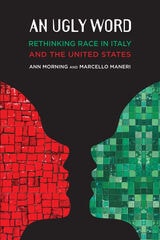
An Ugly Word
Rethinking Race in Italy and the United StatesAnn Morning
Russell Sage Foundation, 2022
Morning and Maneri interviewed over 150 people across the two countries about differences among what they refer to as “descent-based groups.” Using this concept allowed them to sidestep the language of “race” and “ethnicity,” which can be unnecessarily narrow, poorly defined, or even offensive to some. Drawing on these interviews, the authors find that while ways of speaking about group difference vary considerably across the Atlantic, underlying beliefs about it do not. The similarity in American and Italian understandings of difference was particularly evident when discussing sports. Both groups relied heavily on traditional stereotypes of Black physicality to explain Black athletes’ overrepresentation in sports like U.S. football and their underrepresentation in sports like swimming – contradicting the claims that a biological notion of race is a distinctly American phenomenon.
While American and Italian concepts of difference may overlap extensively, they are not identical. Interviews in Italy were more likely to reveal beliefs about groups’ innate, unchangeable temperaments, such as friendly Senegalese and dishonest Roma. And where physical difference was seen by Italians as superficial and unimportant, cultural difference was perceived as deeply meaningful and consequential. In contrast, U.S. interviewees saw cultural difference as supremely malleable—and often ascribed the same fluidity to racial identity, which they believed stemmed from culture as well as biology. In light of their findings, Morning and Maneri propose a new approach to understanding cross-cultural beliefs about descent-based difference that includes identifying the traits people believe differentiate groups, how they believe those traits are acquired, and whether they believe these traits can change.
An Ugly Word is an illuminating, cross-national examination of the ways in which people around the world make sense of race and difference.
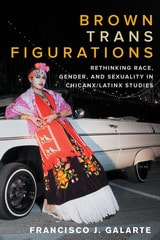
Brown Trans Figurations
Rethinking Race, Gender, and Sexuality in Chicanx/Latinx StudiesBy Francisco J. Galarte
University of Texas Press, 2021
Honorable Mention for the National Women’s Studies Association's 2021 Gloria E. Anzaldúa Book Prize
2021 Finalist Best LGBTQ+ Themed Book, International Latino Book Awards
2022 John Leo & Dana Heller Award for Best Single Work, Anthology, Multi-Authored, or Edited Book in LGBTQ Studies, Popular Culture Association
The Alan Bray Memorial Book Prize, GL/Q Caucus, Modern Language Association (MLA)
2022 AAHHE Book of the Year Award, American Association of Hispanics in Higher Education
Within queer, transgender, and Latinx and Chicanx cultural politics, brown transgender narratives are frequently silenced and erased. Brown trans subjects are treated as deceptive, unnatural, nonexistent, or impossible, their bodies, lives, and material circumstances represented through tropes and used as metaphors. Restoring personhood and agency to these subjects, Francisco J. Galarte advances “brown trans figuration” as a theoretical framework to describe how transness and brownness coexist within the larger queer, trans, and Latinx historical experiences.
Brown Trans Figurations presents a collection of representations that reveal the repression of brown trans narratives and make that repression visible and palpable. Galarte examines the violent deaths of two transgender Latinas and the corresponding narratives that emerged about their lives, analyzes the invisibility of brown transmasculinity in Chicana feminist works, and explores how issues such as transgender politics can be imagined as part of Chicanx and Latinx political movements. This book considers the contexts in which brown trans narratives appear, how they circulate, and how they are reproduced in politics, sexual cultures, and racialized economies.
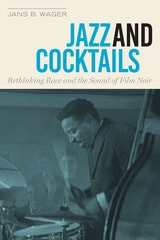
Jazz and Cocktails
Rethinking Race and the Sound of Film NoirBy Jans B. Wager
University of Texas Press, 2017
Film noir showcased hard-boiled men and dangerous femmes fatales, rain-slicked city streets, pools of inky darkness cut by shards of light, and, occasionally, jazz. Jazz served as a shorthand for the seduction and risks of the mean streets in early film noir. As working jazz musicians began to compose the scores for and appear in noir films of the 1950s, black musicians found a unique way of asserting their right to participate fully in American life.
Jazz and Cocktails explores the use of jazz in film noir, from its early function as a signifier of danger, sexuality, and otherness to the complex role it plays in film scores in which jazz invites the spectator into the narrative while simultaneously transcending the film and reminding viewers of the world outside the movie theater. Jans B. Wager looks at the work of jazz composers such as Miles Davis, Duke Ellington and Billy Strayhorn, Chico Hamilton, and John Lewis as she analyzes films including Sweet Smell of Success, Elevator to the Gallows, Anatomy of a Murder, Odds Against Tomorrow, and considers the neonoir American Hustle. Wager demonstrates how the evolving role of jazz in film noir reflected cultural changes instigated by black social activism during and after World War II and altered Hollywood representations of race and music.