Results by title
52 books match the query 'Return' and 4 start with a

A Return to Servitude
Maya Migration and the Tourist Trade in CancúnM. Bianet Castellanos
University of Minnesota Press, 2010
As a free trade zone and Latin America's most popular destination, Cancún, Mexico, is more than just a tourist town. It is not only actively involved in the production of transnational capital but also forms an integral part of the state's modernization plan for rural, indigenous communities. Indeed, Maya migrants make up over a third of the city's population.
A Return to Servitude is an ethnography of Maya migration within Mexico that analyzes the foundational role indigenous peoples play in the development of the modern nation-state. Focusing on tourism in the Yucatán Peninsula, M. Bianet Castellanos examines how Cancún came to be equated with modernity, how this city has shaped the political economy of the peninsula, and how indigenous communities engage with this vision of contemporary life. More broadly, she demonstrates how indigenous communities experience, resist, and accommodate themselves to transnational capitalism.
Tourism and the social stratification that results from migration have created conflict among the Maya. At the same time, this work asserts, it is through engagement with modernity and its resources that they are able to maintain their sense of indigeneity and community.
[more]

A return to the village
community ethnographies and the study of Andean culture in retrospectiveEdited by Francisco Ferreira and Billie Jean Isbell
University of London Press, 2016
This edited volume brings together several scholars who have produced outstanding ethnographies of Andean communities, mostly in Peru but also in neighbouring countries. These ethnographies were published between the 1970s and 2000s, following different theoretical and thematic approaches, and they often transcended the boundaries of case studies to become important reference works on key aspects of Andean culture: for example, the symbolism and ritual uses of coca in the case of Catherine J. Allen; agricultural rituals and internal social divisions in the case of Peter Gose; social organisation and kinship in the case of Billie Jean Isbell; the use of khipus and concepts of literacy in the case of Frank Salomon; and the management and ritual dimensions of water and irrigation in the case of Ricardo Valderrama and Carmen Escalante. In their chapters the authors revisit their original works in the light of contemporary anthropology, focusing on different academic and personal aspects of their ethnographies. For example, they explain how they chose the communities they worked in; the personal relations they established there during fieldwork; the kind of links they have maintained; and how these communities have changed over time. They also review their original methodological and theoretical approaches and findings, reassessing their validity and explaining how their views have evolved or changed since they originally conducted their fieldwork and published their studies. This book also offers a review of the evolution and role of community ethnographies in the context of Andean anthropology. These ethnographies had a significant influence between the 1940s and 1980s, when they could be roughly divided – following Olivia Harris – between ‘long-termist’ and ‘short-termist’ approaches, depending on predominant focuses on historical continuities or social change respectively. However, by the 1990s these works came to be widely considered as too limited and subjective in the context of wider academic changes, such as the emergence of postmodern trends, and reflective and literary turns in anthropology. Overall, the book aims to reflect on this evolution of community ethnographies in the Andes, and on their contribution to the study of Andean culture.
[more]
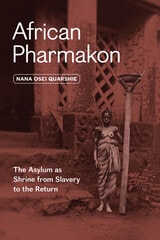
African Pharmakon
The Asylum as Shrine from Slavery to the ReturnNana Osei Quarshie
University of Chicago Press, 2025
Explores how psychiatry in Ghana was never just about medicine; it was about migration, exile, and the politics of who gets to stay and who must be cast out.
For centuries, mental distress in West Africa has been subject to a mix of healing, harming, ritual, and regulation. In African Pharmakon, Nana Osei Quarshie questions conventional narratives about colonial psychiatry. Instead of displacing African therapeutic traditions, he argues, European psychiatric institutions in fact built upon them, adapting long-standing techniques of social control and healing.
With a focus on Ghana, Quarshie explores the shifting landscape of West African mental health practices, tracking their transformation from shrine-based rituals to colonial asylums and modern psychiatric institutions. Combining extensive archival research and ethnographic fieldwork, including the first scholarly examination of patient records from the Accra Psychiatric Hospital, Quarshie identifies five enduring techniques that have shaped the treatment of mental distress: spiritual pawning, logging, manhunting, mass expulsion, and pharmacotherapy.
Rejecting the simplistic opposition of Indigenous healing versus colonial oppression, African Pharmakon provides a nuanced account of how psychiatric care in Ghana became a tool of empowerment as well as exclusion. This pioneering study reframes our understanding of psychiatry and mental health governance in West Africa, past and present.
[more]

After the Ice Age
The Return of Life to Glaciated North AmericaE. C. Pielou
University of Chicago Press, 1991
The fascinating story of how a harsh terrain that resembled modern Antarctica has been transformed gradually into the forests, grasslands, and wetlands we know today.
[more]