Results by title
4 books match the query 'Revealing'
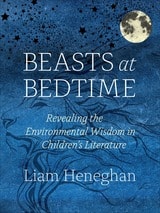
Beasts at Bedtime
Revealing the Environmental Wisdom in Children’s LiteratureLiam Heneghan
University of Chicago Press, 2018
In Beasts at Bedtime, scientist (and father) Liam Heneghan examines the environmental underpinnings of children’s stories. From Beatrix Potter to Harry Potter, Heneghan unearths the universal insights into our inextricable relationship with nature that underlie so many classic children’s stories. Some of the largest environmental challenges in coming years—from climate instability, the extinction crisis, freshwater depletion, and deforestation—are likely to become even more severe as this generation of children grows up. Though today’s young readers will bear the brunt of these environmental calamities, they will also be able to contribute to environmental solutions if prepared properly. And all it takes is an attentive eye: Heneghan shows how the nature curriculum is already embedded in bedtime stories, from the earliest board books like The Rainbow Fish to contemporary young adult classics like The Hunger Games.
Beasts at Bedtime is an awakening to the vital environmental education children’s stories can provide—from the misadventures of The Runaway Bunny to more overt tales like The Lorax. Heneghan serves as our guide, drawing richly upon his own adolescent and parental experiences, as well as his travels in landscapes both experienced and imagined. Organized into thematic sections, the work winds its way through literary forests, colorful characters, and global environments.
This book enthralls as it engages. Heneghan as a guide is as charming as he is insightful, showing how kids (and adults) can start to experience the natural world in incredible ways from the comfort of their own rooms. Beasts at Bedtime will help parents, teachers, and guardians extend those cozy times curled up together with a good book into a lifetime of caring for our planet.

Black Light
Revealing the Hidden History of Photography and CinemaChristophe Wall-Romana
University of Minnesota Press, 2026
A radical assessment of the racial motives underlying the conception of photography and cinema
Conventional histories have long traced the origins of photography and cinema to the goal of reproducing the visible world. Black Light offers a radical counter to this understanding. Investigating the optical, cosmological, and racial thought that surrounded their conception, Christophe Wall-Romana argues that these media developed out of a desire to visualize what cannot be seen.
Taking as its starting point the concurrent invention of the telescope and industrialization of the transatlantic slave trade, Black Light shows how photography and cinema are entangled with two key preoccupations of the Enlightenment: visualizing the mysteries of the cosmos and managing Blackness. Wall-Romana uses literary and technological sources to demonstrate how racial and astronomical thinking interwove throughout the long development of our modern visual media. Retracing the impulses behind nonmimetic photoimaging and dynamic modeling, he exposes the racial underpinnings of research on photosensitive compounds such as silver nitrate and the racist lenses applied in post-Copernican cosmology.
Black Light charts the pivotal period from the seventeenth through the nineteenth century when Europeans were reckoning with “multiple worlds” and natural philosophy was giving way to “mechanical objectivity.” Wall-Romana shows how engagement with the nature of light was always entangled with racist discourses on Blackness—especially after the 1801 discovery of the invisible spectrum and its paradox of “black light.” Deprovincializing media archaeology, this book presents a groundbreaking historical framework with which to reenvision our dominant modes of seeing and understanding the world.
Retail e-book files for this title are screen-reader friendly with images accompanied by short alt text and/or extended descriptions.
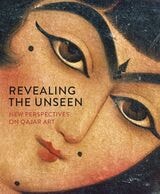
Revealing the Unseen
New Perspectives on Qajar ArtEdited by Melanie Gibson and Gwenaëlle Fellinger
Gingko, 2022
The thirteen articles in this volume were originally given as presentations at the symposium of the same name organized in June 2018 by the Musée du Louvre and the Musée du Louvre-Lens in conjunction with the exhibition The Empire of Roses: Masterpieces of 19th Century Persian Art. The exhibition explored the art of Iran in the nineteenth and early twentieth centuries, while the nation was under the rule of the Qajar dynasty. The symposium set out to present research on previously unknown and unpublished objects from this rich period of art history.
This volume, published with the Louvre Museum in France, is divided into four sections. The first, “Transitions and Transmissions,” is dedicated to the arts of painting, illumination, and lithography. The focus of the second section, entitled “The Image Revealed,” also considers works on paper, looking at new themes and techniques. “The Material World” examines the use of materials such as textiles, carpets, and armor. The articles in the final section discuss the history of two groups of artifacts acquired by their respective museums.
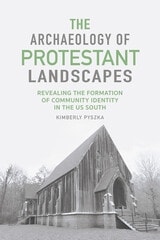
The Archaeology of Protestant Landscapes
Revealing the Formation of Community Identity in the US SouthKimberly Pyszka
University of Alabama Press, 2023
How religious institutions used landscapes and architecture to express their religious and social ideologies
The Archaeology of Protestant Landscapes focuses on three religious institutions in the US South in the eighteenth and nineteenth centuries: St. Paul’s Parish Church in coastal South Carolina, St. Luke’s Episcopal Church in central Alabama, and Cane Hill College in Northwest Arkansas. Drawing from archaeological surveys and excavations, artifact analysis, archival research, geophysical testing, and architectural information on religious structures, Kimberly Pyszka offers case studies of these institutions, which were located in developing communities that varied socially, politically, and economically.
Pyszka uses these case studies to demonstrate that select religious institutions used and modified natural landscape features to create cultural landscapes to express their ideology, identity, goals, and social, religious, and political power. She notes that where those structures were constructed, how they sat on the landscape, their architectural style, and their overall visual appearance were well-considered decisions made by religious leaders to benefit their organizations, communities, and, sometimes, themselves.
Pyszka also uses these case studies to highlight the social roles that religious organizations played in the development of communities. She points to landscape decisions—specifically to how the architectural design of religious structures was used, intentionally or not, to unite people, often those of differing religious backgrounds—as contributing to the creation of a common identity among people living in new and still-growing settlements, aiding in community development. This book contributes to the growing body of work within historical archaeology on churches, churchyards, and cemeteries and to the increasing awareness among archaeologists of how these sites contribute to questions of identity, consumerism, trade, and colonialism.