Results by title
4 books match the query 'Revenge in literature'

Murderous Feeling
Gender and Retribution in Black and Indigenous LiteratureChad Benito Infante
University of Minnesota Press, 2026
Examining revenge narratives as a feminist response to slavery and settler colonialism
From Octavia Butler’s Kindred to The Round House by Louise Erdrich, themes of retribution resound throughout the work of renowned Black and Indigenous women and queer authors. Revealing how the Black Power Movement and the American Indian Movement influenced literature from the 1960s onward, Murderous Feeling explores how these writers have employed revenge narratives as a response to white supremacy and colonialism.
Chad Benito Infante shows how, rather than using retributive violence to cultivate a heroic, masculine ideal, Black and Native women and queer writers use revenge as a way to raise philosophical questions about justice and the reclamation of power in the face of white supremacy. Pairing canonical texts—including work by James Baldwin, Leslie Marmon Silko, Craig Womack, Toni Morrison, and others—he demonstrates how this uniquely queer and feminist literary tradition, the “grammar of interrogation,” allows for generative ambivalence and curiosity about the possibilities and failures of violence.
In highlighting these narratives’ potential to steer anticolonial efforts, Murderous Feeling reconceptualizes literary violence not as an individualized act of cleansing but as a tool for revolutionary inquiry.
Retail e-book files for this title are screen-reader friendly.
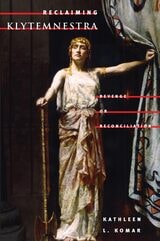
Reclaiming Klytemnestra
REVENGE OR RECONCILIATIONKathleen L. Komar
University of Illinois Press, 2003
By slaying her husband, Klytemnestra exposed the competing ethics of motherhood and matrimony at the beginnings of the Western tradition. In this interdisciplinary study, Kathleen L. Komar first examines the classical archetype of Klytemnestra established by writers such as Aeschylus, Sophocles, and Euripides. Turning to the twentieth century, she investigates the work of modern writers who, since the 1960s, have reconceptualized Klytemnestra’s actions and motivations in the contemporary contexts of dance, fiction, drama, poetry, and the Internet. These revisions include a Martha Graham ballet; a performance piece by multiple authors; a play by Dacia Maraini; novels by Christa Reinig, Nancy Bogen, Christa Wolf, and Marie Cardinal; a short story by Christine Brückner; a poem by Laura Kennelly; a mixed-genre piece by Séverine Auffret; and two Internet presentations.
Eloquent, provocative, and richly detailed, Reclaiming Klytemnestra asks us to reassess the roles women were assigned at the beginnings of Western culture and to reenvision how those roles might be changed in the new millennium.

Renaissance Revivals
City Comedy and Revenge Tragedy in the London Theater, 1576-1980Wendy Griswold
University of Chicago Press, 1986
The Captive Woman's Lament in Greek Tragedy
By Casey Dué
University of Texas Press, 2006
The laments of captive women found in extant Athenian tragedy constitute a fundamentally subversive aspect of Greek drama. In performances supported by and intended for the male citizens of Athens, the songs of the captive women at the Dionysia gave a voice to classes who otherwise would have been marginalized and silenced in Athenian society: women, foreigners, and the enslaved. The Captive Woman's Lament in Greek Tragedy addresses the possible meanings ancient audiences might have attached to these songs. Casey Dué challenges long-held assumptions about the opposition between Greeks and barbarians in Greek thought by suggesting that, in viewing the plight of the captive women, Athenian audiences extended pity to those least like themselves. Dué asserts that tragic playwrights often used the lament to create an empathetic link that blurred the line between Greek and barbarian.
After a brief overview of the role of lamentation in both modern and classical traditions, Dué focuses on the dramatic portrayal of women captured in the Trojan War, tracing their portrayal through time from the Homeric epics to Euripides' Athenian stage. The author shows how these laments evolved in their significance with the growth of the Athenian Empire. She concludes that while the Athenian polis may have created a merciless empire outside the theater, inside the theater they found themselves confronted by the essential similarities between themselves and those they sought to conquer.