Results by title

7 books match the query 'Revolution, 1954-1962'

cover of Abduction

Abduction

Anouar Benmalek

Haus Publishing, 2011

Drawn together by the tortured memory of a massacre years ago, a shared experience binds Mathieu, Tahar and Aziz, and has repercussions for Meriem and Chehra, Aziz's wife and daughter. Chehra is abducted, and the kidnapper's brutal demands and threats of violent torture turn this into a tense thriller. But how far will Aziz go to save his family?
[more]
cover of Algerian Diary: Frank Kearns and the "Impossible Assignment" for CBS News

Algerian Diary

Frank Kearns and the "Impossible Assignment" for CBS News

Gerald Davis

West Virginia University Press, 2016

Frank Kearns was the go-to guy at CBS News for danger- ous stories in Africa and the Middle East in the 1950s, ‘60s, and early ‘70s. By his own account, he was nearly killed 114 times. He took stories that nobody else wanted to cover and was challenged to get them on the air when nobody cared about this part of the world. But his stories were warning shots for conflicts that play out in the headlines today.

In 1957, Senator John Kennedy described America’s view of the Algerian war for independence as the Eisenhower Administration’s “head in the sand policy.” So CBS News decided to find out what was really happening there and to determine where Algeria’s war for independence fit into the game plan for the Cold War. They sent Frank Kearns to find out.

Kearns took with him cameraman Yousef (“Joe”) Masraff and 400 pounds of gear, some of which they shed, and they hiked with FLN escorts from Tunisia, across a wide “no-man’s land,” and into the Aures Mountains of eastern Algeria, where the war was bloodiest. They carried no passports or visas. They dressed as Algerians. They refused to bear weapons. And they knew that if captured, they would be executed and left in unmarked graves. But their job as journalists was to seek the truth whatever it might turn out to be.

This is Frank Kearns’s diary. 

 
[more]
cover of Sex, France, and Arab Men, 1962–1979

Sex, France, and Arab Men, 1962–1979

Todd Shepard

University of Chicago Press, 2017

The aftermath of Algeria’s revolutionary war for independence coincided with the sexual revolution in France, and in this book Todd Shepard argues that these two movements are inextricably linked.​

Sex, France, and Arab Men is a history of how and why—from the upheavals of French Algeria in 1962 through the 1970s—highly sexualized claims about Arabs were omnipresent in important public French discussions, both those that dealt with sex and those that spoke of Arabs. Shepard explores how the so-called sexual revolution took shape in a France profoundly influenced by the ongoing effects of the Algerian revolution. Shepard’s analysis of both events alongside one another provides a frame that renders visible the ways that the fight for sexual liberation, usually explained as an American and European invention, developed out of the worldwide anticolonial movement of the mid-twentieth century.
[more]
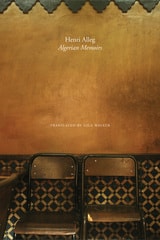
cover of The Algerian Memoirs: Days of Hope and Combat

The Algerian Memoirs

Days of Hope and Combat

Henri Alleg

Seagull Books, 2011

The personal history of journalist Henri Alleg is tied inextricably to the history of the French-Algerian Conflict. Best known for his book The Question, a first-hand account of his torture by French troops during the Algerian war for independence, Alleg is famous both for having brought the issue of French torture to the public eye and for his passionate work as a writer, a newspaperman, and a communist activist.
Beginning with his arrival in Algiers in 1939, when he fell immediately in love with the vibrant city, to his departure in 1965, after Boumédienne seized power, this is a critical work of history made devastatingly personal. Algerian Memoirs recounts his experience under the Vichy regime and such watershed moments in colonial history as the infamous Battle of Algiers. In these pages, he relives the violence and the summary executions, the communist struggle, and his party’s strained relations with the National Liberation Front. And, of course, he revisits in stark detail his arrest and torture by the French, his years in prison, and eventual escape to Czechoslovakia.
 
In the telling of his own story, Alleg explores some of the key events in the history of Europe and North Africa and in the history of the radical press. This is an irreplaceable document of colonialism and its tragic aftermath.
[more]
cover of The Harkis: The Wound That Never Heals

The Harkis

The Wound That Never Heals

Vincent Crapanzano

University of Chicago Press, 2011

In this haunting chronicle of betrayal and abandonment, ostracism and exile, racism and humiliation, Vincent Crapanzano examines the story of the Harkis, the quarter of a million Algerian auxiliary troops who fought for the French in Algeria’s war of independence. After tens of thousands of Harkis were massacred by other Algerians at the end of the war, the survivors fled to France where they were placed in camps, some for as long as sixteen years. Condemned as traitors by other Algerians and scorned by the French, the Harkis became a population apart, and their children still suffer from their parents’ wounds. Many have become activists, lobbying for recognition of their parents’ sacrifices, compensation, and an apology.

More than just a retelling of the Harkis’ grim past and troubling present, The Harkis is a resonant reflection on how children bear responsibility for the choices their parents make, how personal identity is shaped by the impersonal forces of history, and how violence insinuates itself into every facet of human life.

[more]
cover of The Visual Afterlife of Abdelkader Bennahar

The Visual Afterlife of Abdelkader Bennahar

Robert Desjarlais

Duke University Press, 2025
On the night of October 17, 1961, thousands of Algerians peacefully demonstrated in the streets of Paris, protesting an illegal curfew imposed upon them by the French colonial government. The Paris police responded with deadly violence, by some accounts killing over two hundred people and wounding countless others. One of the victims was Abdelkader Bennahar, who was seriously beaten in Nanterre, a commune just west of Paris. Jewish-French photographer Élie Kagan took a number of photographs of Bennahar as he lay bleeding in the street. Bennahar was brought to a Nanterre hospital and reportedly died the next night. In The Visual Afterlife of Abdelkader Bennahar, Robert Desjarlais analyzes Kagan’s photographs and their affective force and political significance from the moment they first circulated through the decades that followed. By drawing on Kagan’s photographs and archival records to consider the trace remnants of Bennahar’s life and the fate of his body in death, Desjarlais offers a compelling account of one person’s “life death” through complicated strands of time and memory.
[more]
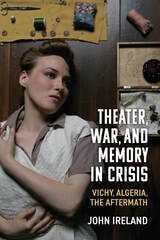
cover of Theater, War, and Memory in Crisis: Vichy, Algeria, the Aftermath

Theater, War, and Memory in Crisis

Vichy, Algeria, the Aftermath

John Ireland

University of Michigan Press, 2025

Theater, War, and Memory in Crisis explores how French and Algerian dramatists have engaged with two traumatic events that continue to haunt France: the German occupation and Vichy government from 1940 to 1944 and the Algerian War from 1954 to 1962. John Ireland’s investigation is guided by one central question: can theater take on issues of violence, war trauma, and conflicted memory in a fundamentally different way from archival forms of culture such as memoirs, narrative fiction, and film? Throughout the twentieth century, French cultural anthropologists, classicists, and social scientists repeatedly revisited links between archaic religious ritual, the practice of sacrifice, and Greek tragedy as attempts to understand, regulate, and mitigate the violence of human conflict and war. Ireland argues that contemporary French playwrights dealing with war trauma and contested memory were influenced by aspects of this research that foregrounded the core virtues of oral culture: presence and the present, the “here and now” that also regulate theatrical performance. That connection to the present encouraged dramatists and performance artists to make “live” historiographical contributions to reverberating, unresolved history but also revived perennial therapeutic values of oral culture that evolved in ancient Greece. Theater, War, and Memory in Crisis brings original readings of canonical authors like Jean-Paul Sartre, Jean Genet, Bernard-Marie Koltès, and Kateb Yacine into dialogue with non-canonical dramatists such as Armand Gatti, Liliane Atlan, and Noureddine Aba. 
[more]