Results by title
6 books match the query 'Revolution, 1959'
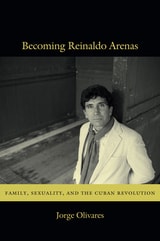
Becoming Reinaldo Arenas
Family, Sexuality, and The Cuban RevolutionJorge Olivares
Duke University Press, 2013
Through insightful close readings of a selection of Arenas's works, including unpublished manuscripts and correspondence, Olivares examines the writer's personal, political, and artistic trajectory, focusing on his portrayals of family, sexuality, exile, and nostalgia. He documents Arenas's critical engagement with cultural and political developments in revolutionary Cuba and investigates the ways in which Arenas challenged literary and national norms. Olivares's analysis shows how Arenas drew on his life experiences to offer revealing perspectives on the Cuban Revolution, the struggles of Cuban exiles, and the politics of sexuality.
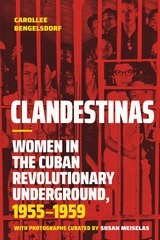
Clandestinas
Women in the Cuban Revolutionary Underground, 1955–1959Carollee Bengelsdorf. With Photographs Curated by Susan Meiselas.
Duke University Press, 2025
Exporting Revolution
Cuba's Global SolidarityMargaret Randall
Duke University Press, 2017

The Cuban Revolution in the 21st Century
George Lambie
Pluto Press, 2010
While most books and articles on Cuba seek to analyse the island’s socialist experiment from the perspective of internal dynamics or international relations, this book attempts to understand the revolutionary process as part of a counter-current against neoliberal globalisation.
Rather than presenting Cuba as a socialist survivor, whose performance must be measured against the standards set by the ‘international community’, George Lambie judges Cuban socialism on the goals which the revolution sets for itself. He shows that despite Cuba’s isolation in the ‘New World Order’, and the enormous pressures it has faced to ‘conform’, its faith in an alternative socialist project has continued and grown.
Now that neoliberalism is in crisis, Cuba’s promotion of socialist values is finding a renewed relevance. In this fascinating study Lambie argues that Cuba is again becoming a symbol, and practical example, of socialism in action. This book is essential reading for students of politics and Latin American studies.
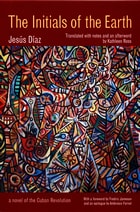
The Initials of the Earth
Jesús Díaz
Duke University Press, 2006
Originally written in the 1970s, then rewritten and published simultaneously in Havana and Madrid in 1987, The Initials of the Earth spans the tumultuous years from the 1950s until the 1970s, encompassing the Revolution and its immediate aftermath. The novel opens as the protagonist, Carlos Pérez Cifredo, sits down to fill out a questionnaire for readmission to the Cuban Communist Party. It closes with Carlos standing before a panel of Party members charged with assessing his merit as an “exemplary worker.” The chapters between relate Carlos’s experiences of the pre- and postrevolutionary era. His family is torn apart as some members reject the Revolution and flee the country while others, including Carlos, choose to stay. He witnesses key events including the Bay of Pigs invasion, the Cuban missile crisis, and the economically disastrous sugar harvest of 1970. Throughout the novel, Díaz vividly renders Cuban culture through humor, slogans, and slang; Afro-Cuban religion; and references to popular music, movies, and comics.
This edition of The Initials of the Earth includes a bibliography and filmography of Diaz’s works and a timeline of the major events of the Cuban revolutionary period. In his epilogue, the Cuban writer Ambrosio Fornet reflects on Díaz’s surprising 1992 renunciation of the Revolution, their decades-long friendship, and the novel’s reception, structure, and place within Cuban literary history.
The Revolution from Within
Cuba, 1959–1980Michael J. Bustamante and Jennifer L. Lambe, editors
Duke University Press, 2019
Contributors. Michael J. Bustamante, María A. Cabrera Arús, María del Pilar Díaz Castañón, Ada Ferrer, Alejandro de la Fuente, Reinaldo Funes Monzote, Lillian Guerra, Jennifer L. Lambe, Jorge Macle Cruz, Christabelle Peters, Rafael Rojas, Elizabeth Schwall, Abel Sierra Madero