Results by title
6 books match the query 'Revolutionary War'
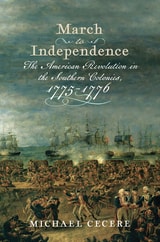
March to Independence
The Revolutionary War in the Southern Colonies, 1775–1776Michael Cecere
Westholme Publishing, 2027
The Independence Trilogy
The American Revolutionary War began when Massachusetts militiamen and British troops clashed at Lexington and Concord on April 19, 1775. Two months later, a much larger engagement occurred at Bunker Hill in Boston. The conflict then expanded into a continent-wide war for independence from Great Britain. Or so we are taught. A closer look at events in the South in the eighteen months following Lexington and Concord tells different story. The practice of teaching the Revolutionary War as one generalized conflict between the American colonies and Great Britain assumes the South’s support for the Revolutionary War was a foregone conclusion. However, once shots were fired, it was not certain that the southern colonies would support the independence movement. What is clear is that both the fledgling American republic and the British knew that the southern colonies were critical to any successful prosecution of the war by either side.
In March to Independence: The American Revolution in the Southern Colonies, 1775–1776, historian Michael Cecere, consulting primary source documents, examines how Virginia, North Carolina, South Carolina, and Georgia ended up supporting the colonies to the north, while East Florida remained within the British sphere. South Carolina, Georgia, and East Florida all retained their royal governors through the summer of 1775, and no military engagements occurred in any of the southern colonies in the six months following the battles in Massachusetts. The situation changed significantly in the fall, however, with armed clashes in Virginia and South Carolina; by early 1776 the war had spread to all of the southern colonies except East Florida. Although their march to independence did not follow the exact route as the colonies to the north, events in the South pulled the southern colonists in the same direction, culminating with a united Declaration of Independence on July 4, 1776. This book explores the crucial events in the southern colonies that led all but East Florida to support the American cause.
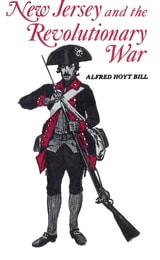
New Jersey and The Revolutionary War
Bill, Alfred
Rutgers University Press, 1970
Bill introduces us to the people who were responsible for winning the war and shaping the future of our country, people such as George Washington, General Hugh Mercer, Thomas Paine, Alexander Hamilton, James Monroe, and Thomas Marshall. He also portrays other colorful figures, such as Benedict Arnold, and British officers, including Howe, Cornwallis, and RaIl. Alfred Bill has produced that rare species of history book that reads like an exciting adventure story. He not only presents the facts, but clearly illuminates them with pertinent background information. Clearly written and highly readable, this book will be enjoyed by everyone from students 10 serious historians.

The Revolutionary War
Jeremy Black
St. Augustine's Press, 2025
Military historian Jeremy Black follows his engagement with the American Civil War (St. Augustine's Press, 2025) with a review of the Revolutionary War in North America and the strategic asymmetry it presents. This was a key episode for global affairs and formative for the United States, but also fascinating for military history as a whole. Black's earlier treatment of this war (1991) remains operational, but he thought it "necessary to revisit the subject and reconsider not only the specifics of assessment, but also the more general ways of analyzing and presenting the struggle."
Black's rendering of the war is accurate, well researched, and successfully hits his target without undue speculation. Identifying all the factors at play is one of Black's strengths, as is his sober restraint in applying hindsight while evaluating leadership and campaigns throughout. His field of vision is expansive and refers to the global theatre when offering any kind of final statements––for example, in his claim that the Revolution was largely lost long after the conclusion of battles, and that Canada in British hands underlined the failure of revolutionary efforts and the embodiment of continued threats.
The Revolutionary War is a masterful treatment of an historical event and also the very nature of revolutionary warfare. Black is a fair-handed assessor of 'American' interests and strategic politics, and likewise observant in explaining that Britain was not entirely bested by the revolution even in losing the war. His discussion of the aftermath is as critical as his illustration of the beginning of hostilities, as in his chapter dedicated to "heritages, lessons, and retrospectives." Black is one of the most important and prolific historians of his generation, a writer whose concise and thorough manner renders readers in the United States a refreshing service of understanding their history more deeply.
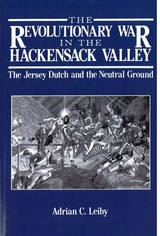
The Revolutionary War in the Hackensack Valley
The Jersey Dutch and the Neutral Ground, 1775-1783Leiby, Adrian C.
Rutgers University Press, 1980
Adrian Leiby offers an exciting narrative of the people of Dutch New Jersey and New York during this conflict. Historians will find colorful details about the Revolutionary War, and genealogists will find much previously unpublished material on hundreds of men and women of Dutch New Jersey and New York in the 1700s.
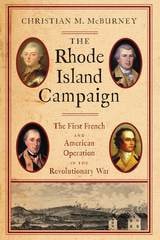
The Rhode Island Campaign
The First French and American Operation in the Revolutionary WarChristian M. McBurney
Westholme Publishing, 2011
The Marquis de Lafayette and the French Navy join Nathanael Green, John Sullivan, and a Continental Army to Attach a British Stronghold in New England
On July 29, 1778, a powerful French naval squadron sailed confidently to the entrance of Narragansett Bay. Its appearance commenced the first joint French and American campaign of the Revolutionary War. The new allies’ goal was to capture the British garrison at Newport, Rhode Island. With British resolve reeling from the striking patriot victory at Saratoga the previous autumn, this French and American effort might just end the war.
As the French moved into the bay, surprised British captains scuttled or burned many of their vessels rather than risk capture, resulting in the most significant loss of warships suffered by the British navy during the war. French Admiral Comte d’Estaing then turned to sea to engage the main British fleet but his ships were scattered and damaged by a huge storm. After his flagship and two other ships were attacked, d’Estaing’s squadron was taken out of the campaign. The American army under General John Sullivan, meanwhile, was stranded on a small island near Newport without the expected French naval support. When they tried to retreat off the island, British and Hessian regulars were sent to destroy Sullivan’s army; instead of a rout, a running battle ensued that lasted for more than six hours. Continentals, brimming with confidence after their training during the winter of Valley Forge, once more proved that they were an effective fighting force. While the Rhode Island Campaign ended in failure for the Americans and French, there were positive signs for the future of the alliance and the Revolution.
The Rhode Island Campaign: The First French and American Operation of the Revolutionary War unravels one of the most complex and multi-faceted events of the war, one which combined land and sea strategies and featured controversial decisions on both sides. Many prominent patriots participated, including Nathanael Greene, Marquis de Lafayette, John Hancock, and Paul Revere. Most important, while the campaign’s failure led to harsh criticism of the French in some quarters, leaders such as Greene, Lafayette, and George Washington steadfastly worked to ensure that the alliance would remain intact, knowing that the next joint operation could well succeed. Relying on in-depth research from American, French, British, and German original sources, author Christian McBurney has written the most authoritative book on this fascinating episode in American history.
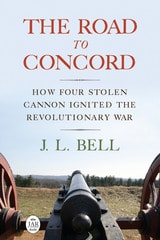
The Road to Concord
How Four Stolen Cannon Ignited the Revolutionary WarJ. L. Bell
Westholme Publishing, 2016
In the early spring of 1775, on a farm in Concord, Massachusetts, British army spies located four brass cannon belonging to Boston’s colonial militia that had gone missing months before. British general Thomas Gage had been searching for them, both to stymie New England’s growing rebellion and to erase the embarrassment of having let cannon disappear from armories under redcoat guard. Anxious to regain those weapons, he drew up plans for his troops to march nineteen miles into unfriendly territory. The Massachusetts Patriots, meanwhile, prepared to thwart the general’s mission. There was one goal Gage and his enemies shared: for different reasons, they all wanted to keep the stolen cannon as secret as possible. Both sides succeeded well enough that the full story has never appeared until now.
The Road to Concord: How Four Stolen Cannon Ignited the Revolutionary War by historian J. L. Bell reveals a new dimension to the start of America’s War for Independence by tracing the spark of its first battle back to little-known events beginning in September 1774. The author relates how radical Patriots secured those four cannon and smuggled them out of Boston, and how Gage sent out spies and search parties to track them down. Drawing on archives in the United States, United Kingdom, and Canada, the book creates a lively, original, and deeply documented picture of a society perched on the brink of war.