Results by title
2 books match the query 'Revolutionary literature'

Politicizing Gender
Narrative Strategies in the Aftermath of the French RevolutionKadish, Doris Y
Rutgers University Press, 1991
It is Doris Kadish's contention in this book that gender and politics went hand-in-hand in the nineteenth century; that nineteenth-century works can often be read as retellings of the French Revolution; and that the political meanings of these works can be gleaned through the study of narrative strategies that she chooses to call "semiotic readings." Building on the work of Marina Warner, Lynn Hunt, Joan Landes, Nancy Armstrong, Foucault and others, she shows how the strategy of politicizing gender during and after the revolution served many functions--among them to articulate representations of revolution, to form the nineteenth-century public sphere, to constitute bourgeois ideology, to distance the unruly masses, and ultimately, perhaps, to express a deep seated fear of women as a threat to the status quo. Looking at the French and English novel, and even selected relevant paintings in this way, she is able to read much-read texts in new and refreshing ways. She shows us how a collective story or master narrative of the revolution was retold and refashioned throughout the century, even where we might least expect to find it. She looks first at small details in order to see the larger patterns, and is among the first to show us how semiotics may make a contribution to gender studies.
[more]
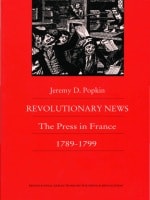
Revolutionary News
The Press in France, 1789–1799Jeremy D. Popkin
Duke University Press, 1990
The newspaper press was an essential aspect of the political culture of the French Revolution. Revolutionary News highlights the most significant features of this press in clear and vivid language. It breaks new ground in examining not only the famous journalists but the obscure publishers and the anonymous readers of the Revolutionary newspapers. Popkin examines the way press reporting affected Revolutionary crises and the way in which radical journalists like Marat and the Pere Duchene used their papers to promote democracy.
[more]