Results by title
3 books match the query 'Revolutions in literature'
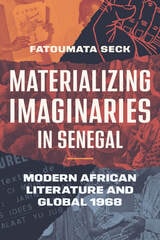
Materializing Imaginaries in Senegal
Modern African Literature and Global 1968Fatoumata Seck
Duke University Press, 2026

Women, Guerrillas, and Love
Understanding War in Central AmericaIleana RodriguezTranslated by Ileana Rodriguez and Robert Carr
University of Minnesota Press, 1996
Women, Guerrillas, and Love was first published in 1996. Minnesota Archive Editions uses digital technology to make long-unavailable books once again accessible, and are published unaltered from the original University of Minnesota Press editions.
How can literature show us what went awry in the process of liberation, and in the construction of a different, better world? Ileana Rodriguez pursues this question through a reading of "politically committed" literature—texts produced within the context of Latin American guerrilla movements. Che Guevara's diary, testimonios by Omar Cabezas and Tomás Borge, novels and short stories by Sergio Ramírez and Arturo Arias: These are among the works Rodriguez examines.
Rodriguez seeks to pinpoint the relationship between the collective and woman, and between woman and the nation-state. Women, Guerrillas, and Love challenges current assumptions about the relationship of gender and sexuality to writing and state building during revolutionary moments. Employing several theoretical paradigms—Marxism, feminism, deconstruction—these readings take into account the "implosion" of socialist or socialist-like societies responding to the expansion of positivistic cultures. The book participates in the debate over the subjugation of insolvent nationstates to the mandates of the market, and the consequent substitution of economic master narratives for historical ones.
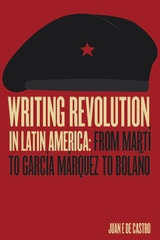
Writing Revolution in Latin America
From Martí to García Márquez to BolañoJuan E. De Castro
Vanderbilt University Press, 2019
In the politically volatile period from the 1960s through the end of the twentieth century, Latin American authors were in direct dialogue with the violent realities of their time and place. Writing Revolution in Latin America is a chronological study of the way revolution and revolutionary thinking is depicted in the fiction composed from the eye of the storm.
From Mexico to Chile, the gradual ideological evolution from a revolutionary to a neoliberal mainstream was a consequence of, on the one hand, the political hardening of the Cuban Revolution beginning in the late 1960s, and, on the other, the repression, dictatorships, and economic crises of the 1970s and beyond. Not only was socialist revolution far from the utopia many believed, but the notion that guerrilla uprisings would lead to an easy socialism proved to be unfounded. Similarly, the repressive Pinochet dictatorship in Chile led to unfathomable tragedy and social mutation.
This double-edged phenomenon of revolutionary disillusionment became highly personal for Latin American authors inside and outside Castro's and Pinochet's dominion. Revolution was more than a foreign affair, it was the stuff of everyday life and, therefore, of fiction.
Juan De Castro's expansive study begins ahead of the century with José Martí in Cuba and continues through the likes of Mario Vargas Llosa in Peru, Gabriel García Márquez in Colombia, and Roberto Bolaño in Mexico (by way of Chile). The various, often contradictory ways the authors convey this precarious historical moment speaks in equal measure to the social circumstances into which these authors were thrust and to the fundamental differences in the ways they themselves witnessed history.