Results by title
14 books match the query 'Rewriting'

Abandoned Women
Rewriting the Classics in Dante, Boccaccio, and ChaucerSuzanne Hagedorn
University of Michigan Press, 2003
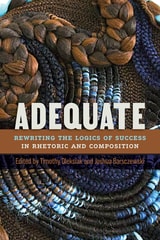
Adequate
Rewriting the Logics of Success in Rhetoric and CompositionTimothy Oleksiak
Utah State University Press, 2025
Fourteen essays from established scholars, ranging from deeply personal, to darkly humorous, to impassioned and blunt, offer theoretical and pragmatic resources for responding to unjust labor extraction and the discipline’s demands that teachers do it all. Drawing on an array of intellectual traditions including labor studies, feminist rhetoric, disability studies, Jewish rhetoric, and theories of writing program administrations, authors assert the reasonable position of being enough and thriving outside of work in the face of growing demands for professional excellence and even perfection.
Adequate reimagines what the concept of adequacy holds for the future of academic work. An invaluable resource for scholars, graduate students, and advanced undergraduate students in the rhetoric and composition field, this volume covers the realities of teaching rhetoric and composition in the modern college environment, as well as potential paths forward for educators in need of a better work-life balance.
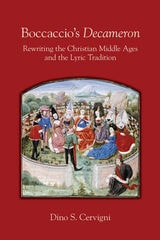
Boccaccio's "Decameron"
Rewriting the Christian Middle Ages and the Lyric TraditionDino S. Cervigni
Arizona Center for Medieval and Renaissance Studies, 2021
This study develops a new interpretation of The Decameron, Giovanni Boccaccio’s masterpiece, which has found new popularity in the wake of COVID. Dino S. Cervigni offers an inclusive and novel reading of the collection, theorizing that the first ninety tales offer a parodic rewriting of the Christian Middle Age, while the last ten tales craft a reconstruction of society based on human and liberal principles such as generosity and sacrifice.
Still relevant to this day, The Decameron offers a notable description of the bubonic plague of 1348 which devastated Western Europe—drawing striking parallels with the current global pandemic. Furthermore, Boccaccio’s concluding message applies to all of us in the present moment, plunged as we are into a world of intellectual and ethical chaos, exhorting us to practice forgiveness, compassion, tolerance, mutual acceptance, and generous open-mindedness. No other book on The Decameron offers such a relevant, up-to-date reading of the classic work.
Media Amnesia
Rewriting the Economic CrisisLaura Basu
Pluto Press, 2018
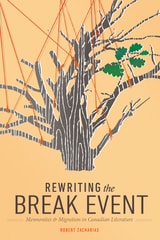
Rewriting the Break Event
Mennonites and Migration in Canadian LiteratureRobert Zacharias
University of Manitoba Press, 2013
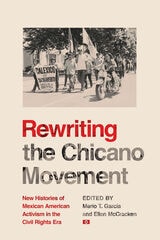
Rewriting the Chicano Movement
New Histories of Mexican American Activism in the Civil Rights EraMario T. García
University of Arizona Press, 2021
The essays in this volume broaden traditional views of the Chicano Movement that are too narrow and monolithic. Instead, the contributors to this book highlight the role of women in the movement, the regional and ideological diversification of the movement, and the various cultural fronts in which the movement was active. Rewriting the Chicano Movement stresses that there was no single Chicano Movement but instead a composite of movements committed to the same goal of Chicano self-determination. Scholars, students, and community activists interested in the history of the Chicano Movement can best start by reading this book.
Contributors: Holly Barnet-Sanchez, Tim Drescher, Jesús Jesse Esparza, Patrick Fontes, Mario T. García, Tiffany Jasmín González, Ellen McCracken, Juan Pablo Mercado, Andrea Muñoz, Michael Anthony Turcios, Omar Valerio-Jiménez
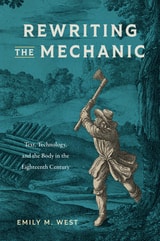
Rewriting the Mechanic
Text, Technology, and the Body in the Eighteenth CenturyEmily M. West
Bucknell University Press, 2027
In the eighteenth century, “technology” didn’t name a particular device or a process. It referred instead to written accounts of the mechanical arts, a now-obsolete category encompassing the wide range of work done by hand, from baking bread to building ships. Rewriting the Mechanic examines how these written descriptions, circulating across genres in eighteenth-century Britain, transformed certain mechanical arts by imagining them as newly innovative, authoritative, and able to make speculative possibilities real—as what we now call technological. Reversing the familiar story in which literature simply reflects technological change, West draws on the work of Robert Hooke, Aphra Behn, Daniel Defoe, Maria Edgeworth, and Jane Austen to demonstrate the influence of literary techniques on ideas about masculinity, power, and the body, and how these texts helped to bring the very idea of technological modernity into being.
Published by Bucknell University Press. Distributed worldwide by Rutgers University Press.
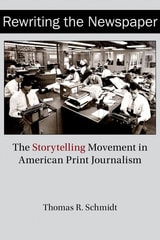
Rewriting the Newspaper
The Storytelling Movement in American Print JournalismThomas R. Schmidt
University of Missouri Press, 2020
Thomas Schmidt analyzes the expansion of narrative journalism and the corresponding institutional changes in the American newspaper industry in the last quarter of the twentieth century. In doing so, he offers the first institutionally situated history of narrative journalism’s evolution from the New Journalism of the 1960s to long-form literary journalism in the 1990s. Based on the analysis of primary sources, industry publications, and oral history interviews, this study traces how narrative techniques developed and spread through newsrooms, advanced by institutional initiatives and a growing network of practitioners, proponents, and writing coaches who mainstreamed the use of storytelling. Challenging the popular belief that it was only a few talented New York reporters (Tome Wolfe, Jimmy Breslin, Gay Talese, Joan Didion, and others) who revolutionized journalism by deciding to employ storytelling techniques in their writing, Schmidt shows that the evolution of narrative in late twentieth century American Journalism was more nuanced, more purposeful, and more institutionally based than the New Journalism myth suggests.
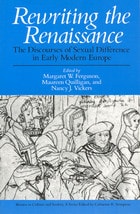
Rewriting the Renaissance
The Discourses of Sexual Difference in Early Modern EuropeEdited by Margaret W. Ferguson, Maureen Quilligan, and Nancy Vickers
University of Chicago Press, 1986
Throughout, the essays focus on the structures of Renaissance patriarchy that organized power relations both in the state and in the family. They explore the major conequences of patriarchy for women—their marginalization and lack of identity and power—and the ways in which individual women or groups of women broke, or in some cases deliberately circumvented, the rules that defined them as a secondary sex. Topics covered include representations of women in literature and art, the actual work done by women both inside and outside of the home, and the writings of women themselves. In analyzing the rhetorical strategies that "marginalized" historical and fictional women, these essays counter scholarly and critical traditions that continue to exhibit patriarchal biases.
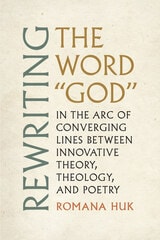
Rewriting the Word "God"
In the Arc of Converging Lines between Innovative Theory, Theology, and PoetryRomana Huk
University of Alabama Press, 2025
Innovative poetry, philosophy, theology and new sciences converge in the project of rewriting the word “God”
In Rewriting the Word “God,” Romana Huk examines the substantive connections between innovative poetry of the last century and contemporary theology and philosophy. Along the way, we encounter ten poets who have, without abandoning their inherited or chosen faith traditions, radically rethought conceptualizations of divinity, human ontology, and the real.
From the startlingly proto-phenomenological encounters with nature by Gerard Manley Hopkins to the post-deconstructive pursuit of “oracular” speech in Fanny Howe, these poets have found inspiration in a wide range of sources, from ancient religious texts to modern philosophical movements. But what unites them is their willingness to continually change, experiment and challenge the status quo, both in their religious beliefs and their poetic practice.
Huk shows how these poets have used their work to explore ultimate questions of life and death, meaning and purpose, and the relationship between humans and materiality, humans and other humans, which for these poets sheds light on humanity’s relationship with the divine. She also highlights the ways in which they have engaged with social and political issues in their poetry to speak out against injustice and oppression.
Rewriting the Word “God” is a thought-provoking and inspiring work that will challenge current perceptions of both religion and poetry from new positions at the intersection of faith, art, philosophy, science, literary theory, and culture.
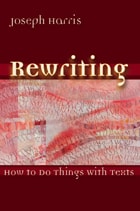
Rewriting
How To Do Things With TextsJoseph Harris
Utah State University Press, 2006
"Like all writers, intellectuals need to say something new and say it well. But unlike many other writers, what intellectuals have to say is bound up with the books we are reading . . . and the ideas of the people we are talking with."
What are the moves that an academic writer makes? How does writing as an intellectual change the way we work from sources? In Rewriting, a textbook for the undergraduate classroom, Joseph Harris draws the college writing student away from static ideas of thesis, support, and structure, and toward a more mature and dynamic understanding. Harris wants college writers to think of intellectual writing as an adaptive and social activity, and he offers them a clear set of strategies—a set of moves—for participating in it.
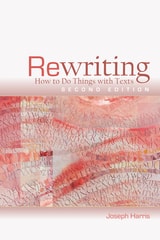
Rewriting
How to Do Things with Texts, Second EditionJoseph Harris
Utah State University Press, 2017
“Like all writers, intellectuals need to say something new and say it well. But for intellectuals, unlike many other writers, what we have to say is bound up with the books we are reading . . . and the ideas of the people we are talking with.”
What are the moves that an academic writer makes? How does writing as an intellectual change the way we work from sources? In Rewriting, Joseph Harris draws the college writing student away from static ideas of thesis, support, and structure, and toward a more mature and dynamic understanding. Harris wants college writers to think of intellectual writing as an adaptive and social activity, and he offers them a clear set of strategies—a set of moves—for participating in it. Introducing remixing as an additional signature move and updated with new attention to digital writing, the second edition both extends and rethinks the ideas of the original.
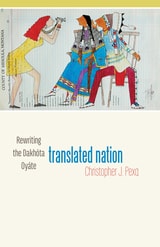
Translated Nation
Rewriting the Dakhóta OyáteChristopher J. Pexa
University of Minnesota Press, 2019
How authors rendered Dakhóta philosophy by literary means to encode ethical and political connectedness and sovereign life within a settler surveillance state
Translated Nation examines literary works and oral histories by Dakhóta intellectuals from the aftermath of the 1862 U.S.–Dakota War to the present day, highlighting creative Dakhóta responses to violences of the settler colonial state. Christopher Pexa argues that the assimilation era of federal U.S. law and policy was far from an idle one for the Dakhóta people, but rather involved remaking the Oyáte (the Očéti Šakówiŋ Oyáte or People of the Seven Council Fires) through the encrypting of Dakhóta political and relational norms in plain view of settler audiences.
From Nicholas Black Elk to Charles Alexander Eastman to Ella Cara Deloria, Pexa analyzes well-known writers from a tribally centered perspective that highlights their contributions to Dakhóta/Lakhóta philosophy and politics. He explores how these authors, as well as oral histories from the Spirit Lake Dakhóta Nation, invoke thióšpaye (extended family or kinship) ethics to critique U.S. legal translations of Dakhóta relations and politics into liberal molds of heteronormativity, individualism, property, and citizenship. He examines how Dakhóta intellectuals remained part of their social frameworks even while negotiating the possibilities and violence of settler colonial framings, ideologies, and social forms.
Bringing together oral and written as well as past and present literatures, Translated Nation expands our sense of literary archives and political agency and demonstrates how Dakhóta peoplehood not only emerges over time but in everyday places, activities, and stories. It provides a distinctive view of the hidden vibrancy of a historical period that is often tied only to Indigenous survival.
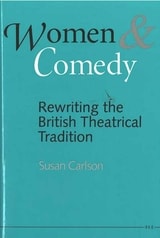
Women and Comedy
Rewriting the British Theatrical TraditionSusan Carlson
University of Michigan Press, 1991