Results by title
2 books match the query 'Reydams-Schils, Gretchen'

Judgment and Action
Fragments toward a HistoryEdited by Vivasvan Soni and Thomas Pfau
Northwestern University Press, 2018
Written by theologians, literary scholars, political theorists, classicists, and philosophers, the essays in Judgment and Action address the growing sense that certain key concepts in humanistic scholarship have become suspect, if not downright unintelligible, amid the current plethora of critical methods. These essays aim to reassert the normative force of judgment and action, two concepts at the very core of literary analysis, systematic theology, philosophy, ethics, aesthetics, and other disciplines.
Interpretation is essential to every humanistic discipline, and every interpretation is an act of judgment. Yet the work of interpretation and judgment has been called into question by contemporary methods in the humanities, which incline either toward contextual determination of meaning or toward the suspension of judgment altogether. Action is closely related to judgment and interpretation and like them, it has been rendered questionable. An action is not simply the performance of a deed but requires the deed’s intelligibility, which can be secured only through interpretation and judgment.
Organized into four broad themes—interiority/contemplation, ethics, politics/community, and aesthetics/image—the aim of this broad-ranging and insightful collection is to illuminate the histories of judgment and action, identify critical sites from which rethinking them may begin, clarify how they came to be challenged, and relocate them within a broader intellectual-historical trajectory that renders them intelligible.
[more]
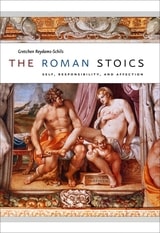
The Roman Stoics
Self, Responsibility, and AffectionGretchen Reydams-Schils
University of Chicago Press, 2005
Roman Stoic thinkers in the imperial period adapted Greek doctrine to create a model of the self that served to connect philosophical ideals with traditional societal values. The Roman Stoics-the most prominent being Marcus Aurelius-engaged in rigorous self-examination that enabled them to integrate philosophy into the practice of living. Gretchen Reydams-Schils's innovative new book shows how these Romans applied their distinct brand of social ethics to everyday relations and responsibilities.
The Roman Stoics reexamines the philosophical basis that instructed social practice in friendship, marriage, parenting, and community. From this analysis emerge Stoics who were neither cold nor detached, as the stereotype has it, but all too aware of their human weaknesses. In a valuable contribution to current discussions in the humanities on identity, autonomy, and altruism, Reydams-Schils ultimately conveys the wisdom of Stoics to the citizens of modern society.
The Roman Stoics reexamines the philosophical basis that instructed social practice in friendship, marriage, parenting, and community. From this analysis emerge Stoics who were neither cold nor detached, as the stereotype has it, but all too aware of their human weaknesses. In a valuable contribution to current discussions in the humanities on identity, autonomy, and altruism, Reydams-Schils ultimately conveys the wisdom of Stoics to the citizens of modern society.
[more]