Results by title
7 books match the query 'Rhetorical criticism'
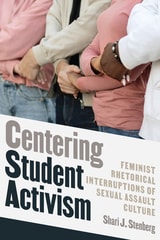
Centering Student Activism
Feminist Rhetorical Interruptions of Sexual Assault CultureShari J. Stenberg
Utah State University Press, 2026
Centering Student Activism is a deep exploration of institutional responses to sexual assault. It addresses critical issues facing campuses today, examining how students navigate institutional dynamics and utilize the power of new and traditional rhetorical strategies to effect change. In doing so, it provides a profound understanding of the mechanisms by which coalitions can transform educational environments.
Centering Student Activism features a national interview-based study of contemporary student activists who deploy rhetorical strategies and tactics—old and new, embodied and digital—with agility and awareness. They aim their strategies and tactics of “intersectional rhetorical feminism” to interrupt and transform a sedimented culture. The students’ activism highlights not only the harms experienced by survivors in the aftermath of their assaults but also how their efforts to communicate those harms are often stymied or silenced by official responses and practices. These student activists pair interruption with rhetorical transformation as they seek to create a survivor-centric culture. In so doing they spotlight the systemic roots of sexual violence and respond to sexual assault through intersectional, coalition-based work.
Through detailed analysis and compelling narratives, Shari J. Stenberg underscores the importance of community care and mutual support in advocacy efforts. Centering Student Activism is an essential work for navigating institutional dynamics, providing an important resource to students, educators, and administrators who seek to understand how universities silence survivors and how students create ways to speak back and transform institutional culture.
Making the Case
Advocacy and Judgment in Public ArgumentKathryn M. Olson
Michigan State University Press, 2012
In an era when the value of the humanities and qualitative inquiry has been questioned in academia and beyond, Making the Case is an engaging and timely collection that brings together a veritable who’s who of public address scholars to illustrate the power of case-based scholarly argument and to demonstrate how critical inquiry into a specific moment speaks to general contexts and theories. Providing both a theoretical framework and a wealth of historically situated texts, Making the Case spans from Homeric Greece to twenty-first-century America. The authors examine the dynamic interplay of texts and their concomitant rhetorical situations by drawing on a number of case studies, including controversial constitutional arguments put forward by activists and presidents in the nineteenth century, inventive economic pivots by Franklin Roosevelt and Alan Greenspan, and the rhetorical trajectory and method of Barack Obama.
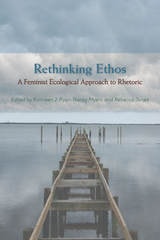
Rethinking Ethos
A Feminist Ecological Approach to RhetoricEdited by Kathleen J. Ryan, Nancy Myers, and Rebecca Jones
Southern Illinois University Press, 2016
Editors Kathleen J. Ryan, Nancy Myers, and Rebecca Jones identify three rhetorical maneuvers that characterize ethos in the feminist ecological imaginary: ethe as interruption/interrupting, ethe as advocacy/advocating, and ethe as relation/relating. Each section of the book explores one of these rhetorical maneuvers. An afterword gathers contributors’ thoughts on the collection’s potential impact and influence, possibilities for future scholarship, and the future of feminist rhetorical studies.
With its rich mix of historical examples and contemporary case studies, Rethinking Ethos offers a range of new perspectives, including queer theory, transnational approaches, radical feminism, Chicana feminism, and indigenous points of view, from which to consider a feminist approach to ethos.
Rhetoric and Scripture
Collected Essays of Thomas H. OlbrichtThomas H. Olbricht
SBL Press, 2021
Rhetorical Criticism
A Study In MethodEdwin Black
University of Wisconsin Press, 1978
This is a book that, almost singlehandedly, freed scholars from the narrow constraints of a single critical paradigm and created a new era in the study of public discourse. Its original publication in 1965 created a spirited controversy. Here Edwin Black examines the assumptions and principles underlying neo-Aristotelian theory and suggests an alternative approach to criticism, centering around the concept of the "rhetorical transaction." This new edition, containing Black's new introduction, will enable students and scholars to secure a copy of one of the most influential books ever written in the field.
Risky Rhetoric
AIDS and the Cultural Practices of HIV TestingJ. Blake Scott
Southern Illinois University Press, 2003
Risky Rhetoric: AIDS and the Cultural Practices of HIV Testing is the first book-length study of the rhetoric inherent in and surrounding HIV testing. In addition to providing a history of HIV testing in the United States from 1985 to the present, J. Blake Scott explains how faulty arguments about testing’s power and effects have promoted unresponsive and even dangerous testing practices for so-called healthy subjects as well as those deemed risky.A new afterword to the paperback edition discusses changes in testing technology, treatments, and public health responses in the last ten years. The ultimate goal of Risky Rhetoric is to offer strategies to policy makers, HIV educators and test counselors, and other rhetors for developing more responsive and egalitarian testing-related rhetorics and practices.
Twentieth-Century American Success Rhetoric
How to Construct a Suitable SelfJohn Ramage
Southern Illinois University Press, 2005
Self-help authors like Tom Peters and Stephen Covey, who have dominated best-seller lists over the last two decades, have exercised increasing influence on political, governmental, and educational organizations. By contrast, the topic of American success books— texts that promise to help readers succeed by retrofitting their identity to meet workplace demands—has been ignored by scholars since the 1980s. John Ramage challenges the neglect of this hugely popular literature and revives a once-lively conversation among eminent critics about the social phenomenon represented in the work of Bruce Barton, Dale Carnegie, and Norman Vincent Peale, among others.
Using literary texts from Don Quixote to Catch-22 to gloss the discussion, Ramage utilizes Kenneth Burke’s rhetorical theory to understand symbolic acts and social issues and brings together earlier commentaries within a new critical framework. He considers the problematic and paradoxical nature of success and examines its meaning in terms of its traditional dialectic partner, happiness. A synopsis of seventeenth- to nineteenth-century forerunners prefaces this analysis in which Ramage links literary code heroes with the activities of twentieth-century business leaders to determine whether, in the search for authenticity, the heroic individual or the corporation is ultimately served.
This comprehensive study chronicles the legitimation of the success book genre, enumerates rhetorical strategies used to win over readers, and supplies the historical context that renders each book’s message timely. After considering some of the dangers of crossing disciplinary borders, as exemplified by Deborah Tannen’s work, Ramage critiques Stanley Fish’s theoretical strictures against this practice, finally summoning academic critics to action with a strong call to exert greater influence within the popular marketplace.