Results by title
6 books match the query 'Rhyme'
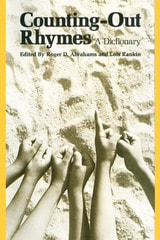
Counting-Out Rhymes
A DictionaryEdited by Roger D. Abrahams and Lois Rankin
University of Texas Press, 1980
Eeny, meeny, figgledy, fig.
Delia, dolia, dominig,
Ozy, pozy doma-nozy,
Tee, tau, tut,
Uggeldy, buggedy, boo!
Out goes you. (no. 129)
You can stand,
And you can sit,
But, if you play,
You must be it. (no. 577)
Counting-out rhymes are used by children between the ages of six and eleven as a special way of choosing it and beginning play. They may be short and simple ("O-U-T spells out/And out goes you") or relatively long and complicated; they may be composed of ordinary words, arrant nonsense, or a mixture of the two.
Roger D. Abrahams and Lois Rankin have gathered together a definitive compendium of counting-out rhymes in English reported to 1980. These they discovered in over two hundred sources from the nineteenth and twentieth centuries, including rhymes from England, Scotland, Ireland, Australia, New Zealand, and the United States. Representative texts are given for 582 separate rhymes, with a comprehensive listing of sources and variants for each one, as well as information on each rhyme's provenience, date, and use. Cross-references are provided for variants whose first lines differ from those of the representative texts. Abrahams's introduction discusses the significance of counting-out rhymes in children's play.
Children's folklore and speech play have attracted increasing attention in recent years. Counting-Out Rhymes will be a valuable resource for researchers in this field.
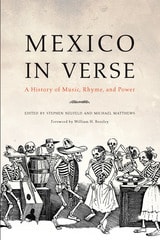
Mexico in Verse
A History of Music, Rhyme, and PowerEdited by Stephen Neufeld and Michael Matthews; Foreword by William H. Beezley
University of Arizona Press, 2015
Focusing on modern Mexico, from 1840 to the 1980s, this volume examines the cultural venues in which people articulated their understanding of the social, political, and economic change they witnessed taking place during times of tremendous upheaval, such as the Mexican-American War, the Porfiriato, and the Mexican Revolution. The words of diverse peoples—people of the street, of the field, of the cantinas—reveal the development of the modern nation. Neufeld and Matthews have chosen sources so far unexplored by Mexicanist scholars in order to investigate the ways that individuals interpreted—whether resisting or reinforcing—official narratives about formative historical moments.
The contributors offer new research that reveals how different social groups interpreted and understood the Mexican experience. The collected essays cover a wide range of topics: military life, railroad accidents, religious upheaval, children’s literature, alcohol consumption, and the 1985 earthquake. Each chapter provides a translated song or poem that encourages readers to participate in the interpretive practice of historical research and cultural scholarship. In this regard, Mexico in Verse serves both as a volume of collected essays and as a classroom-ready primary document reader.

Read Me a Rhyme in Spanish and English
Rose Zertuche Treviño
American Library Association, 2009
Rhyme and Reason in Reading and Spelling
Lynette Bradley
University of Michigan Press, 1985
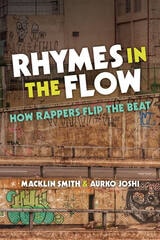
Rhymes in the Flow
How Rappers Flip the BeatMacklin Smith and Aurko Joshi
University of Michigan Press, 2020
Despite its global popularity, rap has received little scholarly attention in terms of its poetic features. Rhymes in the Flow systematically analyzes the poetics (rap beats, rhythms, rhymes, verse and song structures) of many notable rap songs to provide new insights on rap artistry and performance. Defining and describing the features of what rappers commonly call flow, the authors establish a theory of the rap line as they trace rap’s deepest roots and stylistic evolution—from Anglo-Saxon poetry to Lil Wayne—and contextualize its complex poetics. Rhymes in the Flow helps explain rap’s wide appeal by focusing primarily on its rhythmic and thematic power, while also claiming its historical, cultural, musical, and poetic importance.
The Burden of Rhyme
Victorian Poetry, Formalism, and the Feeling of Literary HistoryNaomi Levine
University of Chicago Press, 2024
The Burden of Rhyme shows how the nineteenth-century search for the origin of rhyme shaped the theory and practice of poetry. For Victorians, rhyme was not (as it was for the New Critics, and as it still is for us) a mere technique or ahistorical form. Instead, it carried vivid historical fantasies derived from early studies of world literature. Naomi Levine argues that rhyme’s association with the advent of literary modernity and with a repertoire of medievalist, Italophilic, and orientalist myths about love, loss, and poetic longing made it a sensitive historiographic instrument. Victorian poets used rhyme to theorize both literary history and the most elusive effects of aesthetic form. This Victorian formalism, which insisted on the significance of origins, was a precursor to and a challenge for twentieth-century methods. In uncovering the rich relationship between Victorian poetic forms and a forgotten style of literary-historical thought, The Burden of Rhyme reveals the unacknowledged influence of Victorian poetics—and its repudiation—on the development of modern literary criticism.