Results by title
7 books match the query 'Rhythms'

Mining Coal and Undermining Gender
Rhythms of Work and Family in the American WestJessica Smith Rolston
Rutgers University Press, 2014
Though mining is an infamously masculine industry, women make up 20 percent of all production crews in Wyoming’s Powder River Basin—the largest coal-producing region in the United States. How do these women fit into a working culture supposedly hostile to females? This is what anthropologist Jessica Smith Rolston, herself a onetime mine worker and the daughter of a miner, set out to discover. Her answers, based on years of participant-observation in four mines and extensive interviews with miners, managers, engineers, and the families of mine employees, offer a rich and surprising view of the working “families” that miners construct. In this picture, gender roles are not nearly as straightforward—or as straitened—as stereotypes suggest.
Gender is far from the primary concern of coworkers in crews. Far more important, Rolston finds, is protecting the safety of the entire crew and finding a way to treat each other well despite the stresses of their jobs. These miners share the burden of rotating shift work—continually switching between twelve-hour day and night shifts—which deprives them of the daily rhythms of a typical home, from morning breakfasts to bedtime stories. Rolston identifies the mine workers’ response to these shared challenges as a new sort of constructed kinship that both challenges and reproduces gender roles in their everyday working and family lives.
Crews’ expectations for coworkers to treat one another like family and to adopt an “agricultural” work ethic tend to minimize gender differences. And yet, these differences remain tenacious in the equation of masculinity with technical expertise, and of femininity with household responsibilities. For Rolston, such lingering areas of inequality highlight the importance of structural constraints that flout a common impulse among men and women to neutralize the significance of gender, at home and in the workplace.
At a time when the Appalachian region continues to dominate discussion of mining culture, this book provides a very different and unexpected view—of how miners live and work together, and of how their lives and work reconfigure ideas of gender and kinship.
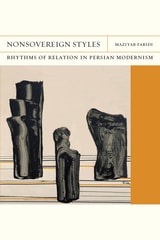
Nonsovereign Styles
Rhythms of Relation in Persian ModernismMaziyar Faridi
Northwestern University Press, 2027
Exploring motifs in modern Persian literature and Iranian film that demand new forms of relationality from politics
Assembling an understudied corpus of literary and filmic texts at the intersection of Persian and global modernism, Maziyar Faridi traces a constellation of aesthetic motifs that resist colonially imported constructs of political relationality in order to argue for an intermedial poetics of nonsovereignty. Moving from the poetry of Nima Yushij and Ahmad Shamlou to the ciné-poems of Férydoun Rahnéma and Forugh Farrokhzad, Nonsovereign Styles charts the transformation of poetic language through its exposure to minor ethnic languages and the rhetorics of English, French, and Spanish modernist poetry and alternative film. Faridi centers two key motifs: ezterāb, a trembling rhythm in which the self encounters itself as difference, and mehr, an aporetic mode of relation beyond identity, community, and sovereignty. Against the state’s project of ethnonationalism, these motifs form a poetics that is both transhistorical and transnational, producing a translational link between Iranian and internationalist poets, such as Langston Hughes and Paul Éluard. By situating Persian modernism within the broader map of global modernism, this book invites us to consider what reading these texts can teach us today about styles of relating to the world and the very sense of the political.
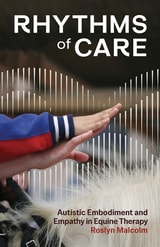
Rhythms of Care
Autistic Embodiment and Empathy in Equine TherapyRoslyn Malcolm
University of Minnesota Press, 2027
A thoughtful exploration of autism, offering a new understanding of social relations through a sensory-perceptual approach
Sensitive and flighty, horses require carefully designed environments to help them feel calm and soothed—precisely the sort of places that are understood to help some autistic youth to flourish. In Rhythms of Care, Roslyn Malcolm changes the conversation around autism, detailing shifting understandings of the condition from neurological misfiring to a whole-body condition of sensory-perceptual difference.
Malcolm chronicles the experiences of several autistic youth and their families at two UK equestrian riding centers, developing new language to elaborate on an advancing sense of autistic embodiment and sociality emerging through equine-assisted therapy. Her inquiry turns away from a focus on autistic brains and toward cultivating ecologies where autistic people's ways of being and embodiments can be accepted and supported.
Tracing the role of sensory and endocrinological knowledge in our formulations of bodies, empathy, and personhood, Rhythms of Care explores more-than-human sociality, multispecies distributions of care, and the anthropology of the body. In our chronically stressful and overstimulating era of late capitalism and inequality, Malcolm envisions a sensory environment for all beings.
Retail e-book files for this title are screen-reader friendly with images accompanied by short alt text and/or extended descriptions.

Rhythms of Resistance
African Musical Heritage in BrazilPeter Fryer
Pluto Press, 2000
Acclaimed author Peter Fryer describes how slaves, mariners and merchants brought African music from Angola and the ports of East Africa to Latin America. In particular, they brought it to Brazil – today the country with the largest black population of any outside Africa. Fryer examines how the rhythms and beats of Africa were combined with European popular music to create a unique sound and dance tradition. Fryer focuses on the political nature of this musical crossover and the role of an African heritage in the cultural identity of Brazilian blacks today.
Rhythms of Resistance is an absorbing account of a theme in global music and is rich in fascinating historical detail.
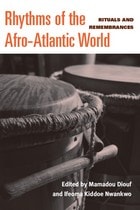
Rhythms of the Afro-Atlantic World
Rituals and RemembrancesEdited by Mamadou Diouf and Ifeoma Kiddoe Nwankwo
University of Michigan Press, 2010
"Collecting essays by fourteen expert contributors into a trans-oceanic celebration and critique, Mamadou Diouf and Ifeoma Kiddoe Nwankwo show how music, dance, and popular culture turn ways of remembering Africa into African ways of remembering. With a mix of Nuyorican, Cuban, Haitian, Kenyan, Senegalese, Trinidagonian, and Brazilian beats, Rhythms of the Afro-Atlantic World proves that the pleasures of poly-rhythm belong to the realm of the discursive as well as the sonic and the kinesthetic."
---Joseph Roach, Sterling Professor of Theater, Yale University
"As necessary as it is brilliant, Rhythms of the Afro-Atlantic World dances across, beyond, and within the Black Atlantic Diaspora with the aplomb and skill befitting its editors and contributors."
---Mark Anthony Neal, author of Soul Babies: Black Popular Culture and the Post-Soul Aesthetic
Along with linked modes of religiosity, music and dance have long occupied a central position in the ways in which Atlantic peoples have enacted, made sense of, and responded to their encounters with each other. This unique collection of essays connects nations from across the Atlantic---Senegal, Kenya, Trinidad, Cuba, Brazil, and the United States, among others---highlighting contemporary popular, folkloric, and religious music and dance. By tracking the continuous reframing, revision, and erasure of aural, oral, and corporeal traces, the contributors to Rhythms of the Afro-Atlantic World collectively argue that music and dance are the living evidence of a constant (re)composition and (re)mixing of local sounds and gestures.
Rhythms of the Afro-Atlantic World distinguishes itself as a collection focusing on the circulation of cultural forms across the Atlantic world, tracing the paths trod by a range of music and dance forms within, across, or beyond the variety of locales that constitute the Atlantic world. The editors and contributors do so, however, without assuming that these paths have been either always in line with national, regional, or continental boundaries or always transnational, transgressive, and perfectly hybrid/syncretic. This collection seeks to reorient the discourse on cultural forms moving in the Atlantic world by being attentive to the specifics of the forms---their specific geneses, the specific uses to which they are put by their creators and consumers, and the specific ways in which they travel or churn in place.
Mamadou Diouf is Leitner Family Professor of African Studies, Director of the Institute of African Studies, and Professor of History at Columbia University.
Ifeoma Kiddoe Nwankwo is Associate Professor of English at Vanderbilt University.
Jacket photograph by Elias Irizarry
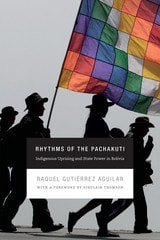
Rhythms of the Pachakuti
Indigenous Uprising and State Power in BoliviaRaquel Gutiérrez Aguilar
Duke University Press, 2014
"In Rhythms of the Pachakuti we can sense the reverberations of an extraordinary historical process that took place in Bolivia at the start of the twenty-first century. The book is the product of Raquel Gutiérrez Aguilar's political engagement in that historical process. . . . Though of Mexican nationality, [she] was intimately involved in Bolivian politics for many years and acquired a quasi-legendary status there as an intense, brilliant activist and radical intellectual. . . . [Her account is] . . . itself a revolutionary document. . . . Rhythms of the Pachakuti deserves to stand as a key text in the international literature of radicalism and emancipatory politics in the new century."—Sinclair Thomson, from the foreword
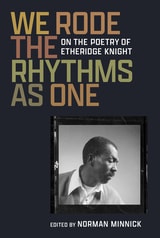
We Rode the Rhythms as One
On the Poetry of Etheridge KnightEdited by Norman Minnick
University of Michigan Press, 2026
Knight’s story is one of transformation—an odyssey from hardship and incarceration to artistic prominence—anchored by his unwavering belief in the power of poetry to unite and heal. This comprehensive volume is also a historical and cultural exploration, situating Knight’s work amid the Black Arts Movement, the Civil Rights Movement, and the ongoing fight for social justice. Readers will find themselves drawn to Knight’s unfiltered voice, his reflections on Black identity, and his insistence on making poetry accessible to all—whether through intimate letters or reflections on the sociopolitical climate that shaped his art. Suitable for poetry enthusiasts, scholars, and general readers alike, We Rode the Rhythms as One invites us to reconsider Knight’s enduring impact and the vital role of poetry in reflecting and reshaping human experience.