Results by title
7 books match the query 'Rice, Jeff'
Abducting Writing Studies
Edited by Sidney I. Dobrin and Kyle Jensen
Southern Illinois University Press, 2017
Each of the twelve essays that comprise this collection sparks new insights about the phenomenon of writing. A must-read for rhetoric and composition scholars and students, Abducting Writing Studies is sure to foster vibrant discussions about what is possible in writing research and instruction.
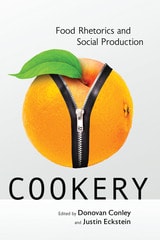
Cookery
Food Rhetorics and Social ProductionEdited by Donovan Conley and Justin Eckstein
University of Alabama Press, 2020
The rhetoric of contemporary food production and consumption with a focus on social boundaries
The rhetoric of food is more than just words about food, and food is more than just edible matter. Cookery: Food Rhetorics and Social Production explores how food mediates both rhetorical influence and material life through the overlapping concepts of invention and production. The classical canon of rhetorical invention entails the process of discovering one’s persuasive appeals, whereas the contemporary landscape of agricultural production touches virtually everyone on the planet. Together, rhetoric and food shape the boundaries of shared living.
The essays in this volume probe the many ways that food informs contemporary social life through its mediation of bodies—human and extra-human alike—in the forms of intoxication, addiction, estrangement, identification, repulsion, and eroticism. Our bodies, in turn, shape the boundaries of food through research, technology, cultural trends, and, of course, by talking about it.
Each chapter explores food’s persuasive nature through a unique prism that includes intoxication, dirt, “food porn,” strange foods, and political “invisibility.” Each case offers new insights about the relations between rhetorical influence and embodied practice through food. As a whole Cookery articulates new ways of viewing food’s powers of persuasion, as well as the inherent role of persuasion in agricultural production.
The purpose of Cookery, then, is to demonstrate the deep rhetoricity of our modern industrial food system through critical examinations of concepts, practices, and tendencies endemic to this system. Food has become an essential topic for discussions concerned with the larger social dynamics of production, distribution, access, reception, consumption, influence, and the fraught question of choice. These questions about food and rhetoric are equally questions about the assumptions, values, and practices of contemporary public life.
Craft Obsession
The Social Rhetorics of BeerJeff Rice
Southern Illinois University Press, 2016
Rice weaves together theories of writing, narrative, new media, and rhetoric with a personal story of his passion for craft beer. He identifies six key elements of social media rhetoric—anecdotes, repetition, aggregation, delivery, sharing, and imagery—and examines how each helps to transform small, personal experiences with craft into a more widespread movement. When shared via social media, craft anecdotes—such as the first time one had a beer—interrupt and repeat one another, building a sense of familiarity and identity among otherwise unconnected people. Aggregation, the practice of joining unlike items into one space, builds on this network identity, establishing a connection to particular brands or locations, both real and virtual. The public releases of craft beers are used to explore the concept of craft delivery, which involves multiple actors across multiple spaces and results in multiple meanings. Finally, Rice highlights how personal sharing operates within the community of craft beer enthusiasts, who share online images of acquiring, trading for, and consuming a wide variety of beers. These shared stories and images, while personal for each individual, reflect the dependence of craft on systems of involvement. Throughout, Rice relates and reflects on his own experience as a craft beer enthusiast and his participation via social media in these systems.
Both an objective scholarly study and an engaging personal narrative about craft beer, Craft Obsession provides valuable insights into digital writing, storytelling, and social media.
Digital Detroit
Rhetoric and Space in the Age of the NetworkJeff Rice
Southern Illinois University Press, 2012
Since the 1967 riots that ripped apart the city, Detroit has traditionally been viewed either as a place in ruins or a metropolis on the verge of rejuvenation. In Digital Detroit: Rhetoric and Space in the Age of the Network, author Jeff Rice goes beyond the notion of Detroit as simply a city of two ideas. Instead he explores the city as a web of multiple meanings which, in the digital age, come together in the city’s spaces to form a network that shapes the writing, the activity, and the very thinking of those around it.
Rice focuses his study on four of Detroit’s most iconic places—Woodward Avenue, the Maccabees Building, Michigan Central Station, and 8 Mile—covering each in a separate chapter. Each of these chapters explains one of the four features of network rhetoric: folksono(me), the affective interface, response, and decision making. As these rhetorical features connect, they form the overall network called Digital Detroit. Rice demonstrates how new media, such as podcasts, wikis, blogs, interactive maps, and the Internet in general, knit together Detroit into a digital network whose identity is fluid and ever-changing. In telling Detroit’s spatial story, Rice deftly illustrates how this new media, as a rhetorical practice, ultimately shapes understandings of space in ways that computer applications and city planning often cannot. The result is a model for a new way of thinking and interacting with space and the imagination, and for a better understanding of the challenges network rhetorics pose for writing.

From A to A
Keywords of MarkupBradley Dilger
University of Minnesota Press, 2010
From A to investigates the relationship between media and culture by articulating questions regarding the role of markup. How do the codes of HTML, CSS, PHP, and other markup languages affect the Web's everyday uses? How do these languages shape the Web's communicative functions? This novel inquiry positions markup as the basis of our cultural, rhetorical, and communicative understanding of the Web.
Contributors: Sarah J. Arroyo, CSU Long Beach; Jennifer L. Bay, Purdue U; Helen J. Burgess, U of Maryland, Baltimore County; Michelle Glaros, Centenary College of Louisiana; Matthew K. Gold, NYCC of Technology; Cynthia Haynes, Clemson U; Rudy McDaniel, U of Central Florida; Colleen A. Reilly, UNC, Wilmington; Thomas Rickert, Purdue U; Brendan Riley, Columbia College Chicago; Sae Lynne Schatz, U of Central Florida; Bob Whipple, Creighton U; Brian Willems, U of Split, Croatia.
The Rhetoric of Cool
Composition Studies and New MediaJeff Rice
Southern Illinois University Press, 2007
The Rhetoric of Cool addresses the disciplinary claim that composition studies underwent a rebirth in 1963. At that time, three writers reviewed technology, cultural studies, and visual writing outside composition studies and independently used the word cool to describe each position. Starting from these three positions, Rice focuses on chora, appropriation, commutation, juxtaposition, nonlinearity, and imagery—rhetorical gestures conducive to new media work-- to construct the rhetoric of cool.
An innovative work that approaches computers and writing issues from historical, critical, theoretical, and practical perspectives, The Rhetoric of Cool challenges current understandings of writing and new media and proposes a rhetorical rather than an instrumental response for teaching writing in new media contexts.
Thinking with Bruno Latour in Rhetoric and Composition
Edited by Paul Lynch and Nathaniel Rivers
Southern Illinois University Press, 2015
Best known for his books We Have Never Been Modern, Laboratory Life, and Science in Action, Bruno Latour has inspired scholarship across many disciplines. In the past few years, the fields of rhetoric and composition have witnessed an explosion of interest in Latour’s work. Editors Paul Lynch and Nathaniel Rivers have assembled leading and emerging scholars in order to focus the debate on what Latour means for the study of persuasion and written communication.
Essays in this volume discern, rearticulate, and occasionally critique rhetoric and composition’s growing interest in Latour. These contributions include work on topics such as agency, argument, rhetorical history, pedagogy, and technology, among others. Contributors explain key terms, identify implications of Latour’s work for rhetoric and composition, and explore how his theories might inform writing pedagogies and be used to build research methodologies.
Thinking with Bruno Latour in Rhetoric and Composition shows how Latour’s groundbreaking theories on technology, agency, and networks might be taken up, enriched, and extended to challenge scholars in rhetorical studies (both English and communications), composition, and writing studies to rethink some of the field’s most basic assumptions. It is set to become the standard introduction that will appeal not only to those scholars already interested in Latour but also those approaching Latour for the first time.