Results by title
6 books match the query 'Rich people'
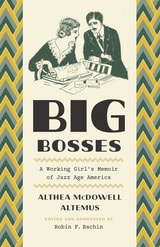
Big Bosses
A Working Girl’s Memoir of Jazz Age AmericaAlthea McDowell Altemus
University of Chicago Press, 2016
Beginning with her employment as a private secretary to James Deering of International Harvester, whom she describes as “probably the world’s oldest and wealthiest bachelor playboy,” Altemus tells us much about high society during the time, taking us inside Deering’s glamorous Miami estate, Vizcaya, an Italianate mansion worthy of Gatsby himself. Later, we meet her other notable employers, including Samuel Insull, president of Chicago Edison; New York banker S. W. Straus; and real estate developer Fred F. French. We cinch up our trenchcoats and head out sleuthing in Chicago, hired by the wife of a big boss to find out how he spends his evenings (with, it turns out, a mistress hidden in an apartment within his office, no less). Altemus was also a struggling single mother, a fact she had to keep secret from her employers, and she reveals the difficulties of being a working woman at the time through glimpses into women’s apartments, their friendships, and the dangers—sexual and otherwise—that she and others faced. Throughout, Altemus entertains with a tart and self-aware voice that combines the knowledge of an insider with the wit and clarity of someone on the fringe.
Anchored by extensive annotation and an afterword from historian Robin F. Bachin, which contextualizes Altemus’s narrative, Big Bosses provides a one-of-a-kind peek inside the excitement, extravagances, and the challenges of being a working woman roaring through the ’20s.
Billionaires and Stealth Politics
Benjamin I. Page, Jason Seawright, and Matthew J. Lacombe
University of Chicago Press, 2018
Page, Seawright, and Lacombe argue that while political contributions offer a window onto billionaires’ influence, especially on economic policy, they do not present a full picture of policy preferences and political actions. That is because on some of the most important issues, including taxation, immigration, and Social Security, billionaires have chosen to engage in “stealth politics.” They try hard to influence public policy, making large contributions to political parties and policy-focused causes, leading policy-advocacy organizations, holding political fundraisers, and bundling others’ contributions—all while rarely talking about public policy to the media. This means that their influence is not only unequal but also largely unaccountable to and unchallengeable by the American people. Stealth politics makes it difficult for ordinary citizens to know what billionaires are doing or mobilize against it. The book closes with remedies citizens can pursue if they wish to make wealthy Americans more politically accountable, such as public financing of political campaigns and easier voting procedures, and notes the broader types of reforms, such as a more progressive income tax system, that would be needed to increase political equality and reinvigorate majoritarian democracy in the United States.
Democracy in America?
What Has Gone Wrong and What We Can Do About ItBenjamin I. Page and Martin Gilens
University of Chicago Press, 2017
How did we get here? Through decades of dysfunctional government. In Democracy in America? veteran political observers Benjamin I. Page and Martin Gilens marshal an unprecedented array of evidence to show that while other countries have responded to a rapidly changing economy by helping people who’ve been left behind, the United States has failed to do so. Instead, we have actually exacerbated inequality, enriching corporations and the wealthy while leaving ordinary citizens to fend for themselves.
What’s the solution? More democracy. More opportunity for citizens to shape what their government does. To repair our democracy, Page and Gilens argue, we must change the way we choose candidates and conduct our elections, reform our governing institutions, and curb the power of money in politics. By doing so, we can reduce polarization and gridlock, address pressing challenges, and enact policies that truly reflect the interests of average Americans.
This book presents a damning indictment. But the situation is far from hopeless. With increased democratic participation as their guide, Page and Gilens lay out a set of proposals that would boost citizen participation, curb the power of money, and democratize the House and Senate. The only certainty is that inaction is not an option. Now is the time to act to restore and extend American democracy.
Democracy in America?
What Has Gone Wrong and What We Can Do About ItBenjamin I. Page and Martin Gilens
University of Chicago Press, 2020
What’s the solution? More democracy. More opportunities for citizens to shape what their government does. To repair our democracy, Page and Gilens argue, we must change the way we choose candidates and conduct our elections, reform our governing institutions, and curb the power of money in politics. By doing so, we can reduce polarization and gridlock, address pressing challenges, and enact policies that truly reflect the interests of average Americans.
Updated with new information, this book lays out a set of proposals that would boost citizen participation, curb the power of money, and democratize the House and Senate.
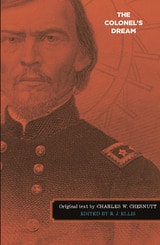
The Colonel's Dream
Charles W. Chesnutt
West Virginia University Press, 2014
Charles Waddell Chesnutt (1858-1932) was an African American writer, essayist, Civil Rights activist, legal-stenography businessman, and lawyer whose novels and short stories explore race, racism, and the problematic contours of African Americans’ social and cultural identities in post-Civil War South. He was the first African American to be published by a major American publishing house and served as a beacon-point for future African American writers.
The Colonel’s Dream, written in 1905, is a compelling tale of the post-Civil War South’s degeneration into a region awash with virulent racist practices against African Americans: segregation, lynchings, disenfranchisement, convict-labor exploitation, and endemic violent repression. The events in this novel are powerfully depicted from the point of view of a philanthropic but unreliable southern white colonel. Upon his return to the South, the colonel learns to abhor this southern world, as a tale of vicious racism unfolds. Throughout this narrative, Chesnutt confronts the deteriorating position of African Americans in an increasingly hostile South. Upon its publication The Colonel’s Dream was considered too controversial and unpalatable because of its bitter criticisms of southern white prejudice and northern indifference, and so this groundbreaking story failed to gain public attention and acclaim.
This is the first scholarly edition of The Colonel’s Dream. It includes an introduction and notes by R. J. Ellis and works to reestablish this great novel’s reputation.
The Second Estate
How the Tax Code Made an American AristocracyRay D. Madoff
University of Chicago Press, 2025
Named by The New Yorker as one of the Best Books of 2025 and featured on the Armchair Expert podcast with Dax Shepherd.
A revelatory book that lifts the curtain on America’s most consequential public deception: how the rich get richer using tools the government gave them.
Amid conflicting narratives about the drivers of wealth and inequality in the United States, one constant hovers in the background: the US tax code. No political force has been more consequential—or more utterly opaque—than the 7,000-page document that details who pays what in American society and government. Most of us have a sense that it’s an unfair system. But does anyone know exactly how it’s unfair?
Legal scholar Ray D. Madoff knows. In The Second Estate, she offers an unprecedented look behind the scenes of America’s byzantine system of taxation, laying bare not only its capacity to consolidate wealth but also the mechanisms by which it has created two fundamentally separate American societies: the working Americans who pay and the ultra-rich who benefit.
This is not a story of offshore accounts or secret tax havens. In The Second Estate, Madoff shows that the US system itself has, over time, been stripped and reconstituted such that it now offers a series of secret paths, hidden in plain sight, for wealthy people in the know to avoid taxation altogether. Through the strategic avoidance of traditional income, leveraging of investments and debt, and exploitation of rules designed to promote charitable giving, America’s wealthy do more than just pay less than their share; they remove themselves from the tax system entirely. Wealth becomes its own sovereign state, and the living is surprisingly—and maddeningly—cheap.