Results by title
5 books match the query 'Richard Wright'
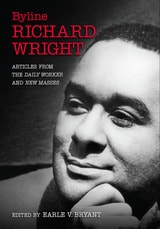
Byline, Richard Wright
Articles from the DAILY WORKER and NEW MASSESEdited by Earle V. Bryant
University of Missouri Press, 2015
A writer perhaps best known for the revolutionary works Black Boy and Native Son, Richard Wright also worked as a journalist during one of the most explosive periods of the 20th century. From 1937 to 1938, Wright turned out more than two hundred articles for the Daily Worker, the newspaper that served as the voice of the American Communist Party. Byline, Richard Wright assembles more than one hundred of those articles plus two of Wright’s essays from New Masses, revealing to readers the early work of an American icon.
As both reporter and Harlem bureau chief, Wright covered most of the major and minor events, personalities, and issues percolating through the local, national, and global scenes in the late 1930s. Because the Daily Worker wasn’t a mainstream paper, editors gave Wright free rein to cover the stories he wanted, and he tackled issues that no one else covered. Although his peers criticized his journalistic writing, these articles offer revealing portraits of Depression-era America rendered in solid, vivid prose.
Featuring Earle V. Bryant’s informative, detailed introduction and commentary contextualizing the compiled articles, Byline, Richard Wright provides insight into the man before he achieved fame as a novelist, short story writer, and internationally recognized voice of social protest. This collection opens new territory in Wright studies, and fans of Wright’s novels will delight in discovering the lost material of this literary great.
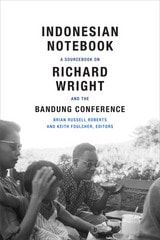
Indonesian Notebook
A Sourcebook on Richard Wright and the Bandung ConferenceBrian Russell Roberts and Keith Foulcher, editors
Duke University Press, 2016
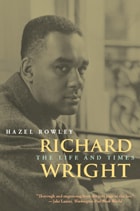
Richard Wright
The Life and TimesHazel Rowley
University of Chicago Press, 2008
Drawing on journals, letters, and eyewitness accounts, Richard Wright probes the author’s relationships with Langston Hughes and Ralph Ellison, his attraction to Communism, and his so-called exile in France. Skillfully interweaving quotes from Wright’s own writings, Rowley deftly portrays a passionate, courageous, and flawed man who would become one of our most enduring literary figures.
“Splendid. . . . Richard Wright is well written, prodigiously researched, and nicely paced, a compelling evocation of the man, his craft, and the different worlds through which he moved.”—Michael J. Ybarra, Wall Street Journal
“A welcome and illuminating work . . . [Rowley] does an outstanding job. . . . Rich and revealing.”—Megan Harlan, San Francisco Chronicle
“A magnificent biography, subtle and insightful. . . . Rowley writes with style and grace, and her research on Wright is prodigious.”—Howard Zinn, The Week

The Unfinished Quest of Richard Wright
Michel Fabre
University of Illinois Press, 1993
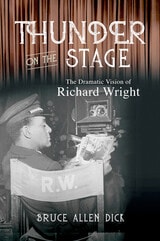
Thunder on the Stage
The Dramatic Vision of Richard WrightBruce Allen Dick
University of Illinois Press, 2024
Drawing on decades of research and interviews with Wright’s family and Wright scholars, Bruce Allen Dick uncovers the theatrical influence on Wright’s oeuvre--from his 1930s boxing journalism to his unpublished one-acts on returning Black GIs in WWII to his unproduced pageant honoring Vladimir Lenin. Wright maintained rewarding associations with playwrights, writers, and actors such as Langston Hughes, Theodore Ward, Paul Robeson, and Lillian Hellman, and took particular inspiration from French literary figures like Jean-Paul Sartre. Dick’s analysis also illuminates Wright’s direct involvement with theater and film, including the performative aspects of his travel writings; the Orson Welles-directed Native Son on Broadway; his acting debut in Native Son’s first film version; and his play “Daddy Goodness,” a satire of religious charlatans like Father Divine, in the 1930s.
Bold and original, Thunder on the Stage offers a groundbreaking reinterpretation of a major American writer.