Results by title
7 books match the query 'Richmond (Va.)'
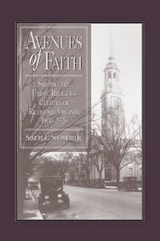
Avenues of Faith
Shaping the Urban Religious Culture of Richmond, Virginia, 1900–1929Samuel C. Shepherd Jr
University of Alabama Press, 2001
Avenues of Faith documents how religion flourished in southern cities after the turn of the century and how a cadre of clergy and laity created a notably progressive religious culture in Richmond, Virginia. Famous as the former capital of the Confederacy, in Avenues of Faith Richmond emerges as a dynamic and growing industrial city invigorated by the social activism of its Protestants.
By examining six mainline white denominations—Episcopalians, Methodists, Presbyterians, Baptists, Disciples of Christ, and Lutherans—Samuel C. Shepherd Jr. emphasizes the extent to which the city fostered religious diversity, even as “blind spots” remained regarding Catholics, African Americans, Mormons, and Jews. Shepherd explores such topics as evangelism, interdenominational cooperation, the temperance campaign, the Sunday school movement, the international peace initiatives, and the expanding role of lay people of both sexes. He also notes the community’s widespread rejection of fundamentalism, a religious phenomenon almost automatically associated with the South, and shows how it nurtured social reform to combat a host of urban problems associated with public health, education, housing, women’s suffrage, prohibition, children, and prisons.
In lucid prose and with excellent use of primary sources, Shepherd delivers a fresh portrait of Richmond Protestants who embraced change and transformed their community, making it an active, progressive religious center of the New South.
[more]

Black Labor in Richmond, 1865-1890
Peter J. Rachleff
University of Illinois Press, 1989
[more]
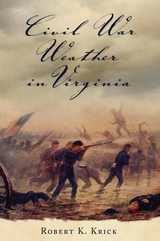
Civil War Weather in Virginia
Robert K. Krick
University of Alabama Press, 2007
This work fills a tremendous gap in our available knowledge in a fundamental area of Civil War studies, that of basic quotidian information on the weather in the theater of operations in the vicinity of Washington, DC, and Richmond, Virginia. Krick adds to the daily records kept by amateur meteorologists in these two locations. Anecdotal descriptions of weather found in contemporary soldiers’ dairies and correspondence combines these scattered records into a chronology of weather information that also includes daybreak and sunset times for each day. The information in Civil War Weather in Virginia is indispensable for students of the Civil War in the vital northern Virginia/Maryland theater of operations, and of the effects of weather on military history in general.
[more]
Richmond's Priests and Prophets
Race, Religion, and Social Change in the Civil Rights EraDouglas E. Thompson
University of Alabama Press, 2017
Explores the ways in which white Christian leaders in Richmond, Virginia navigated the shifting legal and political battles around desegregation even as members of their congregations struggled with their own understanding of a segregated society
Douglas E. Thompson’s Richmond’s Priests and Prophets: Race, Religion, and Social Change in the Civil Rights Era presents a compelling study of religious leaders’ impact on the political progression of Richmond, Virginia, during the time of desegregation. Scrutinizing this city as an entry point into white Christians’ struggles with segregation during the 1950s, Thompson analyzes the internal tensions between ministers, the members of their churches, and an evolving world.
In the mid-twentieth-century American South, white Christians were challenged repeatedly by new ideas and social criteria. Neighborhood demographics were shifting, public schools were beginning to integrate, and ministers’ influence was expanding. Although many pastors supported the transition into desegregated society, the social pressure to keep life divided along racial lines placed Richmond’s ministers on a collision course with forces inside their own congregations. Thompson reveals that, to navigate the ideals of Christianity within a complex historical setting, white religious leaders adopted priestly and prophetic roles.
Moreover, the author argues that, until now, the historiography has not viewed white Christian churches with the nuance necessary to understand their diverse reactions to desegregation. His approach reveals the ways in which desegregationists attempted to change their communities’ minds, while also demonstrating why change came so slowly—highlighting the deeply emotional and intellectual dilemma of many southerners whose worldview was fundamentally structured by race and class hierarchies.
[more]
The Perils and Prospects of Southern Black Leadership
Gordon Blaine Hancock, 1884–1970Raymond Gavins
Duke University Press, 1993
The Perils and Prospects of Southern Black Leadership fills an important gap in uncovering the history of southern black leaders between the death of Booker T. Washington and the rise of Martin Luther King, Jr. Originally published to critical acclaim in 1977 (Duke University Press), and now available in paperback with a new preface by the author, this book provides an intellectual biography of Gordon Blaine Hancock, a Virginia educator, journalist, and minister whose writings and speeches on race relations were widely influential in the South in the thirty years prior to the Brown decision of 1954. In showing how Hancock faced his generation's main dilemma—how to end Jim Crow and ensure integration without abandoning ideals of black identity, independence, and solidarity—Raymond Gavins's biography illuminates the history of African Americans and race relations in America.
[more]
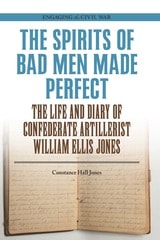
The Spirits of Bad Men Made Perfect
The Life and Diary of Confederate Artillerist William Ellis JonesConstance Hall Jones
Southern Illinois University Press, 2020
This remarkable biography and edited diary tell the story of William Ellis Jones (1838–1910), an artillerist in Crenshaw’s Battery, Pegram’s Battalion, the Army of Northern Virginia. One of the few extant diaries by a Confederate artillerist, Jones’s articulate writings cover camp life as well as many of the key military events of 1862, including the Peninsula Campaign, the Second Battle of Manassas, the Maryland Campaign, and the Battle of Fredericksburg.
In 1865 Jones returned to his prewar printing trade in Richmond, and his lasting reputation stems from his namesake publishing company’s role in the creation and dissemination of much of the Lost Cause ideology. Unlike the pro-Confederate books and pamphlets Jones published—primary among them the Southern Historical Society Papers—his diary shows the mindset of an unenthusiastic soldier. In a model of contextualization, Constance Hall Jones shows how her ancestor came to embrace an uncritical veneration of the army’s leadership and to promulgate a mythology created by veterans and their descendants who refused to face the amorality of their cause.
Jones brackets the soldier’s diary with rich, biographical detail, profiling his friends and relatives and providing insight into his childhood and post-war years. In doing so, she offers one of the first serious investigations into the experience of a Welsh immigrant family loyal to the Confederacy and makes a significant contribution to our understanding of Civil War–era Richmond and the nineteenth-century publishing industry. Invitingly written, The Spirits of Bad Men Made Perfect is an engaging life-and-times story that will appeal to historians and general readers alike.
[more]
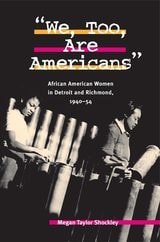
We, Too, Are Americans
African American Women in Detroit and Richmond, 1940-54Megan Taylor Shockley
University of Illinois Press, 2003
During World War II, factories across America retooled for wartime production, and unprecedented labor opportunities opened up for women and minorities. In We, Too, Are Americans, Megan Taylor Shockley examines the experiences of the African American women who worked in two capitols of industry--Detroit, Michigan, and Richmond, Virginia--during the war and the decade that followed it, making a compelling case for viewing World War II as the crucible of the civil rights movement.
As demands on them intensified, the women working to provide American troops with clothing, medical supplies, and other services became increasingly aware of their key role in the war effort. A considerable number of the African Americans among them began to use their indispensability to leverage demands for equal employment, welfare and citizenship benefits, fair treatment, good working conditions, and other considerations previously denied them.
Shockley shows that as these women strove to redefine citizenship, backing up their claims to equality with lawsuits, sit-ins, and other forms of activism, they were forging tools that civil rights activists would continue to use in the years to come.
[more]