Results by title
6 books match the query 'Riddle'
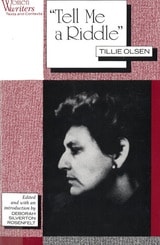
"Tell Me a Riddle"
Tillie OlsenRosenfelt, Deborah S
Rutgers University Press, 1995
This casebook includes an introduction by the editor, a chronology of Olsen’s life, an authoritative text of “Tell Me a Riddle,” relevant essays by Olsen, seven critical essays, and a bibliography.
The contributors are: Joanne Trautmann Banks, Constance Coiner, Rachel Blau Duplessis, Mara Faulkner, Elaine Orr, Linda Ray Pratt, and Deborah Silverton Rosenfelt.

Aquinas, Wittgenstein, and the Riddle of Spiritual Pedagogy
Matthew Dunch
Catholic University of America Press, 2027
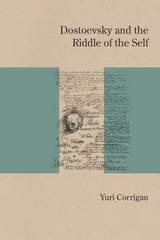
Dostoevsky and the Riddle of the Self
Yuri Corrigan
Northwestern University Press, 2017
Dostoevsky was hostile to the notion of individual autonomy, and yet, throughout his life and work, he vigorously advocated the freedom and inviolability of the self. This ambivalence has animated his diverse and often self-contradictory legacy: as precursor of psychoanalysis, forefather of existentialism, postmodernist avant la lettre, religious traditionalist, and Romantic mystic.
Dostoevsky and the Riddle of the Self charts a unifying path through Dostoevsky's artistic journey to solve the “mystery” of the human being. Starting from the unusual forms of intimacy shown by characters seeking to lose themselves within larger collective selves, Yuri Corrigan approaches the fictional works as a continuous experimental canvas on which Dostoevsky explored the problem of selfhood through recurring symbolic and narrative paradigms. Presenting new readings of such works as The Idiot, Demons, and The Brothers Karamazov, Corrigan tells the story of Dostoevsky’s career-long journey to overcome the pathology of collectivism by discovering a passage into the wounded, embattled, forbidding, revelatory landscape of the psyche.
Corrigan’s argument offers a fundamental shift in theories about Dostoevsky's work and will be of great interest to scholars of Russian literature, as well as to readers interested in the prehistory of psychoanalysis and trauma studies and in theories of selfhood and their cultural sources.
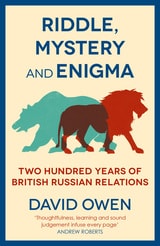
Riddle, Mystery, and Enigma
Two Hundred Years of British–Russian RelationsDavid Owen
Haus Publishing, 2022
With Riddle, Mystery, and Enigma, statesman and author David Owen tells the story of Britain’s relationship with Russia, which has been surprisingly underexplored. Through his characteristic insight and expertise, he depicts a relationship governed by principle as often as by suspicion, expediency, and necessity.
When the two nations formed a pragmatic alliance and fought together at the Battle of Navarino in Greece in 1827, it was overwhelmingly the work of the British prime minister, George Canning. His death brought about a drastic shift that would see the countries fighting on opposite sides in the Crimean War and jostling for power during the Great Game. It was not until the Russian Revolution of 1917 that another statesman had a defining impact on relations between Britain and Russia: Winston Churchill, who opposed Bolshevism yet never stopped advocating for diplomatic and military engagement with Russia. In the Second World War, he recognized early on the necessity of allying with the Soviets against the menace of Nazi Germany. Bringing us into the twenty-first century, Owen chronicles how both countries have responded to their geopolitical decline. Drawing on both imperial and Soviet history, he explains the unique nature of Putin’s autocracy and addresses Britain’s return to “blue water” diplomacy. Newly revised, this paperback edition features extended chapters on Putin’s Russia and the future of British–Russian relations after the Russo-Ukrainian War.
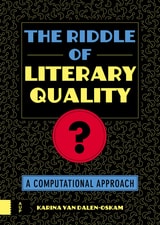
The Riddle of Literary Quality
A Computational ApproachKarina van Dalen-Oskam
Amsterdam University Press, 2023
Using evidence from almost 14,000 readers and building on more textual data than ever before, Van Dalen-Oskam and her team uncovered unconscious biases that shed new light on prejudices many people assumed no longer existed. This monograph explains in an accessible way how the project unfolded, which methods were used, and how the results may change the future of Literary Studies.
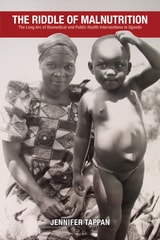
The Riddle of Malnutrition
The Long Arc of Biomedical and Public Health Interventions in UgandaJennifer Tappan
Ohio University Press, 2017
More than ten million children suffer from severe acute malnutrition globally each year. In Uganda, longstanding efforts to understand, treat, and then prevent the condition initially served to medicalize it, in the eyes of both biomedical personnel and Ugandans who brought their children to the hospital for treatment and care. Medicalization meant malnutrition came to be seen as a disease—as a medical emergency—not a preventable condition, further compromising nutritional health in Uganda.
Rather than rely on a foreign-led model, physicians in Uganda responded to this failure by developing a novel public health program known as Mwanamugimu. The new approach prioritized local expertise and empowering Ugandan women, blending biomedical knowledge with African sensibilities and cultural competencies.
In The Riddle of Malnutrition, Jennifer Tappan examines how over the course of half a century Mwanamugimu tackled the most fatal form of childhood malnutrition—kwashiorkor—and promoted nutritional health in the midst of postcolonial violence, political upheaval, and neoliberal resource constraints. She draws on a diverse array of sources to illuminate the interplay between colonialism, the production of scientific knowledge, and the delivery of health services in contemporary Africa.