Results by title
2 books match the query 'Riding, Laura'
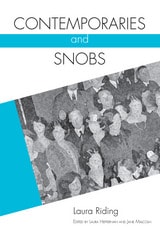
Contemporaries and Snobs
Laura Riding
University of Alabama Press, 2014
A new edition of Laura Riding's landmark 1928 poetry manifesto
Laura Riding’s Contemporaries and Snobs is one of modernism’s most audacious and overlooked manifestos, a book that drew a sharp line through the literary world of the late 1920s that is still visible today. In it, Riding dismantles the pretensions of the “snobs”—critics and poet-professionals who sought to codify modern poetry into systems—and champions the “contemporaries,” those who practiced poetry as an eccentric, individual act of creativity.
In eight incisive essays, Riding takes readers on a tour of the literary scene of her day, exposing how the institutionalization of modernism threatened to clog the wellsprings of poetic originality. With ferocious wit, she critiques the philosophical dogmas of T. S. Eliot, Allen Tate, and the critical machinery of The Criterion, while elevating Gertrude Stein as the figurehead of a radical alternative, a “barbaric” poetics rooted in linguistic freshness. Riding’s defense of the poet as person, her skepticism toward impersonality, and her insistence on poetry’s autonomy from systems of thought anticipate later feminist and avant-garde critiques, making this volume a cornerstone for rethinking modernist traditions. In an era when debates about authenticity, individuality, and the institutional pressures on art feel more urgent than ever, Contemporaries and Snobs offers a counter-history, a reminder that poetry thrives not in conformity but in idiosyncrasy. Riding’s voice, imperious yet visionary, speaks directly to contemporary concerns about creative freedom and the commodification of literature.
Nearing the centenary of its first publication, Contemporaries and Snobs will interest scholars of modernism and literary criticism, readers of Gertrude Stein and experimental poetics, feminist critics and theorists of authorship, and readers fascinated by the intellectual battles that shaped twentieth-century poetry.
Writing Not Writing
Poetry, Crisis, and ResponsibilityTom Fisher
University of Iowa Press, 2017
Writing Not Writing both confirms this question into which crisis puts poetry and explores alternative modes of “response” and “responsibility” that poetry makes possible. Reading the silences of Oppen, Carl Rakosi, and Bob Kaufman, the renunciation of Laura Riding, and other more contemporary instances of poetic abnegation, Tom Fisher explores silence, refusal, and disavowal as political and ethical modes of response in a time of continuous crisis. Through a turn away from writing, these poets offer strategies of refusal and departure that leave anagrammatical hollows behind, activating the negational capacities of writing and aesthetics to disrupt the empire of sense, speech, and agency.
Fisher’s work is both an engaging and detailed analysis of four individual poets who left poetry behind and a theoretically provocative exploration of the political and ethical possibilities of silence, not-doing, and disavowal. In lucid but nuanced terms, Fisher makes the case that, from at least modernism forward, poetry is marked by refusals of speech and sense in order to open possibilities of response outside conventional forms of responsibility.