Results by title
2 books match the query 'Right to health'
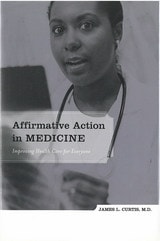
Affirmative Action in Medicine
Improving Health Care for EveryoneJames L. Curtis, M.D.
University of Michigan Press, 2003
Affirmative action programs have significantly changed American medicine for the better, not only in medical school admissions and access to postgraduate training but also in bringing a higher quality of health care to all people. James L. Curtis approaches this important transition from historical, statistical, and personal perspectives. He tells how over the course of his medical education and career as a psychiatrist and professor--often as the first or only African American in his cohort--the status of minorities in the medical professions grew from a tiny percentage to a far more equitable representation of the American population.
Advancing arguments from his earlier book, Blacks, Medical Schools, and Society, Curtis evaluates the outcomes of affirmative action efforts over the past thirty years. He describes formidable barriers to minority access to medical-education opportunities and the resulting problems faced by minority patients in receiving medical treatment. His progress report includes a review of two thousand minority students admitted to U.S. medical schools in 1969, following them through graduation and their careers, comparing them with the careers of two thousand of their nonminority peers. These samples provide an important look at medical schools that, while heralding dramatic progress in physician education and training opportunity, indicates much room for further improvement.
A basic hurdle continues to face African Americans and other minorities who are still confined to segregated neighborhoods and inferior school systems that stifle full scholastic development. Curtis urges us as a nation to develop all our human resources through an expansion of affirmative action programs, thus improving health care for everyone.
James L. Curtis is Clinical Professor Emeritus of Psychiatry, Columbia University College of Physicians and Surgeons.
[more]
Health Care for Some
Rights and Rationing in the United States since 1930Beatrix Hoffman
University of Chicago Press, 2012
In Health Care for Some, Beatrix Hoffman offers an engaging and in-depth look at America’s long tradition of unequal access to health care. She argues that two main features have characterized the US health system: a refusal to adopt a right to care and a particularly American approach to the rationing of care. Health Care for Some shows that the haphazard way the US system allocates medical services—using income, race, region, insurance coverage, and many other factors—is a disorganized, illogical, and powerful form of rationing. And unlike rationing in most countries, which is intended to keep costs down, rationing in the United States has actually led to increased costs, resulting in the most expensive health care system in the world.
While most histories of US health care emphasize failed policy reforms, Health Care for Some looks at the system from the ground up in order to examine how rationing is experienced by ordinary Americans and how experiences of rationing have led to claims for a right to health care. By taking this approach, Hoffman puts a much-needed human face on a topic that is too often dominated by talking heads.
[more]