Results by title
23 books match the query 'Right-wing extremists'

A Conspiratorial Life
Robert Welch, the John Birch Society, and the Revolution of American ConservatismEdward H. Miller
University of Chicago Press, 2021
Though you may not know his name, Robert Welch (1899-1985)—founder of the John Birch Society—is easily one of the most significant architects of our current political moment. In A Conspiratorial Life, the first full-scale biography of Welch, Edward H. Miller delves deep into the life of an overlooked figure whose ideas nevertheless reshaped the American right.
A child prodigy who entered college at age 12, Welch became an unlikely candy magnate, founding the company that created Sugar Daddies, Junior Mints, and other famed confections. In 1958, he funneled his wealth into establishing the organization that would define his legacy and change the face of American politics: the John Birch Society. Though the group’s paranoiac right-wing nativism was dismissed by conservative thinkers like William F. Buckley, its ideas gradually moved from the far-right fringe into the mainstream. By exploring the development of Welch’s political worldview, A Conspiratorial Life shows how the John Birch Society’s rabid libertarianism—and its highly effective grassroots networking—became a profound, yet often ignored or derided influence on the modern Republican Party. Miller convincingly connects the accusatory conservatism of the midcentury John Birch Society to the inflammatory rhetoric of the Tea Party, the Trump administration, Q, and more. As this book makes clear, whether or not you know his name or what he accomplished, it’s hard to deny that we’re living in Robert Welch’s America.

Aryan Cowboys
White Supremacists and the Search for a New Frontier, 1970–2000By Evelyn A. Schlatter
University of Texas Press, 2006
During the last third of the twentieth century, white supremacists moved, both literally and in the collective imagination, from midnight rides through Mississippi to broadband-wired cabins in Montana. But while rural Montana may be on the geographical fringe of the country, white supremacist groups were not pushed there, and they are far from "fringe elements" of society, as many Americans would like to believe. Evelyn Schlatter's startling analysis describes how many of the new white supremacist groups in the West have co-opted the region's mythology and environment based on longstanding beliefs about American character and Manifest Destiny to shape an organic, home-grown movement.
Dissatisfied with the urbanized, culturally progressive coasts, disenfranchised by affirmative action and immigration, white supremacists have found new hope in the old ideal of the West as a land of opportunity waiting to be settled by self-reliant traditional families. Some even envision the region as a potential white homeland. Groups such as Aryan Nations, The Order, and Posse Comitatus use controversial issues such as affirmative action, anti-Semitism, immigration, and religion to create sympathy for their extremist views among mainstream whites—while offering a "solution" in the popular conception of the West as a place of freedom, opportunity, and escape from modern society. Aryan Cowboys exposes the exclusionist message of this "American" ideal, while documenting its dangerous appeal.
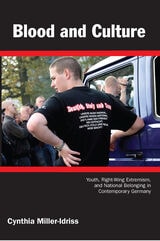
Blood and Culture
Youth, Right-Wing Extremism, and National Belonging in Contemporary GermanyCynthia Miller-Idriss
Duke University Press, 2009
Miller-Idriss describes a new understanding of national belonging emerging among young Germans—one in which cultural assimilation takes precedence over blood or ethnic heritage. Moreover, she argues that teachers’ well-intentioned, state-sanctioned efforts to counter nationalist pride often create a backlash, making radical right-wing groups more appealing to their students. Miller-Idriss argues that the state’s efforts to shape national identity are always tempered and potentially transformed as each generation reacts to the official conception of what the nation “ought” to be.

Bolsonarismo
The Global Origins and Future of Brazil’s Far RightFernando Brancoli
Rutgers University Press, 2024
Through interviews, archival research, and newly available public documents, this book presents a comprehensive and compelling portrait of the neo-evangelical pastors, military personnel, and meritocratic ideologues who are the actors behind the far-right movement. Adding to our understanding of Bolsonarismo's growth in Brazilian politics and the contributing factors behind it, the book also sheds light on the impact of Bolsonarismo on world politics. As a prominent leader of the far-right movement, Jair Bolsonaro's political views and policies have reverberated beyond Brazil's borders, influencing the discourse on issues such as climate change, democracy, and human rights around the world.

Cleavage Politics and the Populist Right
The New Cultural Conflict in Western EuropeAuthored by Simon Bornschier
Temple University Press, 2010
Over the last two decades, right-wing populist parties in Western Europe have gained sizable vote shares and power, much to the fascination and consternation of political observers. Meshing traditionalism and communitarian ideals, right-wing populist parties have come to represent a polar normative ideal to the New Left in Western Europe. In his dynamic study Cleavage Politics and the Populist Right, Simon Bornschier applies a cultural as well as political dimension to analyze the parties of both the right and left in six countries. He develops a theory that integrates the role of political conflict around both established cleavages and party strategies regarding new divisions to explain the varying fortunes of the populist right.
Cyberlibertarianism
The Right-Wing Politics of Digital TechnologyDavid Golumbia
University of Minnesota Press, 2024
An urgent reckoning with digital technology’s fundamentally right-wing legal and economic underpinnings
In a timely challenge to the potent political role of digital technology, Cyberlibertarianism argues that right-wing ideology was built into both the technical and social construction of the digital world from the start. Leveraging more than a decade of research, David Golumbia traces how digital evangelism has driven the worldwide shift toward the political right, concealing inequality, xenophobia, dishonesty, and massive corporate concentrations of wealth and power beneath the utopian presumption of digital technology as an inherent social good.
Providing an incisive critique of the push for open access and open-source software and the legal battles over online censorship and net neutrality, Cyberlibertarianism details how the purportedly democratic internet has been employed as an organizing tool for terror and hate groups and political disinformation campaigns. As he unpacks our naively utopian conception of the digital world, Golumbia highlights technology’s role in the advancement of hyperindividualist and antigovernment agendas, demonstrating how Silicon Valley corporations and right-wing economists; antiestablishment figures such as Julian Assange, Elon Musk, Peter Thiel, Edward Snowden, and Mark Zuckerberg; and seemingly positive voices such as John Perry Barlow, Cory Doctorow, the Electronic Freedom Foundation, and Wikipedia all have worked to hamper regulation and weaken legal safeguards against exploitation.
Drawing from a wide range of thought in digital theory, economics, law, and political philosophy as well as detailed research and Golumbia’s own experience as a software developer, Cyberlibertarianism serves as a clarion call to reevaluate the fraught politics of the internet. In the hope of providing a way of working toward a more genuinely democratic and egalitarian future for digital technology, this magisterial work insists that we must first understand the veiled dogmas from which it has been constructed.
Retail e-book files for this title are screen-reader friendly.

From the Far Right to the Mainstream
Islamophobia in Party Politics and the MediaEdited by Humayun Ansari and Farid Hafez
Campus Verlag, 2012

Hard Right
Muscular Rhetoric and the New NationalismCasey Ryan Kelly
The Ohio State University Press, 2026
A groundbreaking examination of far-right rhetoric around fitness and the human body and how such rhetoric serves white nationalist, masculinist aims.
In recent years, far-right, white-nationalist groups in the US have churned out streams of discourse glorifying “muscularity” as the ideal masculine form. This preoccupation with physical fitness—along with expressed fears of declining testosterone levels in men, race-mixing, and transgender women—all reveal the masculine bodily fantasies and anxieties that underwrite the political unconscious of the far right. In Hard Right, Casey Ryan Kelly examines the link between extreme fitness culture and fascist organizations, arguing that the human body operates as a privileged signifier of national belonging in the rhetoric of the far right.
Drawing from psychoanalytic theory, Kelly shows that far-right rhetoric constructs fantasies of recovering the “natural” or primal masculine body. These fantasies are frequently accompanied by anxieties about “soft,” disabled, and ambiguously gendered bodies, all of which are seen as signs of degeneracy that must be transformed, exiled, or eradicated for the sake of national and racial health. Through its examination of “Red Pill” fitness influencers, “bro science” conspiracy theories, far-right podcasts, and more, Hard Right ultimately shows how the cultural logics of men’s health and physical fitness converge with the political logics of white nationalism and late fascism.

Illiberal Vanguard
Populist Elitism in the United States and RussiaAlexandar Mihailovic
University of Wisconsin Press, 2023
Mihailovic investigates notable right-wing actors like Steve Bannon and Alexander Dugin and targets of right-wing ire such as globalization, LGBTQ+ activism, and mobilizations to remove controversial statues (that honor Confederate generals and Soviet leaders, for instance), but the argument extends beyond the specifics. How and why are radical right-wing movements developing along such similar trajectories in two nominally oppositional countries? How do religious sectarianism, the construction of whiteness, and institutionalized homophobia support each other in this transnational, informal, but powerful allegiance? Despite their appeals to populism and flamboyant theatrics, Mihailovic argues, much of the answer can be found in the mutual desire to justify and organize an illiberal vanguard of elite intellectuals, one that supports and advocates for a new authoritarianism.

Lift High the Cross
Where White Supremacy and the Christian Right ConvergeAnn Burlein
Duke University Press, 2002
Arguing that today’s right engenders its popularity not by overt bigotry or hatred but by focusing on people’s hopes for their children, Burlein finds a politics of grief at the heart of such rhetoric. While demonstrating how religious symbols, rituals, texts, and practices shape people’s memories and their investment in society, she shows how Peters and Dobson each construct countermemories for their followers that reframe their histories and identities—as well as their worlds—by reversing mainstream perspectives in ways that counter existing power relations. By employing the techniques of niche marketing, the politics of scandal, and the transformation of political issues into “gut issues” and by remasculinizing the body politic, Burlein shows, such groups are able to move people into their realm of influence without requiring them to agree with all their philosophical, doctrinal, or political positions.
Lift High the Cross will appeal to students and scholars of religion, American cultural studies, women’s studies, sociology, and gay and lesbian studies, as well as to non-specialists interested in American politics and, specifically, the right.

Nut Country
Right-Wing Dallas and the Birth of the Southern StrategyEdward H. Miller
University of Chicago Press, 2015
In Nut Country, Edward H. Miller tells the story of that transformation, showing how a group of influential far-right businessmen, religious leaders, and political operatives developed a potent mix of hardline anticommunism, biblical literalism, and racism to generate a violent populism—and widespread power. Though those figures were seen as extreme in Texas and elsewhere, mainstream Republicans nonetheless found themselves forced to make alliances, or tack to the right on topics like segregation. As racial resentment came to fuel the national Republican party’s divisive but effective “Southern Strategy,” the power of the extreme conservatives rooted in Texas only grew.
Drawing direct lines from Dallas to DC, Miller's captivating history offers a fresh understanding of the rise of the new Republican Party and the apocalyptic language, conspiracy theories, and ideological rigidity that remain potent features of our politics today.

Partnering with Extremists
Coalitions between Mainstream and Far-Right Parties in Western EuropeKimberly A. Twist
University of Michigan Press, 2019
As long as far-right parties—known chiefly for their vehement opposition to immigration—have competed in contemporary Western Europe, many have worried about these parties’ acceptability to democratic voters and mainstream parties. Yet, rather than treating the far right as pariahs, major mainstream-right parties have included the far right in 15 governing coalitions from 1994 to 2017. Parties do not care equally about all issues at any given time, and Kimberly Twist demonstrates that far-right parties will agree to support the mainstream right’s goals more readily than many other parties, making them appealing partners.
Partnering with Extremists builds on existing work on coalition formation and party goals to propose a theory of coalition formation that works across countries and over time. The evidence comes from 19 case studies of coalition formation in Austria and the Netherlands, countries where far-right parties have been excluded when they could have been included and included when the mainstream right had other options. The argument is then extended to countries where coalitions are less common, France and the United Kingdom, and to cases of mainstream-right adoption of far-right themes. Twist incorporates both office and policy considerations in her argument and reimagines “policy” to be a two-dimensional factor; it matters not just where parties are located on an issue but how firmly they hold those positions.

Politics on the Fringe
The People, Policies, and Organization of the French National FrontEdward G. DeClair
Duke University Press, 1999
Using rare, in-depth interviews with twenty-nine members of the Front elite, as well as public opinion survey data and electoral results, DeClair examines the internal structure of the Front, its political agenda, and its growing influence in France. DeClair shows how the party has dramatically expanded its traditionally narrow core constituency by capitalizing upon anxieties about national identity, immigration, European unification, and rising unemployment. In illustrating how the rhetoric surrounding such topics is key to the Front’s success, DeClair examines the Front’s legacy by detailing the links between the French far-right and similar movements in such countries as Germany, Belgium, Austria, Italy, and the United States. Finally, Politics on the Fringe offers not only a complete picture of the Front’s increasingly influential role in French partisan politics but also further insight into the resurgence of right-wing extremism throughout western societies in the late twentieth century.
This volume will be of primary importance to political scientists and those engaged with European politics, culture, and history. It will also appeal to those concerned with right-wing populism and political movements.
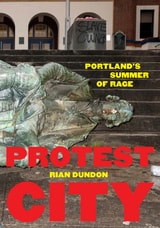
Protest City
Portland's Summer of RageRian Dundon
Oregon State University Press, 2023
In the months leading up to the 2020 presidential election, Portland made national news with nightly social justice protests, often met with violent response by counter protestors and law enforcement. Though frequently regarded as a progressive hub, Portland has a long history of racial inequality and oppression, and the city’s entrenched divisions gained new attention during the Trump years. The photos in Protest City present a visceral visual record of this significant moment in Portland’s history.
Rian Dundon, who has been photographing the rise of extreme politics on the West Coast since 2016, lived only a short walk from the protests that erupted after the murder of George Floyd. For one hundred days, Dundon enmeshed himself in the demonstrations with an unobtrusive point-and-shoot camera. The result is a graphic portrayal of how social movements become politicized, how spectacle serves as a subtext to change in the digital age, and how modern protests blur distinctions among performance, ritual, and surveillance. As he follows the progress of Portland’s conflicts, Dundon draws connections to Oregon’s legacy as a stronghold of white supremacist extremism and interrogates the role of whiteness in racial justice movements.
Most of the photographs in the book were taken between May and October 2020, but the collection also includes photos from protests in late 2020 and 2021 around various related issues, including the Red House eviction blockade, rightwing demonstrations on January 6 and 17, and the one-year anniversary of George Floyd’s murder. Dundon’s striking photos recreate the immediacy and impact of the protests, while essays by historian Carmen Thompson and journalist Donnell Alexander contextualize the uprising’s sociopolitical background. A chronology and author’s note are also featured.
The publisher and author would like to thank the Magnum Foundation, Documentary Arts, and the Economic Hardship Reporting Project for their generous support of this publication. Additional funding has been provided by Furthermore: a program of the J. M. Kaplan Fund.
Radicalizing Men
Fascist Desires, Great Replacement Propaganda, and Political ViolenceJessica Johnson
Duke University Press, 2026

Saints, Sinners, and Sovereign Citizens
The Endless War over the West's Public LandsJohn L. Smith
University of Nevada Press, 2026
The grazing rights battle between Nevada rancher Cliven Bundy and the federal government, resulting in a tense, armed standoff between Bundy’s supporters and federal law enforcement officers, garnered international media attention in 2014. Saints, Sinners, and Sovereign Citizens places the Bundy conflict into the larger context of the Sagebrush Rebellion and the long struggle over the use of federal public lands in the American West.
Author John L. Smith skillfully captures the drama of the Bundy legal tangle amid the current political climate. Although no shots were fired during the standoff itself, just weeks later self-proclaimed Bundy supporters murdered two Las Vegas police officers and a civilian. In Eastern Oregon, other Bundy supporters occupied the federal offices of the Malheur National Wildlife Refuge, and one of them died in a hail of bullets.
While examining the complex history of federal public land policies, Smith exposes both sides of this story. He shows that there are passionate true believers on opposite sides of the insurrection, along with government agents and politicians in Washington complicit in efforts to control public lands for their wealthy allies and campaign contributors. With the promise of billions of dollars in natural resource profits and vast tracts of environmentally sensitive lands hanging in the balance, the West’s latest range war is the most important in the nation’s history. This masterful exposé raises serious questions about the fate of America’s public lands and the vehement arguments that are framing the debate from all sides.
The Battle for White Male Supremacy
The Hydra Reshaping Right-Wing PoliticsMary McThomas
University of Chicago Press, 2027
Explains how interconnected race and gender ideologies underlie grievance politics on the Right and reveals how both are transforming American politics, policy, and law.
In The Battle for White Male Supremacy, Mary McThomas sheds new light on the entwined racial and gender ideologies that have come to define large segments of the American Right and are roiling American law and politics. Individual chapters trace the development, ideas, and influence of several key groups: incels, alt-right vigilante groups, Christian nationalists, and men’s rights groups at war with the judiciary. While these groups are often treated as discrete phenomena with distinct histories and ostensibly different goals, all share an interconnected belief system of victimhood and embattled white masculinity. By tracking these similarities, McThomas exposes how racial and gendered belief systems are connected both within and across groups.
What is more, McThomas shows that these groups’ beliefs and tactics have moved from the extremist fringes of society to the mainstream of American politics. They’ve gained broad traction in public opinion and political discourse, and they are transforming law and policy at both the state and federal levels.

The Emergence of a Euro-American Radical Right
Kaplan, Jeffrey
Rutgers University Press, 1998
The United States and Western Europe are experiencing a new and important cultural and political development: the appearance of a right wing extremist movement that crosses the Atlantic Ocean and transcends national boundaries with as much ease as do e-mail messages on the Internet. In this book, Jeffrey Kaplan and Leonard Weinberg argue that there now exists a set of conditions common to the United States and Western Europe that draws right wing radicals on both sides of the Atlantic closer together. These conditions, based on demographic pressures, social dislocation, economic changes, and technological advances, have set the stage for the formation of a new Euro-American radical right movement whose motives and characteristics differ from the right wing groups of the early twentieth century.
During the first thirty years of this century, radical right wing ideas and material support flowed primarily from Europe to the United States. In recent years, the inspiration for the movement has tended to flow in the opposite direction, with the establishment of various American-based groups, like the Ku Klux Klan and the White Aryan Resistance, on European soil. Kaplan and Weinberg contend that unlike their predecessors contemporary Western right wing groups develop a common identity based more on racial solidarity than on national identity. To support their argument, the authors provide a history of extreme right wing activity in the West and a comprehensive, detailed overview of major figures, groups, and characteristics that comprise the Euro-American radical right. They discuss the role of the Internet in facilitating the transatlantic community and offer personal, inside accounts of people involved in the various movements.
The Personality of Power
A Theory of Fascism for Anti-fascist LifeBrian Massumi
Duke University Press, 2025
The Rage of Replacement
Far Right Politics and Demographic FearMichael Feola
University of Minnesota Press, 2024
Tracing how the “Great Replacement” narrative has shaped far-right extremism and propelled its dangerous political projects and acts of violence
The “Great Replacement” narrative, which imagines that historic white majorities are being intentionally replaced through immigration policies crafted by global elites, has effectively mobilized racist, nationalist, and nativist movements in the United States and Europe. The Rage of Replacement tracks how this narrative has shaped the politics and worldview of the far right, binding its various camps into a community of rage obsessed with nostalgia for a white-supremacist past.
Showing how the replacement narrative has found significant purchase in recent mainstream discourse through the rise of Trumpism, right-wing media figures like Tucker Carlson, and events such as 2017’s “Unite the Right” rally in Charlottesville, Virginia, Michael Feola diagnoses the dangers this racist theory poses as it shapes the far-right imagination, expands through civil society, and deforms political culture. In particular, he tracks how the replacement narrative has given rise to malignant political strategies designed to “take back” the nation from its perceived enemies—by force if deemed necessary.
Identifying the Great Replacement narrative as a central force behind the rise and expansion of far-right extremism, Feola shows how it has motivated a variety of dangerous political projects in pursuit of illiberal, antidemocratic futures. From calls for the creation of segregated white ethnostates to extremist violence such as the mass shootings in Christchurch, El Paso, and Buffalo, The Rage of Replacement makes clear that replacement theory poses a dire threat to democracy and safety.
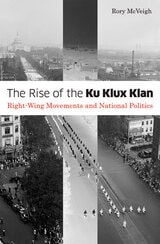
The Rise of the Ku Klux Klan
Right-Wing Movements and National PoliticsRory McVeigh
University of Minnesota Press, 2009
What's Fair on the Air?
Cold War Right-Wing Broadcasting and the Public InterestHeather Hendershot
University of Chicago Press, 2011
Women of the Far Right
The Mothers' Movement and World War IIGlen Jeansonne
University of Chicago Press, 1996
Unlike leftist antiwar movements, the mothers' movement was not pacifist; its members opposed the war on Germany because they regarded Hitler as an ally against the spread of atheistic communism. They also differed from leftist women in their endorsement of patriarchy and nationalism. God, they believed, wanted them to fight the New Deal liberalism that imperiled their values and the internationalists, communists, and Jews, whom they saw as subjugating Christian America.
Jeansonne examines the motivations of these women, the political and social impact of their movement, and their collaborations with men of the far right and also with mainstream isolationists such as Charles Lindbergh. Drawing on files kept by the FBI and other confidential documents, this book sheds light on the history of the war era and on women's place within the far right.