Results by title
5 books match the query 'Rio Grande'
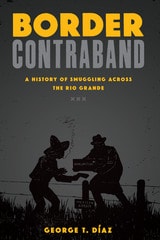
Border Contraband
A History of Smuggling across the Rio GrandeBy George T. Díaz
University of Texas Press, 2015
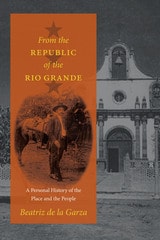
From the Republic of the Rio Grande
A Personal History of the Place and the PeopleBy Beatriz de la Garza
University of Texas Press, 2013
The Republic of the Rio Grande had a brief and tenuous existence (1838–1840) before most of it was reabsorbed by Mexico and the remainder annexed by the United States, yet this region that straddles the Rio Grande has retained its distinctive cultural identity to the present day. Born on one side of the Rio Grande and raised on the other, Beatriz de la Garza is a product of this region. Her birthplace and its people are the subjects of this work, which fuses family memoir and borderlands history.
From the Republic of the Rio Grande brings new insights and information to the study of transnational cultures by drawing from family papers supplemented by other original sources, local chronicles, and scholarly works. De la Garza has fashioned a history of this area from the perspective of individuals involved in the events recounted. The book is composed of nine sections spanning some two hundred years, beginning in the mid-1700s. Each section covers not only a chronological period but also a particular theme relating to the history of the region. De la Garza takes a personal approach, opening most sections with an individual observation or experience that leads to the central motif, whether this is the shared identity of the inhabitants, their pride in their biculturalism and bilingualism, or their deep attachment to the land of their ancestors.
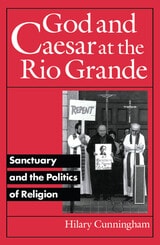
God and Caesar at the Rio Grande
Sanctuary and the Politics of ReligionHilary Cunningham
University of Minnesota Press, 1995
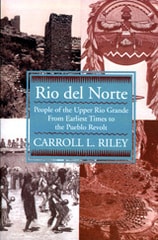
Rio del Norte
People of Upper Rio Grande from Earliest Times to Pueblo RevoltCarroll L. Riley
University of Utah Press, 1995
Rio del Norte chronicles the upper Rio Grande region and its divers peoples across twelve thousand years of continuous history. Based on the most up-to-date historical and archaeological research, Rio del Norte is a tour de force, highlighting the unbroken history of the upper Rio Grande.
Beginning with the mammoth hunters of eleven millennia ago, Carroll Riley adeptly eaves the threads of twelve thousand years of continuous history through the introduction of agriculture, the rise of the Basketmaker-Pueblo (Anasazi) people, and the extraordinary "quickening" that occurred along the Rio Grande and its tributaries as the Anasazi era ended.
At that time large towns appeared, some holding several thousand people who practiced irrigation-based agriculture, maintained complex social and political organizations, and had a rich artistry. This "golden age" was continuing when Spaniards contacted, then colonized and missionized the region. In 1680 the Pueblos joined in a powerful record and ousted the invaders. Although the Spanish returned, the Pueblos have maintained important parts of their cultural heritage to the present.

Texas Ranger Lee Hall
From the Red River to the Rio GrandeChuck Parsons
University of North Texas Press, 2020