Results by title
7 books match the query 'Rio Grande Valley (Colo.-Mexico and Tex.)'
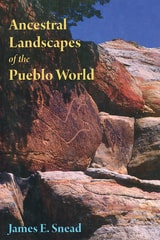
Ancestral Landscapes of the Pueblo World
James E. Snead
University of Arizona Press, 2008
From Mountain Top to Valley Bottom
Understanding Past Land Use in the Northern Rio Grande Valley, New MexicoBradley J. Vierra
University of Utah Press, 2013
The essays in this collection are unified by three specific themes: landscape, movement, and technology. Landscape involves the ecological backdrop of the northern Rio Grande valley, including past and present environments. Movement refers to the positioning of people across the landscape along with the dynamic and fluid nature with which people—past and present—view their relationship with the “above” and “below.” Technology not only refers to the tools and facilities that past people may have used but to the organization of labor needed to cooperatively exploit a variety of subsistence resources and the exchange of products across the region. This volume provides both a cross section of current research from expert scholars and a broad perspective that seeks to integrate new data from lowland and upland contexts. From Mountain Top to Valley Bottom will appeal to those interested in obsidian source studies, geoarchaeology, past climatic regimes, foraging societies, early agriculture, ceramic technology, subsistence, early village formation, ethnogenesis, and historic multiethnic economies.
Indians of the Rio Grande Delta
Their Role in the History of Southern Texas and Northeastern MexicoBy Martín Salinas
University of Texas Press, 1990
Indians of the Rio Grande Delta is the first single-volume source on these little-known peoples. Working from innumerable primary documents in various Texan and Mexican archives, Martin Salinas has compiled data on more than six dozen named groups that inhabited the area in the sixteenth through the eighteenth centuries. Depending on available information, he reconstructs something of their history, geographical range and migrations, demography, language, and culture. He also offers general information on various unnamed groups of Indians, on the lifeways of the indigenous peoples, and on the relations between the Indian groups and the colonial Spanish missions in the region.
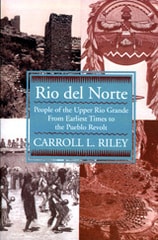
Rio del Norte
People of Upper Rio Grande from Earliest Times to Pueblo RevoltCarroll L. Riley
University of Utah Press, 1995
Rio del Norte chronicles the upper Rio Grande region and its divers peoples across twelve thousand years of continuous history. Based on the most up-to-date historical and archaeological research, Rio del Norte is a tour de force, highlighting the unbroken history of the upper Rio Grande.
Beginning with the mammoth hunters of eleven millennia ago, Carroll Riley adeptly eaves the threads of twelve thousand years of continuous history through the introduction of agriculture, the rise of the Basketmaker-Pueblo (Anasazi) people, and the extraordinary "quickening" that occurred along the Rio Grande and its tributaries as the Anasazi era ended.
At that time large towns appeared, some holding several thousand people who practiced irrigation-based agriculture, maintained complex social and political organizations, and had a rich artistry. This "golden age" was continuing when Spaniards contacted, then colonized and missionized the region. In 1680 the Pueblos joined in a powerful record and ousted the invaders. Although the Spanish returned, the Pueblos have maintained important parts of their cultural heritage to the present.
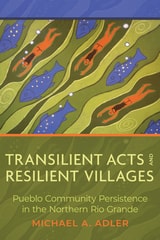
Transilient Acts and Resilient Villages
Pueblo Community Persistence in the Northern Rio GrandeMichael A. Adler
University of Arizona Press, 2026
Focusing on the Tiwa-speaking communities of Taos, Picuris, and Pot Creek Pueblos, Adler shows how social and ritual organization, architectural change, and sacred geographies were mobilized in response to disruption. He challenges conventional resilience theory, which emphasizes systemic stability, instead centering Indigenous agency, mobility, and sacred practice as key to understanding cultural endurance.
Grounded in decades of collaborative research with Pueblo communities, Transilient Acts and Resilient Villages is a vital contribution to southwestern archaeology. It offers a compelling model for how archaeology can respectfully engage with descendant communities and provides essential insights for scholars, students, and community members seeking to understand the complexities of cultural persistence in the face of change.

Valley Interfaith and School Reform
Organizing for Power in South TexasBy Dennis Shirley
University of Texas Press, 2002
Can public schools still educate America's children, particularly in poor and working class communities? Many advocates of school reform have called for dismantling public education in favor of market-based models of reform such as privatization and vouchers. By contrast, this pathfinding book explores how community organizing and activism in support of public schools in one of America's most economically disadvantaged regions, the Rio Grande Valley of South Texas, has engendered impressive academic results.
Dennis Shirley focuses the book around case studies of three schools that have benefited from the reform efforts of a community group called Valley Interfaith, which works to develop community leadership and boost academic achievement. He follows the remarkable efforts of teachers, parents, school administrators, clergy, and community activists to take charge of their schools and their communities and describes the effects of these efforts on students' school performance and testing results.
Uniting gritty realism based on extensive field observations with inspiring vignettes of educators and parents creating genuine improvement in their schools and communities, this book demonstrates that public schools can be vital "laboratories of democracy," in which students and their parents learn the arts of civic engagement and the skills necessary for participating in our rapidly changing world. It persuasively argues that the American tradition of neighborhood schools can still serve as a bedrock of community engagement and academic achievement.

Wild Tongue
A Borderlands MixtapeJonathan Leal
Duke University Press, 2026