Results by title
7 books match the query 'Risk Assessment & Management'
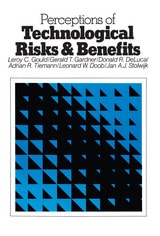
Perceptions of Technological Risks and Benefits
Leroy C. Gould
Russell Sage Foundation, 1988
The election of Ronald Reagan in 1980 was said to herald a new mood of opposition to government regulation. But at the same time, large and vocal segments of the population have been demanding that corporations and regulatory agencies address public concerns about technological safety. What do we really know about people's perceptions of technological risk and their judgments about appropriate levels of technological regulation? Perceptions of Technological Risks and Benefits analyzes the results of a unique body of survey data—the only large-scale, representative survey of public attitudes about risk management in such technologies as nuclear power, handguns, auto travel, and industrial chemicals. The findings demonstrate that public judgments are not simply anti-technological or irrational, but rather the product of a complex set of factors that includes an awareness of benefits as well as a sensitivity to the "qualitative" aspects of risk (how catastrophic, dreaded, or poorly understood a hazard seems to be). This volume offers striking evidence that whatever Americans may think about government regulation in general, they are remarkably consistent in desiring stricter regulation of technological safety. These conclusions suggest that the current trend away from regulation of technology reflects a less than perfect reading of public sentiment.
[more]
Probable Justice
Risk, Insurance, and the Welfare StateRachel Z. Friedman
University of Chicago Press, 2020
Decades into its existence as a foundational aspect of modern political and economic life, the welfare state has become a political cudgel, used to assign blame for ballooning national debt and tout the need for personal responsibility. At the same time, it affects nearly every citizen and permeates daily life—in the form of pension, disability, and unemployment benefits, healthcare and parental leave policies, and more. At the core of that disjunction is the question of how we as a society decide who should get what benefits—and how much we are willing to pay to do so.
Probable Justice traces a history of social insurance from the eighteenth century to today, from the earliest ideas of social accountability through the advanced welfare state of collective responsibility and risk. At the heart of Rachel Z. Friedman’s investigation is a study of how probability theory allows social insurance systems to flexibly measure risk and distribute coverage. The political genius of social insurance, Friedman shows, is that it allows for various accommodations of needs, risks, financing, and political aims—and thereby promotes security and fairness for citizens of liberal democracies.
Probable Justice traces a history of social insurance from the eighteenth century to today, from the earliest ideas of social accountability through the advanced welfare state of collective responsibility and risk. At the heart of Rachel Z. Friedman’s investigation is a study of how probability theory allows social insurance systems to flexibly measure risk and distribute coverage. The political genius of social insurance, Friedman shows, is that it allows for various accommodations of needs, risks, financing, and political aims—and thereby promotes security and fairness for citizens of liberal democracies.
[more]
Reporting on Risk
How the Mass Media Portray Accidents, Diseases, Other HazardsEleanor Singer
Russell Sage Foundation, 1993
After acts of airline terrorism, air travel tends to drop dramatically—yet Americans routinely pursue the far riskier business of driving cards, where accidents resulting in death or injury are much more likely to occur. Reporting on Risk argues that this selective concern with danger is powerfully shaped by the media, whose coverage of potentially hazardous events is governed more by a need to excite the public than to inform it. Singer and Endreny survey a wide range of print and electronic media to provide an unprecedented look at how hundreds of different hazards are presented to the public—from toxic waste and food poisoning to cigarette smoking, from transportation accidents to famine, and from experimental surgery to communicable diseases. Their investigations raise thought-provoking questions about what the media tell us about modern risks, which hazards are covered and which ignored, and how the media determine when hazards should be considered risky. Are natural hazards reported differently than man-made hazards? Is greater emphasis placed on the potential benefits or the potential drawbacks of complex new technologies? Are journalists more concerned with reporting on unproven cures or informing the public about preventative measures? Do newspapers differ from magazines and television in their risk reporting practices? Reporting on Risk investigates how the media place blame for disasters, and looks at how the reporting of risks has changed in the past twenty-five years as such hazards as nuclear power, birth control methods, and industrial by-products have grown in national prominence. The authors demonstrate that the media often fail to report on risks until energized by the occurrence of some disastrous or dramatic event—the Union Carbide pesticide leak in Bhopal, the Challenger explosion, the outbreak of famine in Somalia, or the failed transplant of a baboon heart to "Baby Fae." Sustained attention to these hazards depends less on whether the underlying issues have been resolved than on whether they continue to unfold in newsworthy events. Reporting on Risk examines the accuracy and the amount of information we receive about our environment. It offers a critical perspective on how our perceptions of risk, as shaped by the media, may contribute to misguided individual and public choices for action and prevention in an increasingly complex world. The authors' probing assessment of how the media report a vast array of risks offers insights useful to journalists, policy analysts, risk specialists, legislators, and concerned citizens.
[more]
Risk Acceptability According to the Social Sciences
Mary Douglas
Russell Sage Foundation, 1985
Every day, it seems, we become aware of some new technological or chemical hazard. Yet it is also possible that this very awareness is new, or at least newly heightened. Why are certain kinds of risks suddenly so salient? Are public perceptions of risk simply the sum of individual reactions to individual events, or do social and cultural influences play a role in shaping our definitions of safety, acceptable risk, and danger? Prompted by public outcries and by the confusion and uncertainty surrounding risk management policy, social scientists have begun to address themselves to the issue of risk perception. But as anthropologist Mary Douglas points out, they have been singularly reluctant to examine the cultural bases of risk perception, preferring to concentrate on the individual perceiver making individual choices. This approach leaves unexamined a number of crucial social factors—our concepts of what is "natural" or "artificial," for example; our beliefs about fairness, and our moral judgements about the kind of society in which we want to live. This provocative and path-breaking report seeks to open a sociological approach to risk perception that has so far been systematically neglected. Describing first some exceptions to the general neglect of culture, Douglas builds on these clues and on her own broad anthropological perspective to make a compelling case for focusing on social factors in risk perception. She offers a challenge and a promising new agenda to all who study perceptions of risk and, by extension, to those who study human cognition and choice as well. "An altogether brilliant piece of writing—far-reaching and a joy to read." —Amartya Sen, Oxford University A Volume in the Russell Sage Foundation's Social Science Frontiers Series
[more]
Risk Management and Political Culture
Sheila Jasanoff
Russell Sage Foundation, 1986
This unique comparative study looks at efforts to regulate carcinogenic chemicals in several Western democracies, including the United States, and finds marked national differences in how conflicting scientific interpretations and competing political interests are resolved. Whether risk issues are referred to expert committees without public debate or debated openly in a variety of forums, patterns of interaction among experts, policy makers, and the public reflect fundamental features of each country's political culture. "A provocative argument....Poses interesting questions for the sociology of science, especially science produced for public debate."—Contemporary Sociology A Volume in the Russell Sage Foundation's Social Science Frontiers Series
[more]
Risk Taking
A Managerial PerspectiveZur Shapira
Russell Sage Foundation, 1995
Classical economic theory assumes that people in risk situations follow a course of action based on a rational, consistent assessment of likely outcomes. But as Zur Shapira demonstrates in Risk Taking, corporate managers consistently stray from the prescribed path into far more subjective territory. Risk Taking offers a critical assessment of the relationship between theory and action in managerial decision making. Shapira offers a definitive account of the classical conception of risky decision making, which derives behavioral prescriptions from a calculation of both the value and the likelihood of possible outcomes. He then demonstrates how theories in this vein have been historically at odds with empirical observations. Risk Taking reports the results of an extensive survey of seven hundred managers that probed their attitudes and beliefs about risk and examined how they had actually made decisions in the face of uncertainty. The picture that emerges is of a dynamic, flexible process in which each manager's personal expertise and perceptions play profound roles. Managerial strategies are continually modified to suit changing circumstances. Rather than formulating probability estimates, executives create potential scenarios based not only on the possible outcomes but also on the many arbitrary factors inherent in their own situations. As Shapira notes, risk taking propensities vary among managers, and the need to maintain control and avoid particularly dangerous results exercises a powerful influence. Shapira also examines the impact of organizational structure, long-term management objectives, and incentives on decision making. With perceptive observations of the cognitive, emotional, and organizational dimensions of corporate decision making, Risk Taking propels the study of managerial risk behavior into new directions. This volume signals the way toward improving managerial decision making by revealing the need for more inclusive choice models that augment classical theory with vital behavioral observations.
[more]
The Risk Professionals
Thomas Dietz
Russell Sage Foundation, 1987
In the two decades since a new social movement put environmental issues high on the national policy agenda, Washington has become home to a small group of people—the risk professionals—whose careers center on the identification, assessment, and management of risks to public health and safety. These men and women, experts working in federal agencies, Congress, activist organizations, and corporations, help transform mass concern into government policy, shaping the way our society responds to environmental and technological hazards. Based on nearly 230 interviews, The Risk Professionals provides the first comprehensive sociological analysis of our "danger establishment." Dietz and Rycroft explore the social, educational, and career profiles of risk professionals; their worldviews and ideologies; their networks and norms. Not content to view risk professionals from a single perspective, the authors build an integrated description that considers commonalities in their subjects' backgrounds, interests, values, and communication patterns. The result is a uniquely revealing look into the heart of the risk policy system, and a broader illumination of the social structures and dynamics that will influence environmental policy for years to come. A Volume in the Russell Sage Foundation's Social Science Frontiers Series
[more]