Results by title
5 books match the query 'Risks'
American Childhood
Risks and RealitiesSchneider, Dona
Rutgers University Press, 1995
To show how the statistics can both disguise and highlight problems, Schneider alternates a discussion of the numbers with vivid encounters with individual children and adults: the middle-class black high school student's offhand explanation about how to get a gun; a vital statistics bureau worker's astonishment at his own classification as Hispanic; a young woman's pleasure in holding down a job after teachers dismissed her as learning disabled; and a latchkey child's nightmare of coming home from school to an empty house when she was sick.
This book guides us through the morass of numbers bandied about to describe the state of America's children—what the numbers tell us and what they don't—and it offers a call for action. Comprehensive in its treatment of all groups of children and accessible in style, this book is essential for anyone concerned about children in American society.
Business Confronts Terrorism
Risks and ResponsesDean C. Alexander
University of Wisconsin Press, 2004
These scenarios could be part of a future Hollywood movie. Sadly, they are representative of previous terror attacks against industry and government interests worldwide. Moreover, they are harbingers of global terror threats.
Industry constitutes a prime target of contemporary terrorism. This timely book analyzes the threats companies face due to terrorism, industry responses to these dangers, and terrorism’s effects on conducting business in the post-9/11 environment. Dean C. Alexander details the conventional and unconventional terror capabilities facing industry. He describes the activities of terrorists in the economic system and the ways they finance their operations.
Alexander discusses how companies can reduce terrorist threats and that corporate security can minimize political violence. He outlines the dynamics of the public-private partnership against terrorism: government aiding industry, business supporting government, and tensions between the two. He also delineates terrorism’s effects—financial, physical, and emotional—on workers and employers. He highlights the negative financial and economic consequences of terrorism. He discusses the impact of terrorism on traditional business practices and concludes with an assessment of future trends.
Risks in Agricultural Supply Chains
Edited by Pol Antràs and David Zilberman
University of Chicago Press, 2023
An essential guide to the role of microeconomic incentives, macro policies, and technological change in enhancing agriculture resilience.
Climate change and the recent COVID-19 pandemic have exposed the vulnerability of global agricultural supply and value chains. There is a growing awareness of the importance of interactions within and between these supply chains for understanding the performance of agricultural markets. This book presents a collection of research studies that develop conceptual models and empirical analyses of risk resilience and vulnerability in supply chains. The chapters emphasize the roles played by microeconomic incentives, macroeconomic policies, and technological change in contributing to supply chain performance. The studies range widely, considering for example how agent-based modeling and remote sensing data can be used to assess the impact of shocks, and how recent shocks such as the COVID-19 pandemic and the African Swine fever in China affected agricultural labor markets, the supply chain for meat products, and the food retailing sector. A recurring theme is the transformation of agricultural supply chains and the volatility of food systems in response to microeconomic shocks. The chapters not only present new findings but also point to important directions for future research.
The Risks of Financial Institutions
Edited by Mark Carey and René M. Stulz
University of Chicago Press, 2007
Until about twenty years ago, the consensus view on the cause of financial-system distress was fairly simple: a run on one bank could easily turn to a panic involving runs on all banks, destroying some and disrupting the financial system. Since then, however, a series of events—such as emerging-market debt crises, bond-market meltdowns, and the Long-Term Capital Management episode—has forced a rethinking of the risks facing financial institutions and the tools available to measure and manage these risks.
The Risks of Financial Institutions examines the various risks affecting financial institutions and explores a variety of methods to help institutions and regulators more accurately measure and forecast risk. The contributors--from academic institutions, regulatory organizations, and banking--bring a wide range of perspectives and experience to the issue. The result is a volume that points a way forward to greater financial stability and better risk management of financial institutions.
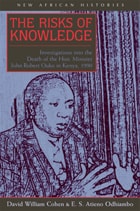
The Risks of Knowledge
Investigations into the Death of the Hon. Minister John Robert Ouko in Kenya, 1990David William Cohen
Ohio University Press, 2004
In February 1990 assailants murdered Kenya’s distinguished Minister of Foreign Affairs and International Cooperation, Robert Ouko. The horror of the attack, the images of his mutilated and burned corpse, the evidence of a notorious cover-up, and the revelations of the pressures, conflicts, and fears he faced in his last weeks have engaged Kenya’s publics for years. The Risks of Knowledge minutely examines the multiple and unfinished investigations into the crime.
Among the probes was an extensive 1990 inquiry organized by a New Scotland Yard team invited to Kenya by the government, as well as an open public commission of inquiry appointed by President Daniel arap Moi. The commission ran for seventeen months in 1990-91 before the president shut it down. International and Kenyan unrest over Ouko’s brutal death brought increasing attention to corruption and violence associated with the Moi government, leading in late 1991 to multiparty politics and in December 2002 to the elections that ended the Moi era.
This powerfully argued book raises important issues about the production of knowledge and the politics of memory that will interest a large interdisciplinary audience.