Results by title
3 books match the query 'Rivalry'

Regionalism and Rivalry
Japan and the U.S. in Pacific AsiaEdited by Jeffrey A. Frankel and Miles Kahler
University of Chicago Press, 1993
As Japan's newfound economic power leads to increased political power, there is concern that Japan may be turning East Asia into a regional economic bloc to rival the U.S. and Europe. In Regionalism and Rivalry, leading economists and political scientists address this concern by looking at three central questions: Is Japan forming a trading bloc in Pacific Asia? Does Japan use foreign direct investment in Southeast Asia to achieve national goals? Does Japan possess the leadership qualities necessary for a nation assuming greater political responsibility in international affairs?
The authors contend that although intraregional trade in East Asia is growing rapidly, a trade bloc is not necessarily forming. They show that the trade increase can be explained entirely by factors independent of discriminatory trading arrangements, such as the rapid growth of East Asian economies. Other chapters look in detail at cases of Japanese direct investment in Southeast Asia and find little evidence of attempts by Japan to use the power of its multinational corporations for political purposes. A third group of papers attempt to gauge Japan's leadership characteristics. They focus on Japan's "technology ideology," its contributions to international public goods, international monetary cooperation, and economic liberalization in East Asia.
The authors contend that although intraregional trade in East Asia is growing rapidly, a trade bloc is not necessarily forming. They show that the trade increase can be explained entirely by factors independent of discriminatory trading arrangements, such as the rapid growth of East Asian economies. Other chapters look in detail at cases of Japanese direct investment in Southeast Asia and find little evidence of attempts by Japan to use the power of its multinational corporations for political purposes. A third group of papers attempt to gauge Japan's leadership characteristics. They focus on Japan's "technology ideology," its contributions to international public goods, international monetary cooperation, and economic liberalization in East Asia.
[more]

Rivalry and Reform
Presidents, Social Movements, and the Transformation of American PoliticsSidney M. Milkis and Daniel J. Tichenor
University of Chicago Press, 2019
Few relationships have proved more pivotal in changing the course of American politics than those between presidents and social movements. For all their differences, both presidents and social movements are driven by a desire to recast the political system, often pursuing rival agendas that set them on a collision course. Even when their interests converge, these two actors often compete to control the timing and conditions of political change. During rare historical moments, however, presidents and social movements forged partnerships that profoundly recast American politics.
Rivalry and Reform explores the relationship between presidents and social movements throughout history and into the present day, revealing the patterns that emerge from the epic battles and uneasy partnerships that have profoundly shaped reform. Through a series of case studies, including Abraham Lincoln and abolitionism, Lyndon Johnson and the civil rights movement, and Ronald Reagan and the religious right, Sidney M. Milkis and Daniel J. Tichenor argue persuasively that major political change usually reflects neither a top-down nor bottom-up strategy but a crucial interplay between the two. Savvy leaders, the authors show, use social movements to support their policy goals. At the same time, the most successful social movements target the president as either a source of powerful support or the center of opposition. The book concludes with a consideration of Barack Obama’s approach to contemporary social movements such as Black Lives Matter, United We Dream, and Marriage Equality.
Rivalry and Reform explores the relationship between presidents and social movements throughout history and into the present day, revealing the patterns that emerge from the epic battles and uneasy partnerships that have profoundly shaped reform. Through a series of case studies, including Abraham Lincoln and abolitionism, Lyndon Johnson and the civil rights movement, and Ronald Reagan and the religious right, Sidney M. Milkis and Daniel J. Tichenor argue persuasively that major political change usually reflects neither a top-down nor bottom-up strategy but a crucial interplay between the two. Savvy leaders, the authors show, use social movements to support their policy goals. At the same time, the most successful social movements target the president as either a source of powerful support or the center of opposition. The book concludes with a consideration of Barack Obama’s approach to contemporary social movements such as Black Lives Matter, United We Dream, and Marriage Equality.
[more]
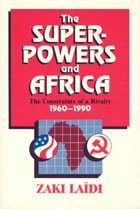
The Superpowers and Africa
The Constraints of a Rivalry, 1960-1990Zaki Laidi
University of Chicago Press, 1990
That Africa—one of the superpowers' crucial diplomatic and economic battlegrounds—now verges on political developments as dramatic as those of eastern Europe compels us to consider the tremendous influence that East and West have wielded in recent African political development. Drawing from American diplomatic archives, firsthand interviews, and the African and international press, Zaki Laidï presents a historical analysis of how the dialectical relationships of the United States, Soviet Union, and African actors evolved to their present state.
The lapse of European influence in the 1960s left a diplomatic void, which the superpowers rushed to fill. Just as Dien Bien Phû and the Suez crisis thrust Asia and the Near East, respectively, into the diplomatic spotlight, so the Angolan crisis lent a multifaceted cast to Africa's international relations. The ebb and flow of African crises is now linked to the rhythm of superpower relations, but Laidï is quick to warn that Africa's internal political circumstances shape the boundaries for external influence and constrain any efforts of the superpowers to exert total control.
Laidï's provocative study, here in its first English translation, addresses diplomatic strategy, often neglected economic considerations, the growing influence of the Bretton Woods institutions, and the decline of French influence in Africa.
[more]