Results by title
4 books match the query 'Rivas-Rodríguez, Maggie'
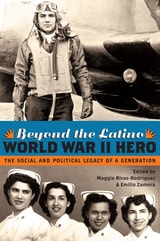
Beyond the Latino World War II Hero
The Social and Political Legacy of a GenerationEdited by Maggie Rivas-Rodríguez and Emilio Zamora
University of Texas Press, 2009
Maggie Rivas-Rodríguez 's edited volume Mexican Americans & World War II brought pivotal stories from the shadows, contributing to the growing acknowledgment of Mexican American patriotism as a meaningful force within the Greatest Generation. In this latest anthology, Rivas-Rodríguez and historian Emilio Zamora team up with scholars from various disciplines to add new insights. Beyond the Latino World War II Hero focuses on home-front issues and government relations, delving into new arenas of research and incorporating stirring oral histories.
These recollections highlight realities such as post-traumatic stress disorder and its effects on veterans' families, as well as Mexican American women of this era, whose fighting spirit inspired their daughters to participate in Chicana/o activism of the 1960s and 1970s. Other topics include the importance of radio as a powerful medium during the war and postwar periods, the participation of Mexican nationals in World War II, and intergovernmental negotiations involving Mexico and Puerto Rico. Addressing the complexity of the Latino war experience, such as the tandem between the frontline and the disruption of the agricultural migrant stream on the home front, the authors and contributors unite diverse perspectives to harness the rich resources of an invaluable oral history.
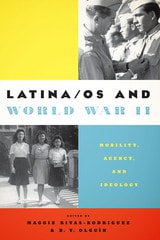
Latina/os and World War II
Mobility, Agency, and IdeologyEdited by Maggie Rivas-Rodriguez and B.V. Olguín
University of Texas Press, 2014
The first book-length study of Latina/o experiences in World War II over a wide spectrum of identities and ancestries—from Cuban American, Spanish American, and Mexican American segments to the under-studied Afro-Latino experience—Latina/os and World War II probes the controversial aspects of Latina/o soldiering and citizenship in the war, the repercussions of which defined the West during the twentieth century. The editors also offer a revised, more accurate tabulation of the number of Latina/os who served in the war.
Spanning imaginative productions, such as vaudeville and the masculinity of the soldado razo theatrical performances; military segregation and the postwar lives of veterans; Tejanas on the homefront; journalism and youth activism; and other underreported aspects of the wartime experience, the essays collected in this volume showcase rarely seen recollections. Whether living in Florida in a transformed community or deployed far from home (including Mexican Americans who were forced to endure the Bataan Death March), the men and women depicted in this collection yield a multidisciplinary, metacritical inquiry. The result is a study that challenges celebratory accounts and deepens the level of scholarly inquiry into the realm of ideological mobility for a unique cultural crossroads. Taking this complex history beyond the realm of war narratives, Latina/os and World War II situates these chapters within the broader themes of identity and social change that continue to reverberate in postcolonial lives.
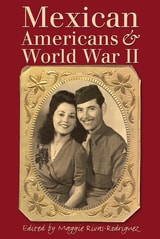
Mexican Americans and World War II
Edited by Maggie Rivas-Rodriguez
University of Texas Press, 2005
Up to 750,000 Mexican American men served in World War II, earning more Medals of Honor and other decorations in proportion to their numbers than any other ethnic group. Mexican American women entered the workforce on the home front, supporting the war effort and earning good wages for themselves and their families. But the contributions of these men and women have been largely overlooked as American society celebrates the sacrifices and achievements of the "Greatest Generation." To bring their stories out of the shadows, this book gathers eleven essays that explore the Mexican American experience in World War II from a variety of personal and scholarly perspectives.
The book opens with accounts of the war's impact on individuals and families. It goes on to look at how the war affected school experiences; how Mexican American patriotism helped to soften racist attitudes; how Mexican Americans in the Midwest, unlike their counterparts in other regions of the country, did not experience greater opportunities as a result of the war; how the media exposed racist practices in Texas; and how Mexican nationals played a role in the war effort through the Bracero program and through the Mexican government's championing of Mexican Americans' rights. As a whole, the collection reveals that World War II was the turning point that gave most Mexican Americans their first experience of being truly included in American society, and it confirms that Mexican Americans of the "Greatest Generation" took full advantage of their new opportunities as the walls of segregation fell.
Texas Mexican Americans and Postwar Civil Rights
By Maggie Rivas-Rodriguez
University of Texas Press, 2015