Results by title
3 books match the query 'Rivera Garza, Cristina'
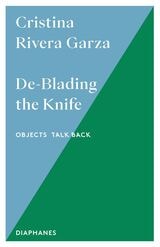
De-blading the Knife
Writing Femicide in MudCristina Rivera Garza
Diaphanes, 2026
Rooted in Mexican and indigenous practices, De-blading theKnife is Pulitzer Prize winner Cristina Rivera Garza's profound meditation on the erasure of violence against women.
Inspired by a walrus-ivory Story Knife from the Arctic region, De-blading theKnife creates a multi-faceted narration that asks: what is remembered? How? For whom? The ephemeral strokes of a Story Knife were traditionally drawn by young Yupik girls into soil or snow to repeat old tales that would then fade away. Mexican writer Cristina Rivera Garza connects this empowering ancient Indigenous practice to the “violentometro,” a contemporary tool designed in Mexico to measure instances of intimate partner violence. The story of violence against women constantly disappears even as it is continuously told and re-told, but perhaps a Story Knife may play a role in reversing such erasure.
[more]
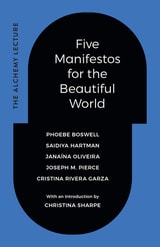
Five Manifestos for the Beautiful World
The Alchemy LecturePhoebe Boswell, Saidiya Hartman, Janaina Oliveira, Joseph M. Pierce, and Cristina Rivera Garza
Duke University Press, 2025
The second annual Alchemy Lecture brought together five artists, thinkers, and writers who proposed new ways of being and discussed radical visions for the future. Five Manifestos for the Beautiful World captures and expands these lectures to illuminate our path toward this possible beautiful world. Joseph M. Pierce (Cherokee Nation) asserts that “for this decolonial future to become possible, the guiding force must no longer be capital but relations.” Film curator Janaína Oliveira (Brazil) evokes music and movement as a means toward this relationality. Visual artist Phoebe Boswell (UK/Kenya) asks, “If we burn down the institution, what happens next?” Saidiya Hartman (US) prompts us to consider our capacity to burn, examining whether “the gift of pragmatism yields a profound tolerance of the unlivable.” Cristina Rivera Garza (US/Mexico) gives us the language of the future in the subjunctive, “the smuggler who crosses the border of the future bearing unknown cargo.” Each alchemist is intimately concerned with this cargo, our ability to bear its weight, and how we might find the beautiful world together.
[more]
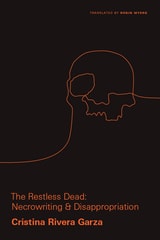
The Restless Dead
Necrowriting and DisappropriationCristina Rivera Garza
Vanderbilt University Press, 2020
Based on comparative readings of contemporary books from Latin America, Spain, and the United States, the essays in this book present a radical critique against strategies of literary appropriation that were once thought of as neutral, and even concomitant, components of the writing process. Debunking the position of the author as the center of analysis, Cristina Rivera Garza argues for the communality—a term used by anthropologist Floriberto Díaz to describe modes of life of Indigenous peoples of Oaxaca based on notions of collaborative labor—permeating all writing processes.
Disappropriating is a political operation at the core of projects acknowledging, both at ethical and aesthetic levels, that writers always work with materials that are not their own. Writers borrow from the practitioners of a language, entering in a debt relationship that can only be covered by ushering the text back to the communities from which it grew. In a world rife with violence, where the experiences of many are erased by pillage and extraction, writing among and for the dead is a form of necrowriting that may well become a life-affirming act of decolonization and resistance.
Disappropriating is a political operation at the core of projects acknowledging, both at ethical and aesthetic levels, that writers always work with materials that are not their own. Writers borrow from the practitioners of a language, entering in a debt relationship that can only be covered by ushering the text back to the communities from which it grew. In a world rife with violence, where the experiences of many are erased by pillage and extraction, writing among and for the dead is a form of necrowriting that may well become a life-affirming act of decolonization and resistance.
[more]